Think of the Trusted Partner Network (TPN) as the official security clearance for the global entertainment industry. It’s a specialised framework, created by the Motion Picture Association (MPA), designed to protect high-value film and TV content from leaks and piracy before it ever hits the screen. For any studio, TPN compliance is the single most important signal you can send that you’re ready to be trusted with a global studio’s crown jewels.
What TPN Certification Means for Your Studio
In the high-stakes world of content creation, security isn't just an IT problem—it’s a core business requirement. A single pre-release leak can obliterate a marketing campaign and cost a studio millions in lost revenue. This is exactly why giants like Disney and Netflix have made TPN compliance a non-negotiable prerequisite for any vendor in their supply chain.
For any post-production house, VFX studio, or creative vendor, TPN is essentially the master key that opens the door to major international projects. Without it, you’re practically invisible to the world’s biggest content creators. They need a standardised, verifiable way to know that every partner, whether they’re in Hollywood or Auckland, is playing by the same strict set of security rules.
Unlocking Global Partnerships
Achieving TPN certification shows you’re serious about protecting intellectual property. It proves your studio has implemented solid, auditable controls across your entire workflow, from the physical security of your building to the configuration of your cloud infrastructure. This isn't just about ticking boxes on a form; it's about embedding a culture of security that clients can see and trust.
TPN compliance transforms your studio from a local service provider into a globally recognised and trusted partner, capable of handling the industry's most sensitive projects.
The process might look daunting, but the return is huge. It positions your business for a level of growth that would otherwise be impossible. The biggest challenge? Navigating the complex web of technical and administrative requirements can be a massive hurdle for busy creative teams.
How an Accredited Partner Can Help
This is where a partner like Wisely makes all the difference. As a TPN accredited partner, Wisely acts as an experienced guide on the certification journey, helping studios prepare for, navigate, and ultimately pass the rigorous TPN assessment. We bring deep expertise on the specific controls required by studios like Disney and Netflix, help you implement the necessary security measures, and get all the documentation in order for the assessors.
Working with an expert streamlines the entire process, taking the burden off your creative and technical staff so they can focus on what they do best. Our support ensures you not only achieve certification faster but also build a sustainable security posture that keeps you compliant year after year—and keeps you on the preferred vendor lists for the biggest studios in the world.
Why Global Studios Like Disney Mandate TPN
For a global media powerhouse like Disney or Netflix, a pre-release content leak is a multi-million dollar disaster. It’s not just about a few spoilers hitting the internet—it’s about derailing massive marketing campaigns, cratering box office revenue, and taking a serious hit to their reputation. Every dollar spent building hype for a blockbuster can evaporate overnight if just one partner in their huge production chain has a security weak spot.
This is exactly why the Trusted Partner Network (TPN) was created. It isn't a suggestion or a "nice-to-have" guideline; for any post-production house wanting to work on high-value content, it's the non-negotiable price of entry. For the big studios, TPN is a critical risk management strategy. It establishes a single, verifiable security standard that applies to every single vendor, whether they're a giant effects house in Hollywood or a specialised audio studio in Auckland.
Standardising Security Across the Supply Chain
Think of it as a quality control system, but for security. Before TPN, a major studio had to run its own gruelling security audits on every vendor. This was slow, incredibly expensive, and often inconsistent from one audit to the next. The TPN framework now does all that heavy lifting, giving everyone a universal benchmark they have to meet.
This standardised model lets studios build a global network of partners they can actually trust, knowing each one has the right controls in place to protect their precious intellectual property. Global studios like Disney and Netflix mandate TPN to create a baseline of security across the entire media and entertainment supply chain. Getting compliant means you’ve proven you can be trusted with their assets in the face of modern threats.
For a studio, mandating TPN is about protecting their investment. For a vendor, achieving TPN certification is about proving you are a worthy custodian of that investment.
The requirement fortifies every link in the supply chain, effectively eliminating the "weakest link" problem by holding everyone to the same high standard—from physical access controls right through to complex cloud security configurations.
The High Cost of a Security Breach
The financial stakes here are astronomical. A leak doesn't just hurt opening weekend ticket sales; the ripple effect is immense.
- Marketing Momentum: Years of carefully orchestrated marketing and hype can be completely wiped out in an instant.
- Merchandising Revenue: Sales of toys, clothing, and other tie-in products can plummet if the project’s buzz is spoiled.
- Brand Damage: A high-profile leak erodes trust with audiences and tarnishes a studio's image as a guardian of creative content.
Netflix, for example, is built on a subscription model where the exclusivity of its original content is everything. A breach strikes at the heart of the value that keeps subscribers paying. For Disney, protecting its iconic franchises is central to its entire business. TPN compliance is their first and most important line of defence. For a deeper dive into how this ecosystem works, you can explore various solutions for the Media Entertainment industry.
How Wisely Helps Meet the Mandate
For a creative studio where security isn't the main focus, meeting these stringent TPN requirements can feel completely overwhelming. That’s where an accredited partner becomes essential. Wisely specialises in guiding studios through the maze of TPN certification. We don't just give you advice; we get in the trenches with you to implement the technical and organisational controls needed.
As an accredited partner, Wisely has a deep understanding of the specific requirements from major studios like Disney and Netflix. We translate their mandates into a clear, manageable plan of action, ensuring your studio becomes a secure, accredited, and highly sought-after partner for the world’s biggest content creators.
Navigating the TPN Assessment From Start to Finish
Getting started with the Trusted Partner Network (TPN) assessment can feel a bit like pre-production on a major film—it seems complex, with a lot of moving parts. But with a clear roadmap, NZ studios can break this down into a manageable project. The whole journey is designed to be methodical, moving from an internal check-up to official, industry-recognised validation.
The process always kicks off with a detailed self-assessment. This isn't just a quick quiz; think of it as a comprehensive questionnaire that acts as your guide. It pokes into every corner of your studio's security, from the physical locks on your doors to how you’ve configured your cloud-based render farms. This step is absolutely crucial for getting an honest look at your current security strengths and, more importantly, finding the gaps that need plugging before the formal audit.
Think of this first phase as an internal health check. It gives you a clear picture of where you stand against the MPA's Best Practices, and completing it honestly is the first real step toward building a security framework that will give both assessors and big-name clients real confidence.
The infographic below shows why a mandated security process like TPN is so important in our industry.
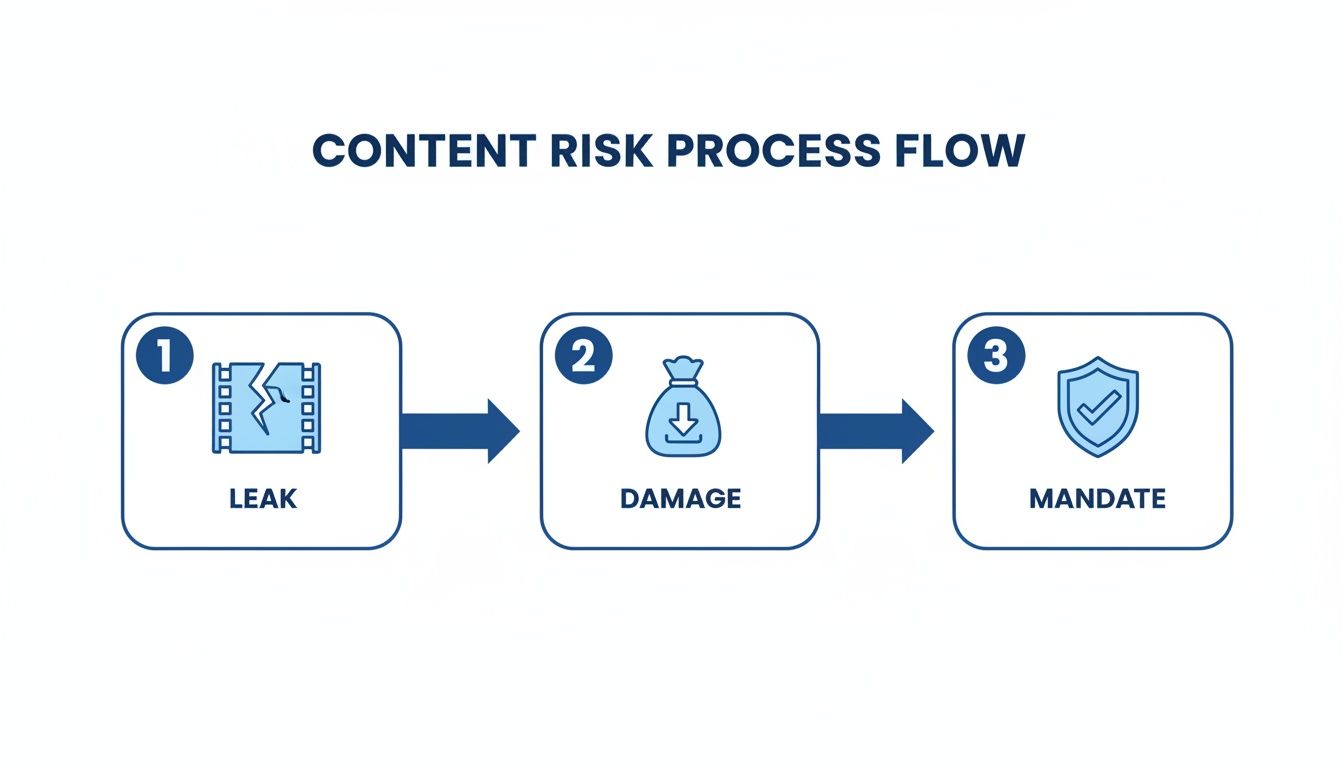
It really just boils down to this: a single content leak can cause massive financial and reputational damage, which is exactly why the major studios now mandate this level of security compliance from their partners.
The Role of the TPN Accredited Assessor
Once you’ve done your self-assessment and patched up any obvious holes, the next key player steps onto the scene: the TPN Accredited Assessor. This is an independent, certified expert whose job is to validate your security controls through a formal audit, which can be done on-site or virtually. They are the official verifiers who confirm whether your security measures are up to the TPN's tough standards.
An assessor does a lot more than just look at paperwork. They get hands-on, scrutinising your physical premises, interviewing your team, and digging into your technical infrastructure. Their goal is to make sure the security policies you have on paper are actually being followed in your day-to-day operations. It’s this independent validation that gives a TPN certification its credibility and weight across the industry.
Managing Your Journey on the TPN+ Platform
The entire assessment is managed through the TPN+ platform. This online portal is your central hub for absolutely everything related to your certification.
It’s the single place where you will:
- Complete and submit your initial self-assessment.
- Talk directly and securely with your assigned assessor.
- Upload all the evidence and documents needed to back up your security claims.
- Track your progress and manage any remediation tasks that come up.
- Share your final compliance status directly with clients like Disney, Netflix, and others.
The TPN+ platform brings a much-needed layer of structure and transparency to the whole process, making sure everyone is on the same page.
To help break down the journey, we've outlined the typical phases of a TPN assessment in the table below. It shows how you move from initial prep work right through to maintaining your compliance status long-term.
| Phase | Key Activities | Primary Goal |
|---|---|---|
| 1. Preparation & Self-Assessment | Join TPN, complete the self-assessment questionnaire, and identify initial security gaps. | To establish a baseline understanding of your current security posture against MPA Best Practices. |
| 2. Remediation & Evidence Gathering | Address the gaps found in the self-assessment and collect all necessary documentation (policies, diagrams, logs). | To strengthen security controls and prepare concrete evidence for the formal audit. |
| 3. Formal Audit with Assessor | Engage a TPN Accredited Assessor to conduct an on-site or virtual audit of your controls. | To have an independent expert validate that your security practices meet TPN standards. |
| 4. Report & Final Remediation | Receive the assessor’s report, address any final findings, and submit a remediation plan to TPN. | To formally document compliance and commit to fixing any outstanding issues. |
| 5. Shield Award & Ongoing Compliance | Achieve Gold and/or Blue Shield status and maintain security posture through regular reviews. | To signal your certified status to clients and ensure security remains a continuous practice. |
Each of these steps builds on the last, creating a structured path that takes the guesswork out of achieving TPN certification.
Understanding the TPN Shields
When you successfully complete the assessment, you earn a TPN Shield. This is a visual badge that instantly signals your compliance status to the entire industry. There are two main shields your studio can aim for, and each one represents a different side of your operational security.
The TPN Gold Shield and Blue Shield aren't just certificates to hang on the wall; they are declarations of trust. They tell the world’s biggest content creators that your studio is a secure and reliable partner for their most valuable assets.
Here are the two shields you can earn:
- The Gold Shield: This one is all about physical site security. It confirms that your on-premise infrastructure—things like building access controls, secure server rooms, and local networks—meets the highest standards for protecting content.
- The Blue Shield: This shield focuses purely on your cloud-based workflows. It verifies the security of your cloud setup and remote collaboration tools, which is obviously critical for modern, distributed production teams.
For many NZ studios running a hybrid model, getting a combination of both shields is the real goal. Achieving them turns what can feel like a complex assessment into a powerful business advantage. If you're looking for a structured way to get started, you can learn more about our TPN assessment pathway.
Your Practical TPN Compliance Checklist
So, you're starting the Trusted Partner Network (TPN) journey. Where do you even begin? Getting compliant requires a clear, actionable plan, and that's exactly what this checklist is for. We've broken down the core security controls TPN demands into two key areas: the technical nuts and bolts of your digital setup, and the organisational policies that build a genuine security-first culture.
Think of this as your pre-audit health check. It’s designed to help you see where you stand and spot any gaps before an official assessor walks through the door.
And you definitely want to be proactive. According to TPN's own data, a staggering 96% of vendors have security gaps even while they're actively working on pre-release content. Getting ahead of these common issues is the secret to a much smoother, less stressful certification process.
Technical Security Controls
These are the non-negotiables—the hard-and-fast technical safeguards that form the bedrock of your TPN compliance. Consider them the digital locks, alarms, and surveillance cameras that protect your clients' content from being seen, changed, or stolen by the wrong people.
Network Segmentation: This is all about building digital walls inside your network. Your production network, where the sensitive client content actually lives, must be completely walled off from your corporate network (used for email and admin tasks) and your guest Wi-Fi. It’s a simple concept that prevents a breach in a less secure area from spreading to your crown jewels.
Multi-Factor Authentication (MFA): Passwords on their own just don't cut it anymore. TPN insists on MFA for all critical systems, which includes remote access points, cloud admin portals, and anything that touches client content. It adds that essential second layer of proof, making it exponentially harder for an attacker to get in.
Detailed Logging and Monitoring: You need total visibility over who is doing what on your network, and when. This means setting up your systems to generate detailed logs of all user activity, paying special attention to anyone accessing sensitive files. Just as important, you need a way to monitor these logs for anything unusual that could signal a security incident in progress.
Content Encryption: All pre-release content must be encrypted, period. That means when it’s sitting on your servers (at rest) and when it's flying across the network (in transit). Encryption ensures that even if someone manages to intercept the data or physically steal a hard drive, the content itself remains unreadable gibberish without the right keys.
Secure Remote Access: With remote and hybrid work being the new standard, the way your team connects to the studio is under a microscope. TPN mandates secure, centrally managed tools like a Virtual Private Network (VPN) protected with MFA. Using personal or unmanaged remote desktop software is a definite no-go.
Organisational and Physical Controls
Technology is only one side of the coin. Your organisational controls are the human-powered policies and procedures that make sure your team uses that technology securely and consistently. This is how you prove to an assessor that security is baked into your company culture, not just configured in a firewall.
First up, you need clearly documented security policies. These aren't just helpful suggestions; they are the official rulebook for your studio. Your policies should cover everything from the acceptable use of company gear to the step-by-step process for reporting a security incident. This documentation is one of the very first things an assessor will ask for.
Regular security awareness training for your entire crew is also mandatory. People are often the weakest link in any security chain. Good training helps them spot and sidestep common threats like phishing emails and social engineering tactics, effectively turning your team into a human firewall.
TPN compliance is built on a simple premise: robust technology is essential, but a well-trained, security-conscious team is your most powerful defence.
Next on the list are strict physical access controls. This is about making sure only authorised people can get into sensitive areas like server rooms or edit suites. This is usually handled with key cards or biometric scanners, alongside a detailed visitor log to track every single person who comes and goes.
Finally, you absolutely must have an Incident Response Plan. When a breach happens—and you should plan as if it will happen—you need a clear, pre-defined plan. It should spell out exactly who to call, what steps to take, and how to communicate with clients. A well-rehearsed plan can massively reduce the damage and recovery time from an incident. As part of this, you must also address the end-of-life for data by implementing secure hard drive destruction methods for old storage media to ensure data can never be recovered.
By methodically working through these technical and organisational controls, you can build a strong foundation for your TPN assessment. For more details on strengthening your digital defences, learn more about our comprehensive https://www.wiselyglobal.tech/cyber-security services that align directly with TPN requirements.
Common TPN Compliance Pitfalls and How to Avoid Them
The road to Trusted Partner Network (TPN) certification is often paved with good intentions, but plenty of studios stumble over the same predictable roadblocks. Knowing what these are ahead of time is the secret to a smoother, faster, and less frustrating journey. It lets you sidestep the common issues that blow out timelines and budgets.
One of the biggest mistakes we see is drastically underestimating the time and resources needed. Studios often treat TPN compliance like a quick IT project they can knock out in a few weeks. In reality, it’s a major business initiative that can easily take several months, demanding serious focus from both your technical crew and management.
That initial miscalculation leads straight into the next major pitfall: treating compliance as a one-off, tick-the-box exercise. TPN isn't a final exam you pass once; it’s an ongoing commitment to keeping your security sharp.
Treating Security as a Project, Not a Programme
Viewing TPN as a one-off project is a recipe for failure. The security controls you put in place for that first audit need to be maintained, monitored, and fine-tuned, year after year. The threat landscape never sits still, and your security posture can't either.
Major studios expect their partners to have a living, breathing security programme, not just a certificate hanging on the wall. That means running regular risk assessments, keeping your team trained up, and consistently updating your policies. If you don't embed security into your studio's culture, that annual re-assessment will feel like a painful scramble every single time.
The Documentation Dilemma
Another huge hurdle is poor documentation. It's a classic story: a studio has fantastic security measures running, but when the TPN assessor asks for proof, they come up empty-handed. Here's the hard truth: if you can’t prove a control exists with clear, organised documents, then for the purpose of an audit, it simply doesn’t exist.
This means you need to have formally documented:
- Security Policies: Your official rulebook covering everything from how data is handled to what happens in a security incident.
- Network Diagrams: Clear, up-to-date maps of how your network is segmented and protected.
- Procedural Records: Logs for visitor access, media handling, and employee training sessions.
- Configuration Details: Proof of how systems like firewalls and servers are securely set up.
An assessor relies on this paper trail to validate your controls. Without it, even the most secure facility is going to have a tough time passing.
A common finding in TPN assessments isn't the absence of security controls, but the absence of evidence. Proper documentation is the bridge between doing security right and proving you do it right.
Overlooking the Physical for the Digital
In an industry obsessed with digital workflows and cloud infrastructure, it’s surprisingly easy to forget that physical security is just as critical. TPN assessors pay very close attention to the real-world protections around your facility. Neglecting this area is a common—and costly—mistake.
This is all about having solid controls for who can physically get into your building and sensitive spots like server rooms or edit suites. Simple oversights, like not keeping a detailed visitor log or having a secure door without proper access controls, are immediate red flags during an audit. This is an area where proactive checks make a huge difference. Think of it like running regular penetration testing for your digital assets; you need to probe for weaknesses in your physical security before an assessor finds them.
Finally, a lack of buy-in from the whole team can quietly sink the entire effort. If security is just seen as "the IT person's problem," compliance is doomed. Every single person on your team, from the front desk to the lead VFX artist, has a role to play in protecting content. Real TPN compliance requires a collective commitment, driven from the top and understood by everyone.
How a TPN Partner Can Fast-Track Your Certification
For any creative studio, tackling a Trusted Partner Network (TPN) assessment is a massive undertaking. Your team is built to create, not to become overnight security experts. This is where bringing in a specialist partner like Wisely changes the game, turning a compliance headache into a genuine business advantage. Think of them as your TPN guide, handling the heavy lifting so your crew can stay focused on their craft.
Meeting the demanding security standards of global giants like Disney and Netflix requires a deep dive into technical controls and piles of documentation. A good partner translates those dense requirements into a simple, step-by-step plan. It usually starts with a readiness check to see where the gaps are, followed by a clear roadmap to get your studio compliant, whether that’s setting up network firewalls or securing your cloud setup.
Taking the Technical Burden Off Your Shoulders
One of the biggest wins of partnering up is getting instant access to specialised security knowledge. Instead of your team losing months to researching and fumbling through unfamiliar security controls, an expert can get the right technology in place, fast.
This support maps directly to the core TPN requirements:
- Managed Security Services: This covers the continuous monitoring that TPN demands, like endpoint protection, vulnerability scanning, and network oversight. Your partner manages this for you.
- Secure Infrastructure: They’ll configure your cloud environments and on-site networks to align with MPA best practices, making sure content is locked down whether it’s stored or on the move.
- Policy and Documentation: This is where so many studios get stuck. An expert partner knows exactly what assessors are looking for and helps create the detailed policies and procedures to prove your security isn't just theory—it's official.
By taking on these technical and admin tasks, a partner can seriously speed up your certification. A process that might take a studio six to nine months on their own can often be done in a fraction of that time with the right help.
Bringing in a TPN-savvy partner isn’t just about ticking a box for an audit. It’s about building a robust, long-term security posture that gives the world’s biggest studios total confidence in your work.
Becoming an Accredited Partner
Ultimately, TPN certification is about becoming an accredited partner that studios like Disney and Netflix can trust implicitly. The process is rigorous for a reason—it separates the prepared from the unprepared. For companies like Netflix, a vendor’s TPN status is a critical factor in their risk assessment. Having an expert manage your compliance ensures nothing gets missed.
Wisely is that dedicated guide. As an accredited partner ourselves, we understand the standards and expectations from the inside out. We make sure your studio not only gets certified but stays that way, year after year. This partnership lifts the compliance weight off your creative team, strengthens your entire security setup, and cements your reputation as a go-to partner for the world’s biggest names in content.
Got Questions About TPN? We've Got Answers
If you're a New Zealand studio looking into Trusted Partner Network certification, you're not alone. A few key questions pop up time and time again. Let’s cut through the noise and give you some straight answers to help you figure out what TPN means for your business.
How Long Does TPN Certification Take?
Honestly, it depends. The timeline for getting TPN certified can range anywhere from three to six months. The biggest variable is your studio's current security setup. If you've already got solid practices in place, you're ahead of the game.
The process involves a deep dive into your own systems (the self-assessment), fixing any security gaps you find (remediation), and finally, the formal audit with a TPN Accredited Assessor. A smart first move? Get a readiness assessment. It’s the fastest way to find your weak spots early and shave weeks or even months off the total time.
Is TPN Certification a One-And-Done Deal?
Not at all. Think of TPN certification as a commitment, not a project you tick off a list. It requires an annual re-assessment to make sure your security controls are still sharp and keeping up with new threats.
This isn't just about compliance for compliance's sake. It's about showing major clients like Disney and Netflix that security is baked into your studio’s culture, day in and day out. It proves you’re serious about protecting their content long-term.
What's the Difference Between the Gold and Blue Shields?
TPN uses a simple shield system to signal what you’re compliant with, so clients can quickly see where you stand.
TPN Gold Shield: This is all about your physical site security. It covers everything from who can access your building and server rooms to the security of your on-premises network. It’s the classic "bricks and mortar" security audit.
TPN Blue Shield: This shield is laser-focused on your cloud workflows. If you’re using cloud rendering, remote collaboration tools, or any digital pipeline that lives online, this one’s for you. It verifies that your data is secure in the cloud.
Depending on how your studio works, you might need one or both shields to land those big contracts. Earning them is a powerful way to build immediate trust with the world's biggest content owners.
Navigating a TPN assessment isn't something you should do alone. Wisely is your accredited partner, ready to guide your studio through every step—from the initial gap analysis and audit prep to keeping you compliant year after year. We make sure you meet the highest security standards without the headache. Learn how we can streamline your certification at https://www.wiselyglobal.tech.