At its core, business continuity planning is about building resilience. It’s the process of creating systems and a clear plan of action to handle potential threats, making sure your organisation can keep its essential operations running both during and after a crisis. This isn't just an IT checklist; it's a complete strategy to protect your people, maintain operational strength, and safeguard your hard-earned reputation.
Why Every NZ Business Needs a Resilience Playbook

Think of it like this: you wouldn't sail a ship across the Pacific hoping for the best. You'd have emergency navigation, life rafts, and a clear set of instructions for when the weather turns. A business continuity plan (BCP) is exactly that for your organisation—a strategic advantage you hope you'll never need, but one you absolutely can't afford to be without.
For businesses here in New Zealand, this kind of foresight is non-negotiable. Our unique geography leaves us open to natural disasters like earthquakes and floods, while the ever-present risk of cyber-attacks adds another layer of complexity. A well-thought-out plan is what separates a business that navigates a crisis from one that’s sunk by it.
More Than Just a Document
It’s easy to picture a BCP as a thick binder collecting dust on a shelf, but that’s a huge mistake. A good plan is a living, breathing strategy that directly impacts your day-to-day ability to function.
A robust plan ensures your team can keep collaborating on crucial projects in tools like monday.com, even if your office is suddenly out of action. It also shields your company’s financial health—a central focus of any good business consulting engagement—by mapping out how to manage cash flow and reporting when things go sideways.
Ultimately, the goals of any effective BCP are to:
- Protect Your People: The safety and clear communication for your team must always be the number one priority.
- Maintain Customer Trust: Showing you can still deliver builds incredible confidence and loyalty when others can't.
- Safeguard Revenue Streams: The less downtime you have, the smaller the financial hit.
- Defend Your Reputation: A fast, organised response prevents a crisis from becoming a long-term brand disaster.
A business continuity plan gives leadership a clear playbook for making smart, data-driven decisions when the pressure is on. It helps you understand emerging threats and their potential impact, shifting your organisation from being reactive to proactively resilient.
Business continuity planning isn't just another business expense; it's a fundamental investment in your company's stability and future. It gives you the framework to handle the unexpected, ensuring you can weather any storm. This guide will walk you through building a plan that truly protects your Kiwi business.
Conducting a Business Impact Analysis to Identify Critical Functions
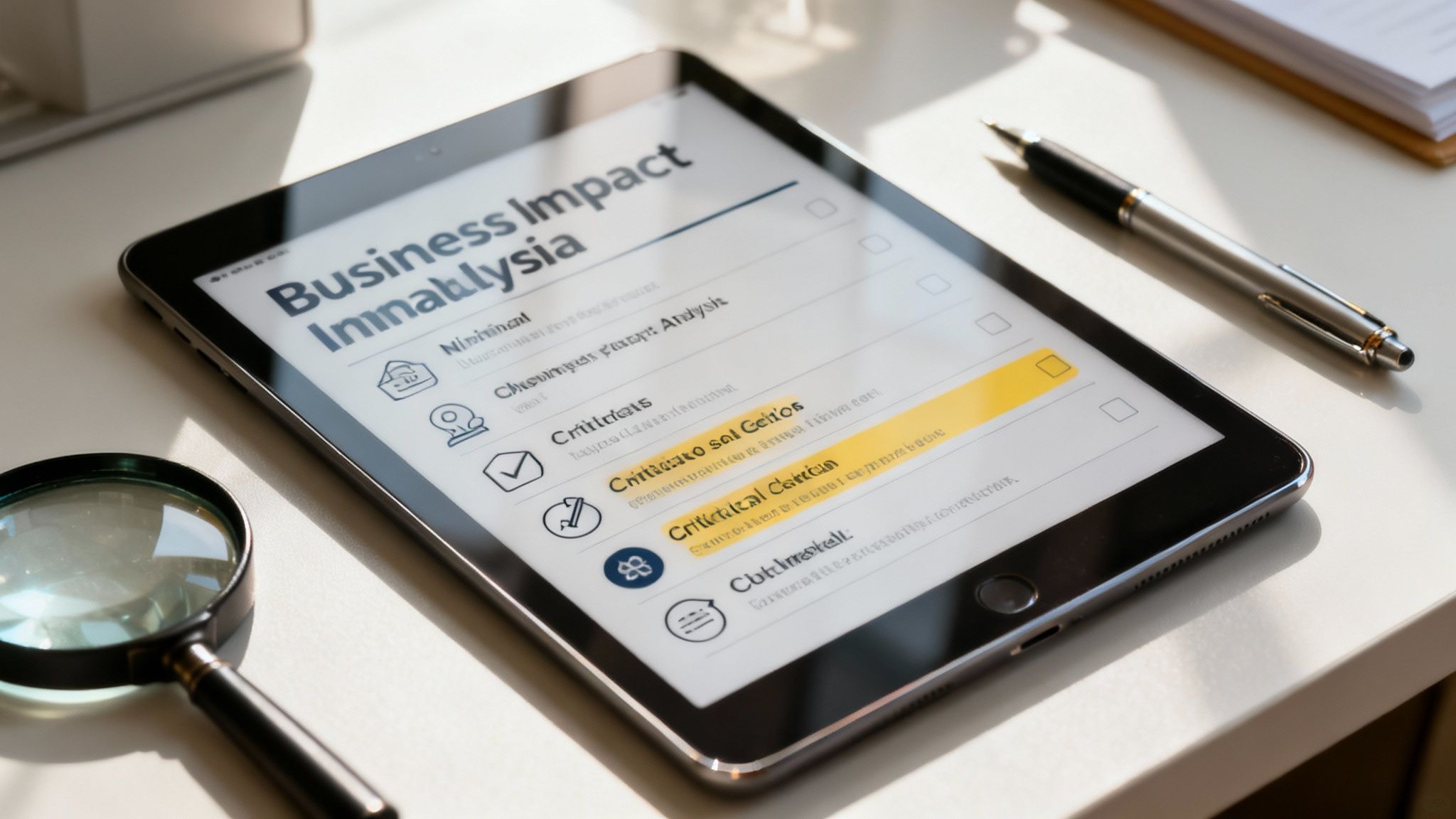
Before you can build a solid defence for your business, you need to know exactly what you’re protecting. This crucial first step is called a Business Impact Analysis (BIA). Think of it as a top-to-bottom health check for your organisation, designed to pinpoint the functions that are absolutely essential for its survival.
A BIA helps you cut through the noise. Instead of worrying about every potential disaster under the sun, it forces you to focus on your most vital operations. It all boils down to one simple but powerful question: "If things go sideways, what do we absolutely need to get running again first to stay afloat?"
Honestly, this analysis is the bedrock of any good continuity plan. Without it, you’re just guessing at priorities when a real crisis hits.
Pinpointing Your Critical Operations
The main goal here is to create a clear hierarchy of your business functions, from mission-critical down to the 'nice-to-haves'. This means taking a hard look at every part of your operation and figuring out the real impact if it were to grind to a halt.
Start by identifying the core processes that bring in revenue and deliver value to your customers. For a lot of Kiwi businesses, these might include things like:
- Customer Service and Support: How long can you realistically go without responding to clients before your reputation takes a serious hit?
- Project Delivery Workflows: What's the fallout if your teams lose access to their project boards on a platform like monday.com?
- Financial Operations: Can you still pay your staff and suppliers, or manage cash flow if your accounting systems are down?
- Core IT Services: Which specific apps, servers, or cloud services are completely indispensable for getting work done day-to-day?
Mapping all this out shows you how a problem in one area can quickly cascade and create a domino effect across the whole business. This level of insight isn't just for emergencies, either; it’s a key part of any successful process improvement initiative, often revealing dependencies you never knew existed.
Understanding Key Recovery Metrics
Once you've got a handle on your critical functions, the BIA helps you quantify just how time-sensitive they are using two key metrics. Getting these right sets clear, achievable goals for your recovery efforts.
A Business Impact Analysis provides the data-driven clarity needed to make strategic decisions under pressure. It transforms your recovery efforts from a panicked reaction into a measured, prioritised response.
1. Recovery Time Objective (RTO)
This is your maximum acceptable downtime for a specific function. It answers the question, "How quickly do we need this back online, really?" For example, the RTO for your e-commerce site might be one hour, but for internal marketing reports, it could be a much more relaxed two days.
2. Recovery Point Objective (RPO)
This metric measures the maximum amount of data you can afford to lose. It asks, "How much work are we willing to redo from scratch?" For a constantly updating customer database, your RPO might be just 15 minutes, which means you need very frequent backups. For a shared document folder, an RPO of 24 hours could be perfectly acceptable.
Defining your RTO and RPO is non-negotiable. These numbers will directly influence your technology choices, your backup strategies, and the urgency of your entire response plan. A tiny RPO and RTO for financial data, for instance, immediately tells you that you need a robust, real-time cloud backup solution. By completing a BIA, you give your business continuity planning a clear, actionable direction.
Assessing Risks That Threaten Your Operations
Once you’ve used a Business Impact Analysis (BIA) to map out your most critical functions, the next move is to figure out what could actually break them. This is where risk assessment comes in—it’s all about spotting and sizing up the specific threats that could bring your business to a halt.
Think of it like being a ship’s captain. You're not just scanning the horizon for obvious storms; you're also looking for hidden reefs, potential equipment failures, and even crew shortages. You’re shifting from the BIA’s question of “what’s important?” to the much sharper question: “What could realistically go wrong here?”
For any business in New Zealand, that list of potential threats is pretty varied. A good risk assessment gets you out of the realm of vague worries and grounds your planning in real-world scenarios. To get a full picture, it helps to look at your vulnerabilities through three different lenses.
Identifying Natural and Environmental Risks
New Zealand’s unique geography means we’re exposed to certain natural events that can stop a business cold. These are often the first things people think of, and for good reason—their impact is immediate, widespread, and can mess with everything from your office space to your team's ability to even get to work.
A proper assessment here means thinking through the real-world consequences of events like:
- Seismic Activity: What if an earthquake makes your office a no-go zone for weeks? It could easily damage vital hardware and take out essential infrastructure like power and internet.
- Flooding and Storms: Severe weather can cause the same kind of physical damage, but it can also cut off transport routes for your supply chain and lead to long-lasting power cuts.
- Pandemics or Health Crises: We’ve all lived this one. These events can force everyone into remote work, cause widespread staff absences, and completely change how your customers behave.
It’s not enough to just list them. You have to connect the dots. If your main server is sitting in an earthquake-prone building, that's a high-priority risk that needs a specific fix, like getting serious about cloud backups.
Evaluating Technological and Cyber Threats
These days, a digital breakdown can stop your business just as fast as a physical one—often with worse financial and reputational fallout. This is especially true if your team relies on tools like monday.com to keep projects moving or uses custom software to deliver your services.
These threats are often sneaky and they’re always changing. You’re looking at things like:
- Cyberattacks: Ransomware could lock up your entire system in an instant. A data breach could expose sensitive client information, leading to massive fines and a devastating loss of trust.
- System and Server Outages: It doesn't matter if your on-site server fails or your cloud provider has an outage. The result is the same: your team is dead in the water without the tools they need.
- Data Corruption or Loss: This could be caused by anything from hardware failure or a software bug to plain old human error. One wrong click could wipe out critical financial records or project data.
The digital threat landscape is particularly nasty right now. In 2023, ransomware attacks on small and medium Kiwi businesses shot up by 65%. The average cost of a data breach is now a staggering $4.5 million NZD per incident, often caused by simple things like not updating software.
Here’s the kicker, though: businesses with a solid continuity plan kept 85% of their client trust after a cyber incident, while those without a plan held onto only 40%. You can find more insights on why every New Zealand business needs a continuity plan on pscconnect.co.nz.
Analysing Human-Related Disruptions
Finally, some of the most common—and often overlooked—disruptions come from people. These human-related risks can be just as damaging as a natural disaster or a cyberattack. They centre on your team, your suppliers, and the broader world your business operates in.
Understanding your operational risks is about building situational awareness. It enables you to shift from a reactive scramble during a crisis to a proactive, measured response that protects your people, revenue, and reputation.
Think about the domino effect of:
- Key Staff Absence: What happens if your lead developer or financial controller is suddenly out of action for a month? Does anyone else have the knowledge—or even the passwords—to do their job?
- Supply Chain Failures: Your ability to deliver your product or service can be completely crippled if a critical supplier suddenly goes out of business or faces their own disaster.
- Human Error: A simple mistake, like an employee accidentally deleting a key database or falling for a phishing email, can easily trigger a major business incident.
By systematically working through these three categories, you’ll end up with a prioritised list of threats. This lets you focus your energy on creating smart strategies for the dangers most likely to hit your specific business, giving you a solid foundation for the rest of your continuity plan.
Developing Your Business Continuity Plan Strategies and Solutions
Once you’ve got a clear handle on your most critical functions and the risks they face, it’s time to shift from analysis to action. This is where you get down to the business of building the strategies and solutions that will become the heart of your business continuity plan. Think of it as your operational playbook for a crisis—a document that gives your team clear, practical steps to follow when things go sideways.
A classic mistake is to create a plan so dense and complicated that it just gathers dust on a shelf. Forget that. The goal here is clarity and practicality. A great BCP isn't about having a perfect answer for every wild scenario; it's about building a flexible framework that empowers your people to make smart decisions under pressure.
At its core, the risk assessment process is straightforward. You simply need to identify potential threats, evaluate their impact, and figure out how to mitigate them.
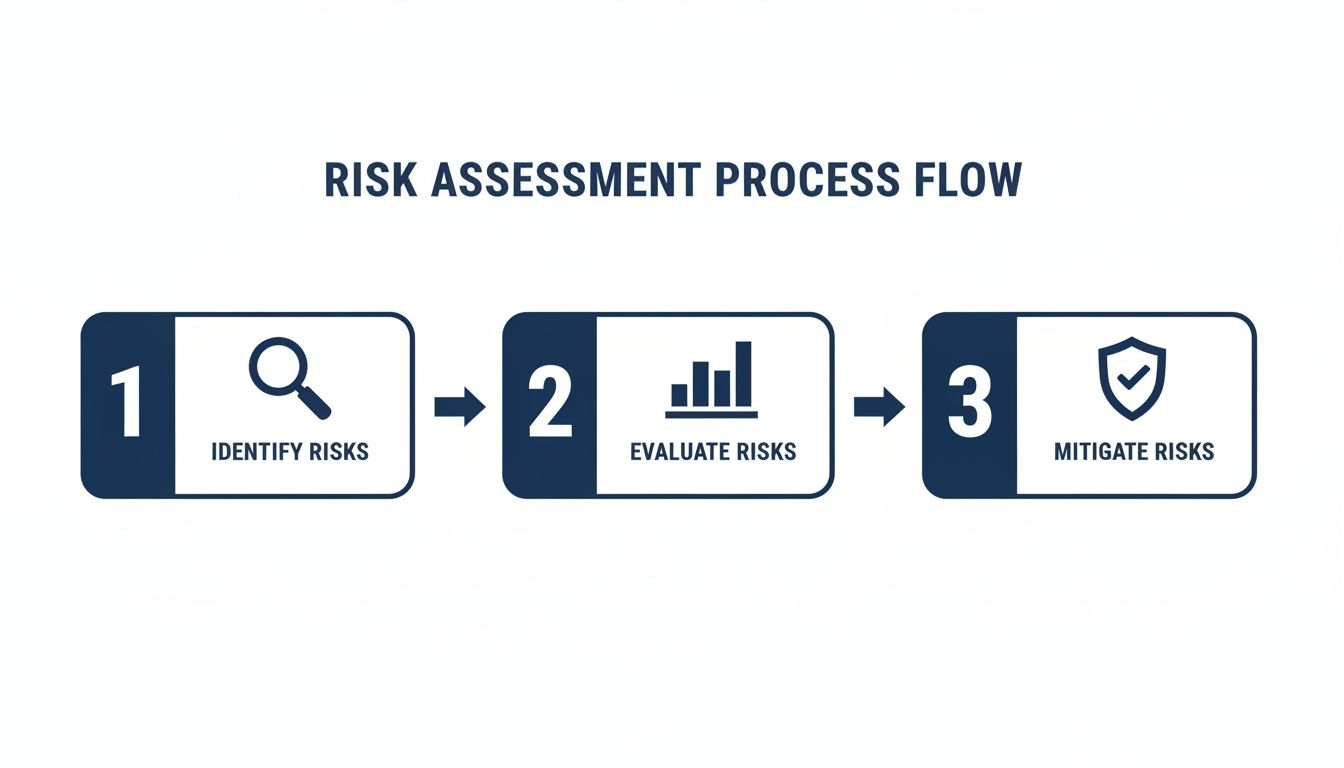
This simple flow ensures your response strategies are directly tied to the real-world threats your organisation is most likely to encounter.
Core Components of a Business Continuity Plan
To be effective, your plan needs a solid structure. It should be organised into logical sections so anyone can pick it up in a high-stress moment and know exactly what to do. While every business has its unique needs, a robust BCP usually contains a few non-negotiable components.
Think of these as the essential chapters in your company's resilience story. Each one covers a specific piece of your response puzzle, from the first moments of a crisis to the long-term recovery efforts. Below is a simple table outlining the core components that every good plan should have.
Core Components of a Business Continuity Plan
| Component | Objective and Key Actions |
|---|---|
| Incident Response Team | Defines who is in charge during a crisis. This section should clearly list team members, their specific roles and responsibilities, and a clear chain of command. |
| Activation Triggers | Outlines the specific conditions that will activate the BCP. This removes ambiguity and ensures a timely, decisive response when an incident occurs. |
| Communication Protocols | Details how you will communicate with employees, customers, suppliers, and stakeholders. It should include contact lists, preferred channels, and pre-approved message templates. |
| Resource Management | Identifies the essential resources needed for recovery, such as backup IT systems, alternate worksites, key software licenses, and access to financial reserves. |
| Recovery Procedures | Provides step-by-step instructions for restoring critical business functions in their order of priority, as determined by your Business Impact Analysis (BIA). |
Having a structured plan like this means nothing critical will fall through the cracks when the pressure is on.
Tailoring Strategies for Operational Resilience
With the basic structure in place, it’s time to develop specific strategies to tackle the risks you've already identified. This is where the plan becomes uniquely yours, shaped by how your business actually operates. The goal is to build solutions that are not only effective but also practical for your team to implement.
For example, if your risk assessment flagged a major threat from physical disruption (like an earthquake or flood), enabling remote work is a no-brainer. But this goes beyond just handing out laptops. It means making sure your team has secure and reliable access to every essential tool they need, no matter where they are.
An effective continuity strategy is not a static document; it's a dynamic capability. It should be built to integrate seamlessly with your existing workflows and technology, turning resilience into a natural part of how you operate.
This is where the right technology can be a real game-changer. For a modern Kiwi business, some key strategies often include:
- Robust Offsite and Cloud Backups: Your data is one of your most valuable assets, so a rock-solid backup strategy is non-negotiable. This is especially true in New Zealand, given our seismic activity. After the Christchurch earthquakes, a shocking 20-30% of affected businesses never reopened, often due to inadequate planning. In stark contrast, companies with comprehensive BCPs and tested offsite IT backups recovered 50% faster.
- Leveraging Cloud-Based Platforms: Tools like monday.com are invaluable for keeping teams collaborating and projects on track when you can’t all be in the office. Your BCP should outline exactly how you'll use these platforms to manage critical workflows during a disruption.
- Financial Contingency Planning: A crisis can put an immense strain on your cash flow. Setting up a financial contingency plan, perhaps with a Virtual CFO, ensures you have a clear strategy for managing funds, accessing emergency capital, and making sound financial decisions under pressure.
Ultimately, your BCP should be a living document that evolves with your business. By adopting a clear plan-build-deliver approach, you ensure these strategies aren't just written down but are woven into your company's DNA. This proactive mindset transforms business continuity from a box-ticking exercise into a powerful strategic advantage, built on a foundation of smart technologies like cloud computing that enable true resilience.
Testing Your Plan and Training Your Team for Success

Getting a detailed business continuity plan down on paper is a massive achievement, but it's really only half the job. A plan that just sits on a server, unread and untested, is nothing more than a good intention. To build real resilience, you have to put that theory into practice and make sure every person on your team knows their role when things go wrong.
It’s just like a fire drill. You don’t just pin an instruction sheet to the wall and cross your fingers. You actually practise the evacuation, time how long it takes, and work out any confusion before there's any smoke. Testing your BCP is exactly the same; it turns a static document into a living, breathing capability.
This is how you uncover the hidden flaws, find the incorrect assumptions, and build the muscle memory your team needs to act decisively under pressure. It's all about finding the gaps in your strategy in a safe, controlled way, not in the middle of a real disaster.
Starting with Simple and Effective Tests
For many small and medium-sized businesses, the whole idea of "testing" can sound like a huge undertaking—expensive, complex, and time-consuming. The good news? It absolutely doesn't have to be.
The best way to start is small. You can begin with simple, yet incredibly powerful, exercises that require minimal resources and build your team's confidence along the way.
Here are two great ways to get started:
- Tabletop Exercises: This is the most straightforward type of test. You get your incident response team together in a meeting room (or on a video call) and simply talk through a simulated crisis, step-by-step. You could walk through a hypothetical ransomware attack, a key supplier going out of business, or a sudden flood that closes your office. The aim is to review the plan, clarify who does what, and spot any obvious holes in your procedures.
- Walk-through Drills: Taking it a small step further, a walk-through involves physically performing a specific recovery task. This might be as simple as having your IT person actually restore data from a backup, or getting your communications manager to draft and send a mock internal crisis alert.
These foundational tests build confidence and deliver valuable insights without getting in the way of daily operations, making them a perfect fit for busy teams.
Advancing to More Realistic Drills
Once your team is comfortable with the basics, it's time to introduce more involved exercises that better simulate the pressure of a real event. These are functional drills designed to test specific parts of your BCP in a live, controlled environment.
The trick is to make the scenarios as relevant to your business as possible. For instance, you could run a drill where you simulate a complete loss of access to your main project management tool. Can your team switch to manual workarounds or alternative systems to keep critical projects on track?
An untested plan can create a dangerous sense of false security. Regular testing is the only way to validate your assumptions, close gaps, and ensure your team is truly prepared to execute the plan when it matters most.
This is where overconfidence can be a real risk for Kiwi businesses. A survey of 2,278 New Zealand small businesses found that while 71% rated themselves as highly resilient, only 27% had invested in critical business continuity insurance. This gap highlights the danger of thinking you're prepared without actually testing your plans. You can discover more insights about business resilience in New Zealand in the full report.
Another powerful exercise is to run a mock cybersecurity incident. This type of drill can test both your technical response (like isolating systems and restoring data) and your communication plan (notifying customers and stakeholders) in a realistic but safe way. By making testing a regular, scheduled part of your business rhythm, you ensure your BCP delivers genuine, real-world resilience, not just a document that gathers dust.
Answering Your Top Questions About Business Continuity Planning
Even with a good grasp of the basics, we find many Kiwi business owners still have a few practical questions before they dive in. Getting these sorted can make the whole process feel much less daunting and show that a solid plan is well within reach for any business.
Let’s tackle some of the most common questions we hear from small to mid-sized businesses. Here are the straightforward answers you need to move forward with confidence.
How Often Should We Update Our Business Continuity Plan?
Think of your BCP as a living document, not a "set and forget" project. Best practice is to give it a thorough review and update at least annually.
But a yearly check-in is just the baseline. You’ll also want to revisit the plan anytime your business goes through a significant change.
This could be triggered by things like:
- Bringing in new critical software or systems.
- Key people in leadership or response roles changing.
- Shifting to a new office or opening another site.
- Launching a major new product or service.
On top of that, your regular plan testing will almost certainly uncover gaps that need addressing. In a dynamic environment like New Zealand, keeping your plan current is the only way to ensure it actually works when you need it.
Is Business Continuity Planning Only for Large Corporations?
Not at all. This is one of the biggest myths out there.
While big corporations might have more complex plans, BCP is arguably even more vital for small to mid-sized businesses. SMEs typically have fewer resources and a smaller financial buffer to absorb the hit from a major disruption. A single event, like a cyberattack or natural disaster, could genuinely threaten their survival.
A good BCP for an SME isn't about covering every single possibility. It’s about protecting your most critical functions so you can keep serving customers and bringing in revenue—no matter what. That’s the key to survival, whatever your size.
For an SME, a smart plan zeroes in on the core processes that keep the lights on and your customers happy.
What Is the Difference Between a Business Continuity Plan and a Disaster Recovery Plan?
This is a great question, because the two terms are often mixed up, but they cover very different ground. The easiest way to think about it is in terms of scope.
A Disaster Recovery Plan (DRP) is a laser-focused, technical plan that sits inside your broader Business Continuity Plan.
The DRP is the specific playbook for your IT team. Its one and only job is to get your technology infrastructure, data, and systems back up and running after a disaster. We’re talking about the nuts and bolts of restoring servers, recovering data from backups, and getting networks reconnected.
A Business Continuity Plan (BCP), on the other hand, takes a bird's-eye view of the entire organisation. It’s all about keeping the whole business operational during a crisis, not just the IT department.
It’s built on three key pillars:
- People: Looking after staff safety, communication plans, and assigning temporary roles.
- Processes: Figuring out manual workarounds for key tasks when technology is down.
- Technology: This is where the DRP fits in, as the strategy for technical restoration.
In short, disaster recovery gets your tech back online; business continuity keeps your business in business.
How Can We Create a BCP Without a Dedicated Risk Manager?
Most SMEs don't have a dedicated risk manager on the payroll, and that’s completely okay. You can absolutely build an effective BCP without one.
The trick is to make it a team sport. Pull together a small group from across your key departments—think operations, IT, finance, and HR. Each person brings a crucial piece of the puzzle, offering their unique view on what makes the business tick.
Start simple. Use free templates and resources, like those from business.govt.nz, to give you a framework. Don't try to solve everything at once. Just ask your team: "What are the three to five things that, if they stopped today, would shut us down?" That’s where you begin.
For the areas where you feel out of your depth, bringing in a bit of outside help can be a game-changer. An experienced partner can guide you through identifying critical digital workflows, securing your IT, and planning for financial resilience. They act as an expert extension of your own team, making robust business continuity planning achievable for any organisation.
A resilient business is a prepared business. Creating, testing, and maintaining a robust business continuity plan is one of the most important investments you can make in your company's future. Wisely provides the expert guidance and unified solutions to help you build that resilience, from securing your IT and cloud infrastructure to optimising your financial operations for any eventuality.
Strengthen your business resilience with Wisely's expert support
Article created using Outrank