Think of it as a strategic partnership. You hand over the reins of your organisation's technology management to a dedicated third-party expert, all for a predictable monthly fee. This move transforms IT from a reactive, unpredictable cost centre into a stable, performance-driving asset. It’s all about letting the experts handle your digital infrastructure so you can get back to focusing on your core business goals.
What Exactly Are Managed IT Services
Imagine you’re trying to captain a ship, but you’re also stuck below deck fixing the engine, patching every little leak, and trying to navigate through a storm—all at the same time. That’s how many New Zealand businesses handle their technology. They're constantly putting out fires, which drains resources and pulls focus away from where they’re actually trying to go. This reactive model, often called the 'break-fix' approach, is as inefficient as it is expensive.
You only call for help when something is already broken. This inevitably leads to unexpected downtime and painfully high emergency repair bills. Managed IT services completely flip that script.
Think of it as hiring a dedicated, expert crew for your ship's technology. This crew doesn't just wait for the engine to cough and splutter; they're performing regular maintenance, monitoring systems 24/7, and proactively sorting out potential issues long before they become catastrophic failures. And they do it all for a predictable, agreed-upon fee.
This kind of strategic outsourcing is a true partnership, not just a transaction. Your Managed Service Provider (MSP) effectively becomes an extension of your team, deeply invested in your operational success and long-term growth.
Shifting from Reactive to Proactive IT
The whole philosophy behind managed services is proactive management. Instead of waiting for a server to crash or a security breach to happen, an MSP works tirelessly behind the scenes to prevent these issues from ever occurring. For small and mid-sized enterprises (SMEs), this proactive stance delivers some serious advantages:
Increased Uptime and Reliability: With someone constantly monitoring your systems, they stay running smoothly. This minimises the kind of disruptions that cost you both time and money.
Enhanced Security Posture: You have experts managing your cybersecurity, covering everything from firewalls to employee training. This keeps your valuable data protected from the constant barrage of threats.
Predictable Budgeting: A single, fixed monthly cost covers all your IT needs. This means no more surprise expenses, which allows for much smarter financial planning.
Access to Expertise: You get the collective knowledge of an entire team of IT professionals, but without the significant cost of hiring them all in-house.
This model allows business leaders to stop worrying about technology and start focusing on steering their organisation toward its goals. As NZ businesses continue to embrace digital tools, the need for scalable and effective solutions is only growing. In fact, the local IT Management and Outsourcing Services Market is set for major expansion through 2031, driven by this exact demand from SMEs. You can explore more about these trends and the future of IT outsourcing in New Zealand.
By embracing managed IT services, you aren't just fixing problems—you're building a resilient, efficient, and secure technological foundation that will support your future growth.
The Core Services in a Managed IT Partnership
When you team up with a Managed Service Provider (MSP), you're getting much more than a single product. You’re getting a full suite of interconnected services designed to keep your business running smoothly, securely, and efficiently. Think of it like a mechanic’s workshop for your technology—each tool has a specific job, but they all work together to keep your engine in top condition.
These core services form the foundation of any solid managed IT agreement, tackling the most common and critical tech challenges New Zealand businesses face. It’s everything from day-to-day user frustrations to major strategic decisions about your digital future.
This map shows how managed IT services weave together your business's core needs—strategy, proactive support, and growth—into one cohesive plan.
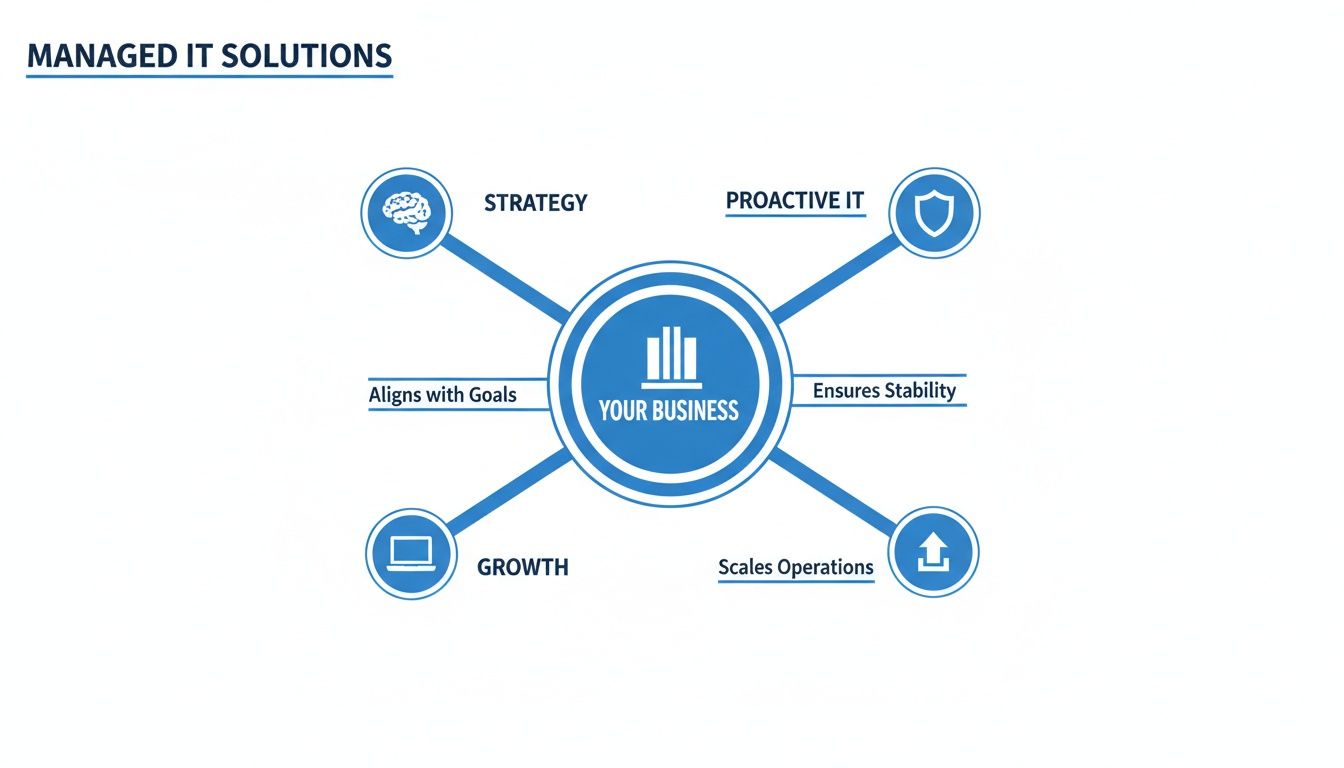
As you can see, a true partnership goes way beyond just fixing things when they break. It’s about embedding proactive IT management right into your business strategy so you can grow with confidence.
Proactive Network Monitoring and Management
One of the biggest game-changers is 24/7 proactive monitoring. Instead of waiting for a system to crash, your MSP uses specialised software to keep a constant eye on the health of your network, servers, and computers. They spot early warning signs—like a server running low on memory or unusual network traffic—and fix them before they can cause disruptive downtime.
This constant vigilance is what separates managed IT from the old break-fix model. It’s the difference between your mechanic regularly servicing your car to prevent a breakdown and only calling them after you’re already stranded on the side of the motorway. This proactive approach keeps your technology a reliable asset, not a constant headache.
Responsive Helpdesk and User Support
Even with the best monitoring in the world, your team will still need help from time to time. That's where the helpdesk comes in. A managed helpdesk gives your employees a single point of contact for any IT issue, whether it’s a forgotten password, a software glitch, or a dodgy Wi-Fi connection.
A dedicated helpdesk is the frontline of productivity. It ensures that small technical hiccups don't turn into major work stoppages, allowing your team to get fast, expert assistance and return to their tasks quickly.
This is absolutely crucial for keeping your team efficient and happy. When staff know that reliable support is just a phone call or email away, they feel more confident and less frustrated by the tools they use every day.
Robust Cybersecurity Services
With digital threats becoming more sophisticated by the day, robust security is non-negotiable. An MSP delivers multi-layered cybersecurity services to protect your sensitive business and customer data. This isn’t just about installing antivirus software; it’s a complete defence strategy.
Key security services usually include:
Firewall Management: Actively managing and updating your network's first line of defence.
Endpoint Protection: Securing every single device connected to your network, from laptops to mobile phones.
Security Patching: Regularly updating software and systems to close security holes that hackers love to exploit.
Threat Detection: Using advanced tools to spot and neutralise malicious activity before it can do any real damage.
Having an expert lead your security significantly lowers your risk of a costly data breach or ransomware attack, giving you—and your clients—invaluable peace of mind.
Strategic Cloud Management
Many Kiwi businesses now rely on cloud platforms like Microsoft Azure or Amazon Web Services (AWS) for their flexibility and power. But managing these environments effectively takes real expertise. An MSP can handle all the technical complexities, ensuring your cloud setup is secure, cost-effective, and perfectly aligned with your business goals.
This involves optimising resources to control costs, managing security settings, and making sure everything works seamlessly with your other systems. You can learn more about how expert management unlocks the full potential of your cloud environment by exploring these strategic cloud computing services and how they support business growth.
Reliable Data Backup and Disaster Recovery
Ask yourself this: what would happen if your office had a fire, flood, or a critical server failure tomorrow? A comprehensive backup and disaster recovery (BDR) plan is your business's insurance policy against the unexpected.
Your MSP will set up automated, regular backups of all your critical data and create a clear, actionable plan to get you back up and running quickly if disaster strikes. This means that even in a worst-case scenario, your business can recover with minimal data loss and downtime. It’s a fundamental service that gives you the resilience to operate confidently, no matter what comes your way.
How Managed Services Drive Business Growth
Thinking of managed IT services as just ‘the IT guys’ who fix things when they break is a huge understatement. In reality, a true managed IT services partner is a powerful engine for business growth.
For a lot of small and mid-sized businesses in New Zealand, the idea of having enterprise-grade technology and expert support seems completely out of reach—something reserved for the big players with deep pockets. Partnering with a Managed Service Provider (MSP) totally flips that script.
It’s like getting a dedicated Chief Technology Officer and a full IT department overnight, but for a fraction of what it would cost to hire a single senior engineer. This strategic shift levels the playing field, giving smaller organisations the tools and guidance to compete head-to-head with much larger companies. It’s not just about keeping the lights on; it’s about optimising everything to find new efficiencies and opportunities.

Unlocking Operational Efficiency
At its core, an MSP is focused on making your day-to-day operations run like a well-oiled machine. When your systems are properly managed and optimised, downtime stops being a regular headache and becomes a genuine rarity.
Your team can finally get on with their work without the constant drag of slow networks, glitchy software, or that one printer that never seems to cooperate. This consistent performance feeds directly into higher productivity. Just think about all the hours your team loses waiting for an app to load or trying to fix a connection issue. An MSP gives those hours back, freeing up your people to focus on what actually drives revenue and keeps clients happy.
Strengthening Your Security Posture
With cyber threats becoming more sophisticated by the day, solid security isn't just an IT problem—it’s a fundamental business necessity. For a small or mid-sized business, a single data breach can be devastating, causing serious financial and reputational damage.
An MSP delivers a multi-layered security strategy that most businesses simply couldn't build or maintain on their own. This typically includes:
Proactive Threat Monitoring: Keeping a constant eye on your network for any suspicious activity.
Regular Security Audits: Finding and plugging security holes before cybercriminals can exploit them.
Employee Awareness Training: Teaching your team how to spot and dodge phishing emails and other tricky scams.
Handing your security over to the experts doesn't just reduce your risk. It builds trust with your customers, who are more aware than ever about how their personal information is being handled.
By transforming IT from an unpredictable capital expense into a stable operational cost, managed services empower leaders to budget with confidence and invest strategically in other growth areas.
This financial predictability is a game-changer, especially for businesses looking to scale. You can plan for the future without the constant fear of a surprise server failure or an emergency repair bill wiping out your budget.
A Real-World Example of Growth
Let’s look at a mid-sized professional services firm in Auckland. As they expanded, their small in-house IT team was completely swamped. They spent all their time putting out fires, which meant employee productivity was tanking and their old systems just couldn’t handle the growing client load.
They decided to partner with an MSP and immediately gained a team of specialists. The provider got their network stable, rolled out modern cloud tools for better collaboration, and seriously beefed up their cybersecurity. Downtime became a thing of the past, and their team could securely access client files from anywhere.
With the technology headaches gone, the firm’s partners could get back to focusing on winning new clients and delivering great service. The results? Within 18 months, they were able to handle 30% more client work without having to hire more admin staff. The MSP also helped them find and adopt new software that automated a bunch of manual tasks, boosting their profit margins even further. You can see how this plays out for other businesses by exploring these inspiring client case studies.
This is a perfect example of how managed IT services lay the groundwork for sustainable growth. In New Zealand’s thriving ICT sector, these kinds of solutions are fast becoming essential. Projections show that IT services will generate a revenue of US$4.12 billion in 2025, underlining just how central they are to modern business. You can dive deeper into the data about New Zealand's IT services market on Statista.com.
Choosing the Right Managed IT Partner in NZ
Picking a Managed Service Provider (MSP) is easily one of the most critical technology decisions any Kiwi business will make. This isn’t just about finding someone to fix your computers when they break; it's about bringing on a strategic partner who becomes woven into the fabric of your daily operations and your big-picture goals.
Get it right, and you can seriously accelerate your growth. But the wrong choice? That’s a fast track to frustration, costly downtime, and wasted investment.
The whole process demands some careful thought and a bit of homework. You need a partner who not only has the technical chops but also genuinely understands the unique challenges and opportunities of the New Zealand market. A provider pushing a generic, one-size-fits-all package is unlikely to deliver the specific value your organisation needs to get ahead.
Finding that ideal fit means looking past the slick sales pitch and really digging into how they deliver their service, what their team is like, and whether their company culture clicks with yours.
Your Essential Evaluation Checklist
Before you even start picking up the phone, it’s a good idea to have a clear checklist of what you're really looking for. This makes sure you’re sizing up every potential partner against the same set of standards, allowing you to compare them objectively and find a true fit.
Start by looking at these core areas:
Technical Expertise and Certifications: Do they have genuine, proven experience with the specific software and systems your business runs on? Keep an eye out for certifications from major players like Microsoft or specialised security credentials—these show a real commitment to their craft.
Local NZ-Based Support: When a critical issue pops up, you need a team that's in your time zone and can get someone on-site if things get really hairy. Make sure you confirm where their helpdesk and senior engineers are actually based.
Scalability and Flexibility: Your business isn't going to stand still. Can the MSP scale their services up or down as you grow or your needs change? Their agreements should be flexible enough to adapt without locking you into services you no longer use.
Security and Compliance: Don't be shy about asking tough questions about their security practices. How do they protect their own systems, and how will they protect yours? If your industry has compliance rules, you need to know they have experience navigating them.
Choosing a managed IT partner is fundamentally about trust. You are giving them the keys to your digital kingdom, so you must be confident in their ability to protect it, maintain it, and help it grow.
This first pass will help you build a solid shortlist of providers who are genuinely equipped to support your business.
Key Questions to Ask Potential Providers
Once you have your shortlist, it’s time to start talking. The way a provider answers these questions will tell you a lot about their processes, their transparency, and how much they care about their clients. Don't be afraid to ask for specific, detailed answers.
1. What is your client onboarding process?
A professional MSP will have a well-defined, documented plan for bringing on new clients. They should be able to walk you through their discovery, setup, and training stages clearly, giving you confidence that the handover will be smooth and not disrupt your business.
2. Can we see a sample Service Level Agreement (SLA)?
The SLA is your rulebook. It needs to clearly spell out response times, service availability, and how performance is measured. If the SLA is vague or full of confusing jargon, that’s a major red flag.
3. How do you handle reporting and performance reviews?
A great partner provides regular, easy-to-understand reports on your system's health, support tickets, and security status. They should also schedule regular catch-ups to talk about your business goals and make sure the IT strategy is still on track.
4. Who will be our primary point of contact?
It’s crucial to understand their account management structure. You want a dedicated contact who gets to know your business inside and out, not just a generic support queue where you're starting from scratch every time.
5. Can you provide references from NZ clients of a similar size or in our industry?
Chatting with their current clients is one of the best ways to get a real feel for their day-to-day performance and customer service.
Ultimately, the goal is to find an organisation that gels with your company culture and feels like a true extension of your own team. This means finding experts who can slot right into your operations. To see how this works in practice, you can explore the approach of a trusted business partner delivering unified solutions that go far beyond simple IT support.
Making an informed choice now is something that will pay dividends for years to come.
Integrating IT with Business Process Optimisation
Standard managed IT services are great for keeping the lights on. They’re designed to make sure your technology is stable, secure, and running smoothly. But that’s just the foundation. The real magic happens when IT stops being a background support function and becomes part of your core business strategy.
This is where you find genuine value. Think of it like this: a well-maintained engine is essential, but it’s not the whole car. To get where you’re going efficiently, you need the engine, chassis, and navigation system all working together. The goal isn’t just IT support; it’s true business process optimisation.
So many New Zealand businesses are stuck with tech that works in isolation. Your accounting software won’t talk to your project management tool, and sales data is on a completely different planet from your operations team. This digital friction forces your people into clunky, manual workarounds just to get through the day.

Beyond Traditional IT: A Holistic Approach
A modern managed services partner gets that technology doesn’t exist in a vacuum. A truly effective approach weaves IT together with other critical functions like process automation, bespoke software development, and even strategic financial services. This model is built to solve far bigger problems than a slow computer or a forgotten password.
For example, a solid, secure IT foundation is the non-negotiable launchpad for a successful monday.com implementation. Without stable infrastructure, even the world's best work management platform will fall flat.
This integrated way of working ensures technology decisions are business decisions. It aligns every IT action with a measurable outcome, whether that's boosting team productivity, improving data accuracy, or opening up new ways to make money.
This synergy creates powerful solutions. Imagine custom software that finally connects your scattered systems into one seamless workflow, getting rid of data silos and giving your leadership a clear, unified view of the entire business.
A Structured Path to Transformation
Getting to this level of integration doesn't happen by accident. A chaotic approach will only create more headaches. At Wisely, we use a structured plan-build-deliver framework to make sure the transition is smooth and delivers real results for our clients across New Zealand.
The process has several key stages:
Plan: We start by getting a deep understanding of your current world—your workflows, your frustrations, and your goals. This discovery phase helps us map out a clear path forward.
Build: Next, we design and implement the solution. This could be anything from optimising your monday.com setup to building custom software or redesigning your cloud environment for better performance.
Deliver: After thorough testing, we roll out the solution with careful change management and give your team the training they need to feel confident and capable from day one.
This isn’t a one-and-done project; it’s a partnership. We provide ongoing support and fine-tuning to make sure the solutions grow with your business, driving real productivity gains long after the initial rollout is complete. This focus on tying technology directly to business outcomes is what defines modern managed IT services.
Connecting IT to Your Bottom Line
When you integrate IT with financial services, the insights get even more powerful. A Virtual CFO, for instance, can use real-time data from your newly connected systems to build much more accurate financial forecasts, manage cash flow with precision, and offer strategic advice based on solid, up-to-the-minute information.
This combination turns your tech spend from a cost into a direct contributor to your financial health. It helps you make smarter, data-driven decisions about where to invest and how to grow. By closing the gap between technical support and strategic business improvement, you unlock the full power of your digital tools. Learn more about how to do this by exploring our approach to strategic business process improvement.
Ultimately, this integrated model ensures your technology isn't just a cost centre—it's your competitive advantage.
Common Questions About Managed IT Services
Bringing a Managed Service Provider (MSP) on board is a big move, and it’s only natural to have a few questions. For many New Zealand business owners, stepping away from the old break-fix IT model can feel like a leap into the unknown.
To help clear things up, we’ve tackled some of the most common questions we hear. Our goal is to give you honest, straightforward answers that demystify the world of managed IT and help you feel confident you’re making the right call for your business.
How Much Do Managed IT Services Cost in New Zealand
Let's get straight to it—this is usually the first question on everyone's mind. The honest answer is, it depends. Here in New Zealand, pricing is typically based on a 'per-user' or 'per-device' model. This could be anywhere from $50 to over $200 per person each month, depending on how deep the service goes.
Some providers will offer set packages—think bronze, silver, and gold—while others run an 'all-you-can-eat' model, which bundles almost everything into one predictable monthly fee.
The key is to look past the sticker price and get a clear picture of what’s actually included. Will they come onsite when you need them? Are crucial cybersecurity tools part of the deal, or are they expensive extras? A good partner will be completely transparent, working with you to build a plan that delivers real value without any nasty surprises down the line.
Is My Business Too Small for Managed IT Services
This is a classic myth we hear all the time, but the truth is the exact opposite. It's often the small and mid-sized businesses that get the most out of an MSP partnership.
Think of it this way: hiring one senior IT expert in-house is a huge investment, and even the best person can’t know everything. An MSP gives you access to a whole team of specialists—cybersecurity pros, network engineers, cloud experts—for a fraction of that cost.
Managed services are built to scale. They provide the right level of support whether you have 10 staff or 100, growing with you and adapting as your business evolves.
This model really levels the playing field. It gives smaller companies access to the kind of enterprise-grade technology and security that was once only for the big players. It’s not about your size; it’s about your ambition.
What Is the Onboarding Process Like
A professional MSP won't just flick a switch and walk away. They’ll have a structured, well-thought-out plan to make the transition as smooth as possible, with minimal disruption to your team’s day-to-day work.
The whole process should unfold in a few clear stages:
Discovery and Audit: It all starts with a deep dive. The provider will conduct a thorough audit of your current IT setup to understand your systems, pinpoint frustrations, and map out what your business actually needs.
Strategic Planning: With that information, they’ll build a detailed migration plan. This roadmap lays out every step, from rolling out new tools to moving your data, so everyone knows exactly what to expect.
Implementation and Training: This is the hands-on part where new software is installed, security measures are put in place, and systems are configured. But just as importantly, it’s followed by training to make sure your team is comfortable and ready to go from day one.
A smooth, organised onboarding process is the sign of a provider you can trust. It’s the foundation for a strong partnership built on clarity and mutual respect.
How Do Managed Services Improve Cybersecurity
Cybersecurity isn't just an IT problem anymore—it's a core business risk. A good MSP provides a multi-layered defence that most small businesses would find impossible to build and manage themselves.
And we're not just talking about installing antivirus software. A proper MSP delivers a complete security strategy, including:
24/7 Network Monitoring: Keeping a constant watch for any suspicious activity or potential threats, day and night.
Firewall and Endpoint Management: Securing every single device connected to your network, from servers to laptops and phones.
Proactive Security Patching: Consistently updating your software to close the security gaps that cybercriminals are always looking for.
Data Backup and Recovery: Making sure you can get back up and running quickly if the worst happens, like a ransomware attack.
This expert-led, proactive approach massively reduces your risk of a breach that could cripple your business. It's no surprise that the managed security services market in New Zealand is projected to hit US$84.22 million in revenue by 2025—businesses are taking this very seriously.
Ready to move beyond reactive IT and build a true technology partnership that drives growth? Wisely offers integrated managed IT, business process, and financial services designed to eliminate inefficiency and give you a clear path forward.
Discover how our unified solutions can transform your business at wiselyglobal.tech