When you hear the term process automation services, think of it as bringing in a specialist crew to build a digital engine for your business. It's a strategic partnership where experts design, build, and manage automated workflows that take care of your repetitive, time-consuming tasks. The whole point is to connect your different software systems, smooth out your operations, and free up your team to focus on what really matters.
What Are Process Automation Services Really
Let’s use an analogy. Imagine your business is a bustling café. In a manual setup, you’ve got one person taking orders, someone else grinding beans, another frothing milk, and a fourth handling payments. It works, sure, but during the morning rush, it’s chaotic, slow, and a forgotten coffee order is almost guaranteed.
Now, picture an automated version. A customer places an order, and a smart system instantly tells the coffee machine to grind and brew, while simultaneously processing the payment. That seamless, error-free flow is exactly what business process automation delivers. It’s not about just buying a piece of software; it’s about fundamentally rethinking and improving how work actually gets done in your organisation.
Beyond Software: A Strategic Partnership
The word "services" in process automation services is key here. This isn’t about you buying a tool and then being left alone to figure it all out. It’s about engaging a partner who manages the entire journey for you—from start to finish.
This partner dives deep into your current ways of working, finds the bottlenecks, and then designs a custom digital solution that links your people, your tasks, and your tech. This approach means you get the best possible return on your investment without needing to hire a whole new team of in-house automation experts. The goal is simple: remove the friction and create a smooth, transparent flow of information across the business.
"True automation isn't just about making tasks faster. It's about building an operational backbone that is more reliable, accurate, and intelligent, allowing your business to scale without the growing pains."
From Manual Chaos to Automated Clarity
To really get a feel for this shift, let's look at the practical differences between the old manual way and the new automated approach in a typical NZ business.
Here's a quick comparison to highlight the core differences.
Manual vs Automated Processes At a Glance
| Business Function | Manual Approach (The Old Way) | Automated Approach (The Smart Way) |
|---|---|---|
| Client Onboarding | Relies on back-and-forth emails, messy spreadsheets, and manual data entry. Information gets lost and delays are common. | A digital form instantly creates a new client profile in your system, assigns tasks to the team, and sends out welcome materials. |
| Invoice Processing | Involves printing invoices, chasing physical signatures for approval, and then manually typing everything into your accounting software. | Invoices are automatically scanned, routed for digital approval, and synced directly with your books without anyone lifting a finger. |
| Reporting | Requires someone to spend hours pulling data from different places, pasting it into a spreadsheet, and trying to make sense of it all for a weekly or monthly report. | A live dashboard pulls real-time data from all your connected systems, giving you up-to-the-minute reports whenever you need them. |
The move from manual to automated isn’t just about clawing back a few hours here and there; it’s about building a more resilient, efficient, and intelligent business from the ground up.
Of course, before you can automate, you need to understand and refine your existing operations. For a deeper dive, our guide to process improvement is the perfect next step. It lays the groundwork for a smarter way of working, where technology handles the grind, and your team is free to drive the growth.
The Core Technologies Driving Business Automation
To get your head around process automation services, you need to look at the powerful tools working behind the scenes. It's best not to think of these technologies as complex jargon, but more like a specialist’s toolkit. Each tool has a very specific job, and when you combine them correctly, they can build a remarkably efficient engine for your business.
This diagram helps visualise how automation connects your team, tasks, and technology to get real results.
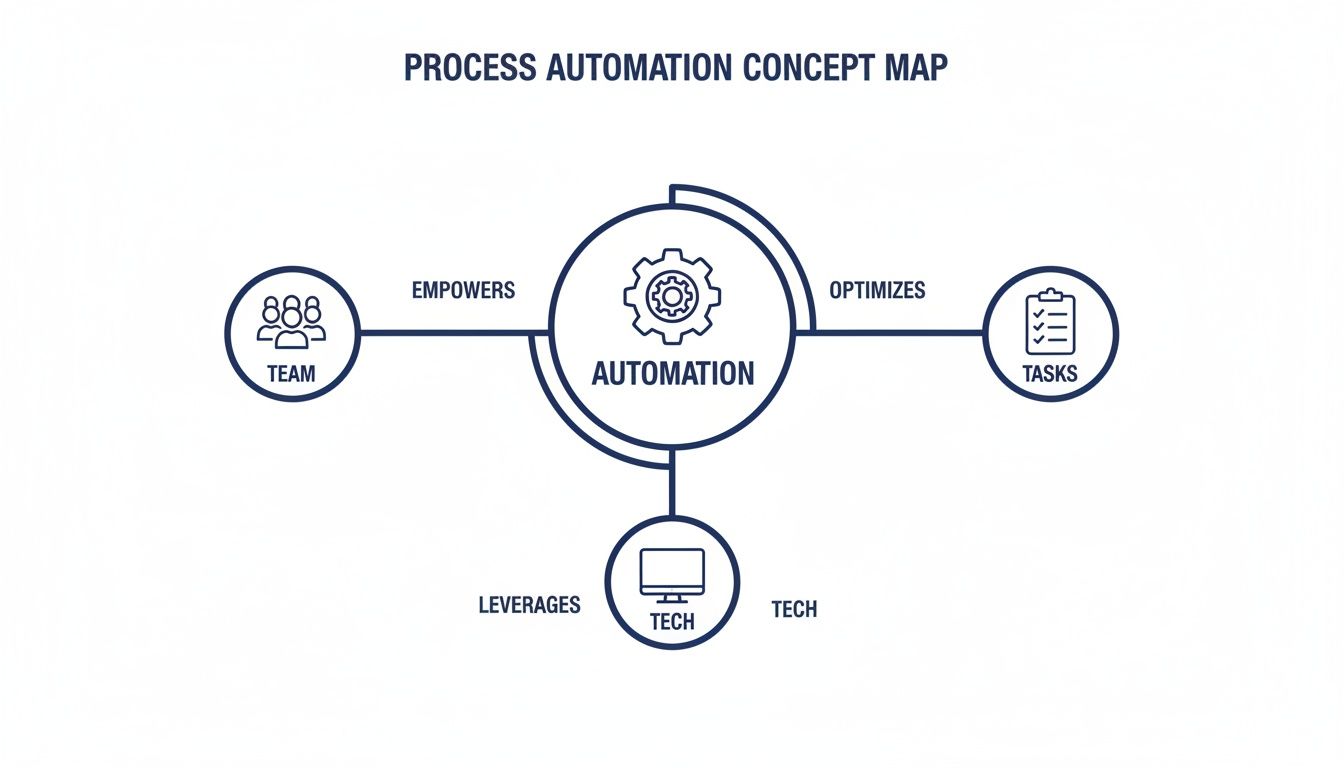
As you can see, a smart automation strategy isn’t just about the software. It's about aligning the right tech with the right jobs to give your people the support they need.
Let’s break down the core components that make this happen.
Robotic Process Automation (RPA)
Imagine having a digital assistant who works at lightning speed, never needs a coffee break, and never, ever makes a typo. That’s Robotic Process Automation (RPA) in a nutshell.
RPA uses software 'bots' to copy the way humans handle repetitive, rule-based tasks on a computer. These bots can log into apps, copy and paste data, fill out forms, and move files around—just like a person would, only much faster and with perfect accuracy.
A classic example is processing supplier invoices. An RPA bot can:
Open an email and find the invoice attachment.
Scan and extract key details like the invoice number, date, and amount.
Punch this data directly into your accounting software.
Flag any odd-looking invoices for a human to review.
This simple automation frees up your finance team from soul-crushing data entry, letting them focus on actual financial analysis that adds value.
Business Process Management (BPM)
While RPA is brilliant at automating individual tasks, Business Process Management (BPM) looks at the bigger picture. BPM is all about taking a step back to analyse, map out, and improve your entire business workflows from end to end. It's the blueprint for how work actually gets done in your organisation.
Think of it this way: if RPA is the robotic arm that tightens a single bolt on an assembly line, BPM is the master plan that designs the whole assembly line for maximum efficiency. It examines a complete process, like onboarding a new client, and maps out every single step—from the first call to the final sign-off—to find and eliminate bottlenecks.
Workflow Automation Platforms
This is where your strategy turns into action. Workflow automation platforms are the hands-on tools that bring your BPM blueprint to life. Platforms like monday.com give you a visual way to build automated sequences that pass tasks between different people and systems.
For instance, you could set up a workflow for your marketing content. When a writer finishes a blog post, the system automatically assigns it to an editor for review. Once approved, it zips over to the graphic designer, and finally, it’s scheduled for publishing. Everyone involved gets notified in real time, and managers have a clear view of where every piece of content is at any given moment. You can also explore more advanced ways these platforms use artificial intelligence, as detailed in our guide on AI solutions for business.
Integrations: The Digital Glue
Finally, we have integrations—the digital glue that holds everything together. Most businesses run on a collection of different apps: a CRM for sales, an accounting system for finance, and project management software for operations. Integrations build bridges between these separate systems so that information can flow freely between them.
This seamless flow of information is becoming a massive focus for NZ businesses. The regional market for business process automation is projected to grow from USD 17.1 billion in 2025 to USD 52.2 billion by 2035, with SMEs leading the charge. Many are seeing productivity gains of up to 40% by automating core functions and slashing process cycle times.
Without integrations, you’re stuck with data silos and manual data entry. With them, you create a single source of truth where your tools can finally "talk" to each other, creating a truly connected and automated operation.
Real-World Wins From Automating Your Processes
The technical stuff is all well and good, but the real story is in the results. When you bring in process automation services, you’re not just buying another piece of software; you’re investing in a powerful upgrade for your entire business. The benefits ripple out far beyond simply saving a bit of time—they help you build a stronger, more competitive organisation.

From shrinking operational costs right through to delighting your customers, a well-planned automation strategy makes a tangible impact. Let’s break down the key advantages you can expect to see.
Slash Costs and Boost Productivity
This is usually the first and most obvious win. Those manual, repetitive tasks—the copy-pasting, the follow-up emails, the data entry—they add up, consuming thousands of staff hours every year. That’s time you’re paying for. Automation takes this administrative weight off your team’s shoulders, letting you get more done without increasing your headcount.
Imagine a construction firm here in New Zealand. Project managers might spend hours every week chasing subcontractors for compliance paperwork, then manually typing that info into a separate safety system. An automated workflow can handle all of it—sending reminders, collecting documents through a simple form, and updating records instantly.
Automation isn't about replacing people; it's about reallocating their intelligence. By freeing your team from monotonous work, you empower them to focus on strategic initiatives, client relationships, and problem-solving—activities that directly drive business growth.
This shift has a double impact: you dramatically cut the labour costs tied to low-value tasks and, at the same time, boost the productivity of your most valuable asset—your people.
Enhance Data Accuracy and Compliance
Let’s be honest, human error happens. But it can be expensive. A single typo on an invoice, a wrong number in a client’s file, or a missed compliance deadline can lead to financial loss, frustrated customers, and regulatory headaches. Automation, on the other hand, runs on pure logic and rules. It’s incredibly precise.
By automating how data moves between your systems, you eliminate the risk of someone mis-keying information. This leads to cleaner, more reliable data you can actually trust to make big decisions. For businesses in regulated industries, this isn't just a nice-to-have; it's essential for staying compliant and avoiding hefty penalties.
Improve Employee and Customer Satisfaction
Nobody enjoys spending their day chasing paperwork or copy-pasting between spreadsheets. When you automate these frustrating jobs, it has a massive impact on team morale. Your staff feel more valued when they can use their skills on meaningful work, which leads to higher job satisfaction and lower staff turnover.
And that internal boost quickly flows outward. When your operations are running like a well-oiled machine, your customers feel it.
Faster Response Times: Automated systems can process orders, answer basic queries, and send client updates in a flash.
Fewer Mistakes: Accurate order processing and invoicing mean fewer headaches and frustrating phone calls for your customers.
Consistent Service: Every customer gets the same high-quality, efficient service, every single time.
This is especially critical in New Zealand's booming e-commerce sector. The local warehousing automation market has surged to USD 1.1 billion, driven by an insatiable demand for speed and accuracy. Adopting automation can slash manual errors in picking and sorting by up to 40%, while a good Warehouse Management System (WMS) can improve order fulfilment speeds by a massive 30-50%. These are the kinds of efficiency gains that build serious customer loyalty.
Ultimately, a happier, more efficient team delivers a better customer experience. It’s a positive feedback loop that strengthens your entire business. You can see how these principles deliver real-world outcomes by exploring some of our client success stories.
Your Practical Roadmap To Implementing Automation
Knowing why you should automate is one thing, but actually doing it is a completely different ball game. A clear, step-by-step plan is what separates a successful project from a frustrating one. This isn't about taking a massive, risky leap; it's about making a series of smart, confident moves.
Think of this as your guide, taking you from the initial idea all the way to ongoing success, making the entire journey feel manageable and predictable.

Step 1: Pinpoint Your Priorities
The first move has nothing to do with technology. It’s all about strategy. Diving headfirst into automating a massive, mission-critical process is asking for trouble. Instead, we need to find the "low-hanging fruit."
These are the tasks that are repetitive, rules-based, and a magnet for human error. They're important, but if something went a little sideways during the setup, it wouldn't bring your entire operation to a halt.
Good starting points usually look something like this:
Data Entry and Transfer: Think about all the time spent copying information from an email or a form into a spreadsheet or another system.
Report Generation: Pulling the same data from the same places to create standard weekly or monthly reports.
Internal Approvals: Routing simple things like leave requests or small expense claims through the right people.
By starting small, you get a quick win. This builds incredible momentum and proves the value of automation to the rest of the team, making it much easier to get their support for bigger projects later on.
Step 2: Find Your Tools and Partner
Once you’ve picked your target process, it’s time to get the right tools and, just as importantly, the right expertise. Your choice of technology needs to be able to grow with you. A platform like monday.com is perfect for this—it can handle simple automations to start, but has the power to manage far more complex workflows and integrations as your business evolves.
Your implementation partner is the other half of this equation. You want a provider of process automation services who feels more like a guide than a salesperson. A great partner has real-world experience with businesses like yours and invests the time to truly understand your specific challenges. They bring the technical skill to build the solution and the strategic foresight to make sure it aligns with where you want to go.
Step 3: Design and Build
This is where the real collaboration begins. Your automation partner will sit down with your team to map out every single step of your current process. They'll ask the tough questions, uncover the hidden steps, and get to grips with all the exceptions to the rules. This deep dive is essential to ensure the final automated workflow genuinely reflects how your business works.
With the design locked in, the build starts. Your partner will configure the software, set up the triggers and rules, and connect the dots between your different apps. For example, if you're automating lead management, this is where they build the flow that grabs a new lead from your website, creates a contact in your CRM, and assigns it to a sales rep—all in an instant. Building these digital bridges is a core part of our work with business systems integration.
"The design phase is where success is determined. A well-designed automation is intuitive, reliable, and requires minimal human intervention. A poorly designed one simply digitises a bad process, creating new problems."
Step 4: Test and Go Live
Before you flip the switch for the whole company, it's crucial to run a pilot programme. A small, hand-picked group of users can test the new workflow in a real-world scenario. This is your chance to catch any gremlins, get honest feedback, and fine-tune everything in a low-risk setting.
The "go-live" moment is also about managing change. A good partner will help you communicate what's happening to the wider team, provide straightforward training, and be on standby for support. Celebrating the launch and showing everyone how this new process makes their jobs easier is the key to a smooth and positive transition.
To keep your project on track, a simple checklist can be a lifesaver. It breaks down the journey into clear phases and actions, ensuring nothing gets missed along the way.
Automation Implementation Checklist
| Phase | Key Action | Success Indicator |
|---|---|---|
| Discovery | Identify and document the target process. | A clear process map is created and agreed upon. |
| Planning | Define project scope, goals, and key metrics (KPIs). | The project has a defined budget and timeline. |
| Selection | Choose the right automation tool and implementation partner. | Contracts are signed with a clear scope of work. |
| Design | Co-design the new automated workflow with your partner. | The final workflow design is approved by stakeholders. |
| Build | Configure the software and build necessary integrations. | The automated workflow is functional in a test environment. |
| Testing | Run a pilot programme with a small group of users. | User feedback is collected and any bugs are fixed. |
| Deployment | Train all users and officially launch the new process. | The automated process is live and user adoption is high. |
| Monitoring | Track performance against initial KPIs. | The automation is meeting or exceeding its goals. |
Following these steps methodically turns a potentially complex project into a series of achievable milestones, guiding you smoothly from planning to a successful launch.
Step 5: Monitor and Grow
Process automation isn't a "set and forget" task. It's a living part of your business that needs to be nurtured. After going live, you and your partner should be keeping a close eye on the workflow's performance, tracking the metrics that matter, and always looking for ways to make it even better.
As your business grows, your processes will inevitably change. A top-tier automation partner offers ongoing support and managed services to make sure your digital workflows evolve right alongside you, continuing to deliver value and keep your operations running like a well-oiled machine.
Choosing The Right Process Automation Partner
Picking the right technology is only half the story; the partner you choose to bring it to life is just as vital. A good provider of process automation services isn’t just a tech vendor. They're a strategic guide who gets inside your business goals and turns them into a smooth, efficient digital workflow.
This partnership is a game-changer for small to mid-sized New Zealand businesses. You get the deep expertise you need without the overhead of a large, in-house IT department. The right partner really does become an extension of your own crew, someone who is genuinely invested in seeing you succeed.
Look For Proven Experience And Industry Fit
First things first, you need a partner with a solid track record. Look for real-world case studies or testimonials from businesses that look and feel like yours – similar in size, and more importantly, in the same industry. A partner who already knows the ins and outs of NZ construction, for example, will deliver value far quicker than a generalist.
They should speak your language from day one. This means having a good grasp of the common bottlenecks, compliance headaches, and opportunities you face. That industry-specific know-how shortens the learning curve dramatically and results in a solution that feels custom-built for your team.
When you're talking to potential partners, get specific with your questions:
Have you worked with a business like ours before?
What were the tangible outcomes you helped them achieve?
How do you approach industry-specific rules around data security and compliance?
Their answers will tell you everything you need to know about their experience and whether they're the right fit for your project.
Prioritise Platform Expertise And Flexibility
A top-tier partner will have deep, hands-on expertise in flexible and scalable platforms like monday.com. Why does this matter? Because the last thing you want is to be boxed into a rigid system that can’t grow with you. A platform like monday.com lets you start small with simple automations and scale up to more complex, company-wide workflows when you're ready.
Your partner should be able to show you not just how the platform works, but how they can shape it to fit your unique operational needs. This often means building custom integrations to connect monday.com with the other essential software you rely on, creating one seamless, unified system.
"A partner's value isn't just in their ability to build an automation. It's in their vision to build an automation that will still serve you effectively in three years, not just three months."
Demand Transparency And Ongoing Support
A clear, transparent implementation plan is non-negotiable. Your partner should lay out a project roadmap with clear stages, timelines, and costs. No surprises. You should know exactly what’s happening at every step, from the initial discovery workshop to post-launch support.
And on that note, ask them about their approach to ongoing support and optimisation. Automation isn’t a set-and-forget project; it's a continuous cycle of improvement. The best partners offer managed services to keep an eye on your automated workflows, tweak them as needed, and proactively find new ways to boost your efficiency. This is what turns a one-off transaction into a lasting relationship focused on growth.
To see how this fits into a bigger picture, exploring professional business consulting can help map out your entire digital journey.
How To Measure Your Automation Success And ROI
Putting money into process automation services is a big move for any business, and you absolutely need to prove it was worth it. This is how you build momentum and get the green light for future projects. It's about having a clear, undeniable way to show that your investment is paying off – moving beyond a gut feeling that things are running smoother and getting into the hard numbers.
Measuring success isn't just about justifying the initial cost; it's about building a rock-solid business case for making things better, continuously. When you track the right metrics, you can clearly show the value of automation to your team, the leadership, and anyone else who needs to see it. It changes the conversation from "this feels more efficient" to "we've saved X hours and cut errors by Y percent."
Calculating Hard ROI
The most straightforward way to measure your return on investment (ROI) is by looking at the "hard ROI"—the tangible, financial gains. These are the numbers that hit your bottom line directly, the kind everyone understands.
Start by adding up the hours you've reclaimed. If a manual task that took an employee five hours a week is now completely automated, you've just freed up 260 hours a year. Easy. Now, multiply that by the employee's hourly rate to see the clear dollar value you've saved.
Next, look at the costs you've cut by reducing errors. A single mistake in processing an order can spiral into return shipping costs, a refunded product, and the staff time it takes to fix it all. If automation gets rid of those mistakes, the savings are real and easy to count.
Recognising Soft ROI
Just as crucial, but a bit trickier to capture on a spreadsheet, is the "soft ROI." These are the qualitative benefits that build a healthier, more competitive business over the long haul.
Think about what this does for your team. When you take away the tedious, mind-numbing work, you almost always see a major lift in morale and job satisfaction. A happier, more engaged team is a more productive one, and they're far less likely to leave. That means lower recruitment and training costs, which is a very real financial win.
And then there's the customer experience. Faster response times, more accurate service, and consistent delivery all lead to better customer loyalty and retention. You can't always put an exact dollar figure on a happy customer, but their lifetime value is a powerful sign that you're on the right track.
"The true value of automation lies in its ripple effect. It starts with saving time on one task, which leads to a more engaged employee, who then delivers a better customer experience, ultimately strengthening the entire business."
Key Performance Indicators To Track
To get the full picture of your automation success, you need to be tracking a mix of Key Performance Indicators (KPIs). These are the specific metrics that give you the data to back up all your ROI claims.
Here are the essential KPIs you should be watching:
Process Cycle Time: How long does it take to get a process done, from the very start to the very end? A big drop here is a clear sign of improved efficiency.
Error Rate Reduction: Keep a tally of human errors before and after you automate. This is a powerful way to show you've boosted quality and accuracy.
Cost Per Transaction: Figure out what it costs to complete a single task, like processing one invoice. Automation should send this number way down.
Employee Productivity: This one can be tougher to measure directly, but you can look at outputs. Think about the number of customer cases resolved per day or projects completed in a quarter.
User Adoption Rate: This shows how well your team is actually using the new automated process. High adoption is absolutely critical to getting the full benefits.
By consistently keeping an eye on these KPIs, you can build a clear, data-driven story that proves the ongoing value of your process automation services and makes a compelling case for what's next.
Common Questions About Process Automation
Even after seeing the potential, taking the first step into automation can feel like a leap. For many NZ business leaders we talk to, a few key questions usually pop up around security, cost, and what it all means for the team.
Let's clear the air and tackle those questions head-on. Think of this as the final chat over coffee before you dive in, making sure you’re moving forward with total confidence.
Will Automation Replace My Staff?
This is, without a doubt, the question we hear most often. And the answer is a resounding "no". The whole point of automation in a small or mid-sized business isn’t about replacing people—it’s about making them better.
Automation is designed to take over the repetitive, soul-crushing tasks that eat up your team's time and energy. This frees your people to focus on the things that actually grow the business, the stuff only humans can do well:
Big-Picture Thinking: Analysing what’s working, what isn’t, and planning the next move.
Building Relationships: Fostering genuine connections with customers that build real loyalty.
Creative Problem-Solving: Coming up with clever solutions to tricky challenges that no machine could figure out.
When you automate the grind, you empower your staff to add more value. What we see time and again is a boost in job satisfaction and a direct contribution to business growth.
Is Process Automation Secure?
Absolutely. Security isn't just a feature; it's the foundation. Any automation partner worth their salt will make this their absolute top priority. Professional automation solutions are built from the ground up with robust security measures baked in.
This means using secure, industry-leading platforms, encrypting sensitive data, and putting strict access controls in place so only the right people can interact with your automated workflows.
Here’s something that surprises a lot of people: automation often improves your security. By taking manual data entry and clumsy spreadsheet sharing out of the equation, you dramatically cut down the risk of human error and potential data leaks.
How Much Does It Cost To Get Started?
This isn’t a one-price-fits-all situation, and that's a good thing. The cost of process automation services is far more accessible than most people think, and it’s tailored to your specific needs.
The investment really depends on the complexity of the process you want to sort out first and how much support you need along the way. Most businesses we work with start small by automating a single, high-impact workflow. This gives them a quick, clear win and a tangible return on a modest initial investment.
A good partner will give you transparent pricing from the get-go, breaking it down into the initial setup and any ongoing support or licensing. No nasty surprises. The focus should always be on the incredible value and time savings it delivers, not just the upfront cost.
Ready to finally get rid of those bottlenecks and see exactly what’s happening across your business? The team at Wisely specialises in designing and implementing digitised workflows that connect your people, processes, and technology. Book a discovery call today to explore how our process automation services can drive real, measurable productivity gains for your business.