Business Intelligence (BI) is more than just data charts and dashboards; it's the engine that transforms raw information into strategic insights, empowering small and medium-sized businesses (SMBs) to make smarter, faster decisions. But where do you start? The question of what is business intelligence often leads to a maze of complex software and technical jargon. For a more detailed breakdown of its core concepts, you can explore this guide on What Is Business Intelligence and Analytics.
This article cuts through the noise. We've compiled 10 essential resources designed to help you understand BI, build a data-driven culture, and gain a competitive edge.
1. Business Intelligence 2024: A Comprehensive Guide to Data-Driven Decision Making
This comprehensive industry report from Gartner offers a deep dive into what business intelligence is and how modern organisations are leveraging it. The guide details current BI trends, evaluates the vendor landscape, and outlines best practices for turning raw data into strategic assets. It’s essential reading for leaders, particularly in finance and operations, aiming to implement real-time reporting and data-driven strategies.
For example, the report highlights how Fortune 500 companies use BI to slash reporting cycles from weeks to mere days and how financial firms deploy live dashboards for proactive risk management. For a forward-looking perspective on how the field is evolving, you might explore insights into the future of business analytics.
Key Takeaways:
- Assess your maturity: Use the guide's models to benchmark your current BI capabilities.
- Inform tool selection: Reference the vendor comparisons to choose the right BI tools.
- Plan realistically: Apply the implementation timelines for effective project planning and process improvement.
2. Business Intelligence: A Data Warehouse Approach
This foundational book by Mark Humphries, Michelle Kelley, and Mick Hawks explains the architecture behind a core component of what is business intelligence: the data warehouse. It offers practical guidance on designing systems that integrate data from multiple sources, creating a single source of truth for unified reporting. This is vital for organisations seeking complete visibility across siloed workflows and financial data, forming the backbone of a robust BI strategy.

For example, retail organisations use these principles to consolidate point-of-sale, inventory, and customer data for a complete view of business performance. Similarly, manufacturing companies can integrate supply chain and production data to optimise operations. For more on the infrastructure supporting these systems, you can explore the role of cloud computing.
Key Takeaways:
- Design your foundation: Use the book’s architecture diagrams as templates for your own designs.
- Model your data: Read the chapters on data modelling before implementing your BI solution.
- Integrate effectively: Apply the ETL (Extract, Transform, Load) principles when connecting tools like monday.com with other systems.
3. Microsoft Power BI Fundamentals Course
This official Microsoft learning path is a foundational resource for understanding what is business intelligence in a practical, tool-based context. It guides users through Power BI’s core functionalities, from connecting data sources and performing transformations to creating compelling visualisations and interactive dashboards. It's perfectly suited for non-technical users, like finance leaders or operations managers, who need to build and share decision-ready reports without relying on dedicated IT teams.
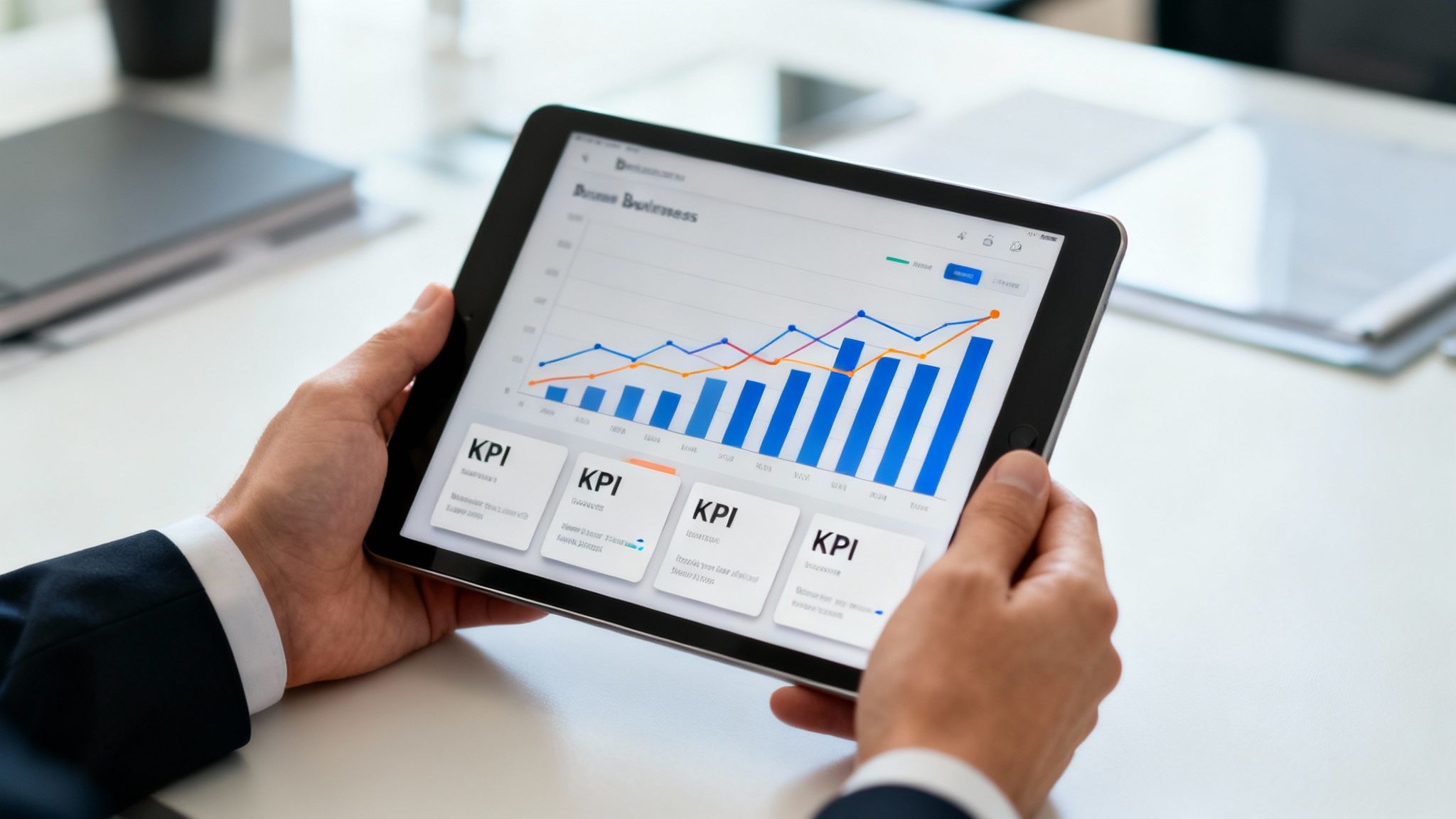
For example, finance teams can use the skills learned to automate monthly budget variance reports, while sales directors can build real-time dashboards to track KPIs and forecast revenue. The course empowers operations teams to visualise project timelines and monitor resource allocation, transforming complex data into clear, actionable insights for better management and strategic planning.
Key Takeaways:
- Start with the basics: Begin with the 'Get Started with Power BI' module to build a solid foundation.
- Practise with real data: Apply your learning by building dashboards using your organisation's own data for immediate relevance.
- Master data preparation: Use Power Query to efficiently clean and prepare data, which is a critical step for accurate reporting.
4. Harvard Business Review: The AI-Powered Enterprise
This thought leadership article from Harvard Business Review explores how artificial intelligence is transforming what is business intelligence and decision-making. It examines the strategic implications of AI-driven analytics for organisational leadership and competitive advantage, making it crucial reading for founders and finance leaders planning a digital transformation. It details how AI moves beyond historical reporting to offer predictive and prescriptive insights.

For instance, the article discusses how financial services firms use AI to detect fraud in real-time and how retailers apply predictive analytics for inventory optimisation. For a deeper understanding of practical applications, you can explore the benefits of AI-powered solutions.
Key Takeaways:
- Justify investment: Use the insights to build a strong business case for BI and AI projects.
- Develop strategy: Apply the article's frameworks to create your own AI implementation roadmap.
- Manage change: Plan for the cultural and operational shifts required to adopt AI-driven processes effectively.
5. Tableau Learning Library & Tutorials
Tableau's free learning library is a comprehensive collection of video tutorials, live webinars, and interactive guides designed to master data visualisation. It is an essential resource for teams aiming to translate complex datasets into compelling visual stories and actionable insights. This platform demystifies what business intelligence can achieve by providing practical, hands-on training for creating dashboards that stakeholders can easily understand and act upon.
For example, a sales team could use these tutorials to build an interactive revenue dashboard tracking performance against targets, while an operations team could visualise workflow efficiency to pinpoint bottlenecks. The library’s focus on practical application makes it invaluable for turning raw metrics into strategic assets.
Key Takeaways:
- Start with fundamentals: Begin with the 'Getting Started' series to build a solid foundation before tackling more advanced analytics topics.
- Learn by doing: Replicate the sample visualisations provided in the tutorials to understand and master specific techniques.
- Practise storytelling: Apply the principles taught to craft clear narratives with your data, ensuring your insights drive decisions.
6. Business Intelligence and Data Warehousing Strategy Report 2024
Published by Forrester Research, this annual report provides strategic guidance on what business intelligence is and how to align technology investment with core objectives. The paper is designed for operations leaders and IT managers in mid-market organisations, offering a clear roadmap for BI, data governance, and analytics priorities during digital transformation initiatives. It serves as an essential resource for those planning significant data-centric projects.
For example, the report details how mid-sized financial services firms can implement robust governance frameworks, how manufacturing companies can establish effective data stewardship roles, and how professional services organisations can build new client analytics capabilities from the ground up.
Key Takeaways:
- Design with governance: Use the report’s frameworks to design a structured BI approach.
- Build a strong business case: Reference the budget data when justifying BI projects.
- Plan for security: Assess your organisational maturity and plan for compliance from day one.
7. Google Analytics Academy - Data Analytics Fundamentals
This free course from Google provides a comprehensive foundation in data analytics, centred on the powerful Google Analytics platform. While its primary focus is web analytics, the course teaches essential principles of data collection, processing, and reporting that are fundamental to any modern business intelligence strategy. It is ideal for marketing directors, sales leaders, and anyone looking to understand how customer behaviour data translates into business outcomes.
For example, e-commerce companies use these principles to optimise conversion funnels, while digital marketing teams can precisely attribute revenue to specific campaigns. For a deeper understanding of how to apply these concepts across your entire operation, you might explore our guide on process improvement.
Key Takeaways:
- Build foundational skills: Learn core analytics concepts applicable beyond just marketing data.
- Master practical tools: Gain hands-on experience with Google Analytics and Google Data Studio.
- Connect data to strategy: Understand how to track pipeline and conversion metrics to inform business decisions.
8. SQL for Business Intelligence: A Practical Guide
This practical guide by Svetla Boeva is a foundational resource for anyone needing to understand what business intelligence means from a technical standpoint. It teaches SQL specifically for querying, manipulating, and transforming data for BI applications. This book is essential for IT teams, data analysts, and BI specialists responsible for building the data pipelines and reports that feed into strategic business decisions. It demystifies the process of extracting meaningful information directly from databases.
For example, the guide provides clear instructions for writing efficient queries to analyse large financial datasets or building automated data pipelines for regular reporting. It also covers how to optimise dashboard queries to ensure they deliver real-time performance, a critical component of modern BI.
Key Takeaways:
- Master the fundamentals: Start with SELECT and WHERE clauses before moving to more complex joins and aggregations.
- Optimise for performance: Use execution plans to identify and fix bottlenecks in your queries.
- Standardise your work: Create reusable query templates for common business scenarios to improve efficiency and consistency.
9. LinkedIn Learning: Business Intelligence Fundamentals
This comprehensive LinkedIn Learning course provides a structured introduction to understanding what business intelligence is and its core functions. The video series covers essential concepts, common BI tools, and implementation strategies, making it ideal for professionals at all levels looking to build foundational knowledge. It’s a practical resource for teams aiming to align on BI terminology and methodology before adopting new platforms or processes.
For instance, the course shows how finance teams can apply BI principles to improve forecasting accuracy and how operations leaders can use dashboards to monitor key performance indicators. For those seeking a deeper dive into modernising their data practices, this course serves as a great primer before exploring concepts like cloud modernisation strategies.
Key Takeaways:
- Establish a baseline: Use the course to ensure everyone in your organisation shares a common understanding of BI.
- Learn the "why": Start with the strategy modules to connect BI concepts directly to business value.
- Apply your learning: Practice the concepts discussed using a free trial of a BI tool for a hands-on experience.
10. The McKinsey Analytics Report 2024: AI and Data-Driven Decision Making
This executive-level report from McKinsey explores how leading organisations are harnessing analytics and AI for a significant competitive edge. The research delivers strategic insights into the organisational change and capability building required for successful digital transformation, making it vital for C-suite leaders wondering what is business intelligence in the age of AI. It moves beyond theory to provide clear frameworks for measuring ROI.
For instance, the report highlights financial services firms achieving 15-20% efficiency gains and retailers optimising inventory turns through advanced analytics. For a deeper look at translating strategy into action, consider how a Virtual CFO can help implement these financial frameworks.
Key Takeaways:
- Secure buy-in: Share the executive summary with leadership to build consensus.
- Build a strong case: Use the report's ROI models in your business proposals.
- Benchmark progress: Compare your organisation's analytics maturity against the case studies.
10-Resource Comparison: What Is Business Intelligence?
| Resource | Type & 👥 | Core features ✨ | Value / 💰 | Quality ★ / USP 🏆 | Best for Wisely |
|---|---|---|---|---|---|
| Business Intelligence 2024: A Comprehensive Guide to Data-Driven Decision Making | Industry Report · 👥 CIOs, Finance & Ops leaders | Market sizing, vendor analysis, maturity models | 💰 Paid subscription; high strategic value | ★★★★☆ · 🏆 Authoritative analyst insights | Advising tech selection & roadmaps |
| Business Intelligence: A Data Warehouse Approach | Book · 👥 IT teams, Architects | DW architecture, ETL, data modelling | 💰 One‑time purchase; long‑term reference | ★★★★☆ · ✨ Deep technical foundation | Designing integrated data infrastructure |
| Microsoft Power BI Fundamentals Course | Online Course · 👥 Finance, Ops, Project teams | Self‑paced labs, dashboard design, connectors | 💰 Free/low‑cost; certification path | ★★★★☆ · 🏆 Official Microsoft training | Transforming monday.com data into dashboards |
| Harvard Business Review: The AI‑Powered Enterprise | Article · 👥 Founders, Finance leaders | Executive frameworks, case studies, ethics | 💰 May require HBR access; strategic insight | ★★★☆☆ · ✨ Business‑focused AI frameworks | Communicating strategic AI value to leaders |
| Tableau Learning Library & Tutorials | Tutorial Platform · 👥 Analysts, Visualisers, Teams | Video guides, sample workbooks, community | 💰 Free tutorials; paid software licensing | ★★★★☆ · 🏆 Strong visual learning & community | Training clients on compelling visual narratives |
| Business Intelligence and Data Warehousing Strategy Report 2024 | Industry Report · 👥 Mid‑market IT & Ops leaders | Governance frameworks, tech matrices, budgets | 💰 Paid; budget & governance guidance | ★★★★☆ · ✨ Mid‑market focus | Advising governance structures & investments |
| Google Analytics Academy - Data Analytics Fundamentals | Online Course · 👥 Marketing, Sales, Analysts | GA4, interactive lessons, Data Studio integration | 💰 Free; certification available | ★★★☆☆ · ✨ Practical web analytics foundations | Upskilling marketing & sales teams on metrics |
| SQL for Business Intelligence: A Practical Guide | Book · 👥 SQL/IT & BI developers | SQL for BI, optimization, window functions | 💰 One‑time purchase; practical ROI | ★★★★☆ · ✨ Performance‑focused SQL guidance | Building efficient data pipelines and queries |
| LinkedIn Learning: Business Intelligence Fundamentals | Online Course · 👥 Broad professionals & stakeholders | Strategy + tech chapters, exercise files, cert | 💰 Subscription; corporate training friendly | ★★★☆☆ · ✨ Broad stakeholder alignment | Aligning diverse teams on BI value & approach |
| The McKinsey Analytics Report 2024: AI and Data‑Driven Decision Making | Industry Report · 👥 C‑suite, Founders | Survey data, ROI frameworks, change management | 💰 Paid; executive‑level strategic insight | ★★★★☆ · 🏆 Extensive primary research & impact data | Justifying investment & planning capability build-up |
From Knowledge to Action: Your Next Steps in BI
Understanding what is business intelligence is more than just grasping a technical definition; it's about fundamentally changing how your organisation operates. We've explored the core components of BI, from data warehousing to visualisation, and outlined the tangible benefits it delivers for small and mid-sized businesses, such as enhanced cash flow visibility and optimised sales funnels. The journey from raw data to decisive action is no longer reserved for large enterprises. With the right strategy and tools, any business can harness its data to gain a competitive edge.
The key takeaway is that BI is an ongoing process, not a one-off project. It requires a commitment to collecting clean data, asking the right questions, and fostering a culture that values evidence over intuition. The resources highlighted in this guide, from practical SQL tutorials to strategic reports, provide a solid foundation. Your next step is to translate this knowledge into practice. Start by identifying one critical business challenge-perhaps forecasting resource needs or analysing customer behaviour-that BI could directly address.
By centralising your operational data in a platform like monday.com, you create the single source of truth needed for meaningful analysis. From there, connecting to visualisation tools can turn complex datasets into clear, actionable insights. Ultimately, mastering business intelligence means empowering your team to make smarter, faster, and more confident decisions that drive sustainable growth and operational excellence. This proactive, data-informed approach is the new standard for success.
Ready to transform your data into a strategic asset but unsure where to begin? The experts at Wisely specialise in creating and implementing tailored BI strategies that align with your unique business goals. Book a consultation with Wisely today to build your roadmap from data to decision.