Information technology managed services are all about taking a proactive, strategic approach to your IT support. Instead of waiting for things to break and then scrambling to fix them, an external company takes complete ownership of managing and maintaining your technology infrastructure.
This simple shift turns your IT from an unpredictable, reactive expense into a predictable, strategic asset that helps your business grow.
Unpacking Your Virtual IT Department
Think about it this way: what if you had an entire team of IT experts on call, ready to handle everything from cybersecurity threats to routine system updates, but without the hefty payroll and overhead of hiring them in-house?
That’s the core idea behind information technology managed services. It’s a complete departure from the old "break-fix" model, where you only ring up an IT technician after a server has crashed or a critical application has gone offline.
Instead, a managed service provider (MSP) works more like a subscription to expert IT management. They operate quietly in the background, monitoring your systems 24/7 to catch and resolve issues before they can ever disrupt your day-to-day operations.
The proactive stance is the fundamental difference. A break-fix technician profits when your technology fails. A managed service provider profits when your technology runs smoothly, which means their success is directly tied to yours.
From Reactive Firefighting to Proactive Strategy
The old way of doing things often meant small businesses would let routine maintenance slide, inevitably leading to sudden, expensive downtime. An MSP completely flips this model around. Their entire goal is to build stability and efficiency through a suite of ongoing services designed to keep your business humming along without a hitch.
This lets your team get back to focusing on what they do best, instead of getting bogged down by frustrating tech headaches. It’s about turning your technology from a potential liability into a reliable engine for growth.
A Growing Trend in New Zealand
This approach is picking up serious momentum, not just overseas but right here in New Zealand. The local IT services market is on track to hit NZ$8.52 billion by 2029. A big driver for this is Kiwi businesses needing to modernise quickly but running into a major shortage of specialised talent in areas like AI, cloud, and cybersecurity.
This skills gap makes an MSP an incredibly valuable partner. They bring the high-level expertise that most businesses simply can't find or afford to build internally. For companies using containerisation, for example, knowing about specialised offerings like Managed Kubernetes services is crucial for defining what an MSP should cover. Learn more about the key IT market trends for 2025.
Exploring the Core Services You Should Expect
A good partnership with a managed service provider (MSP) is built on a handful of core services. These aren't just line items on an invoice; they're the essential components that work together to create a safety net for your technology. Getting this right means shifting your IT from a reactive cost centre to a proactive business asset.
To really know what a provider is offering, you need to understand these key pillars.
This concept map shows how managed IT helps you get ahead of problems, lock in predictable costs, and keep your team focused on what they do best.
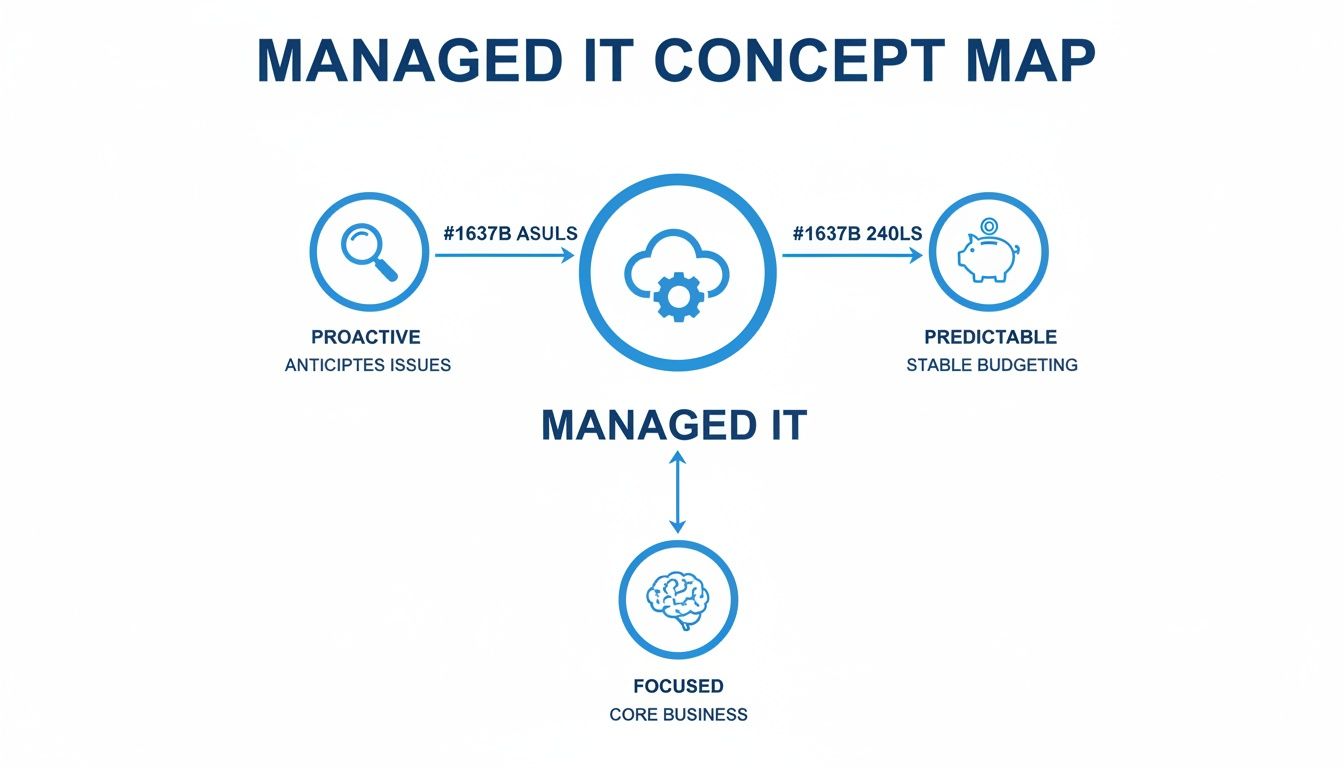
The real goal here is to move beyond just fixing things when they break. It’s about anticipating needs and making sure your tech is actually helping you meet your business goals.
Proactive Monitoring and Maintenance
This is the absolute foundation of any decent managed IT plan. Think of it like a 24/7 digital guardian watching over your entire network, from servers to individual laptops. This constant oversight lets the provider spot small irregularities—like a server acting sluggishly or a hard drive showing early signs of failure—before they turn into major outages that bring your business to a halt.
It also covers all those routine but critical tasks that are so easy to forget, like applying software updates and security patches. By keeping everything current, your MSP closes security loopholes and makes sure your systems are running as efficiently as possible.
Helpdesk and Technical Support
When someone on your team hits a technical snag, they need help, and they need it fast. A managed helpdesk gives them a single, reliable point of contact for every IT issue, whether it’s a forgotten password or a piece of software that won’t cooperate. This stops your staff from wasting time trying to troubleshoot on their own and keeps them focused on their actual jobs.
Great IT support is all about clear communication. Using a structured process, much like an effective bug report template, can make a huge difference in how quickly issues get solved. It cuts down on the back-and-forth and ensures problems are documented and resolved with total efficiency.
Cybersecurity and Data Protection
With digital threats becoming more sophisticated every day, solid security is simply non-negotiable. An MSP can deliver enterprise-grade security services that would be out of reach for most small businesses, which is a big reason the market here in New Zealand is growing so quickly.
These layers of defence are absolutely critical for protecting your sensitive business information and your clients' data. You can dig deeper into this by checking out our essential SMB defence guide for cybersecurity in New Zealand.
A good MSP doesn’t just sell you software; they manage a complete security strategy tailored to your business. They effectively become your dedicated security team, always adapting to new threats so you don’t have to.
The Real-World Benefits for Growing Businesses
Let's move past the technical jargon for a moment. The true measure of any IT service is the real, tangible impact it has on your business—on your performance, your team, and your bottom line. For growing Kiwi businesses, partnering with a Managed Service Provider (MSP) is about turning your tech from a frustrating cost centre into a genuine strategic asset.

It’s a fundamental shift. Instead of just fixing what’s broken, a great MSP aligns your technology with your business goals, solving problems before they even start.
Gain Predictable IT Budgeting
One of the first things you'll notice is the end of chaotic, reactive IT spending. No more heart-stopping invoices for emergency server repairs or unexpected hardware failures. Instead, you get a simple, fixed monthly fee.
This predictable cost structure makes financial planning a breeze. You can forecast your IT spend just like any other operational expense, turning your budget from a wild guess into a reliable plan.
Access Specialised Expertise Instantly
Let’s be realistic—hiring a full-time cybersecurity guru, a cloud architect, and a network engineer just isn't on the cards for most SMEs. An MSP gives you access to an entire team of these specialists for a fraction of what it would cost to hire even one senior expert.
It completely levels the playing field, giving your business the kind of enterprise-grade knowledge that was once reserved for the big players.
This isn't just about having someone to call when things go wrong; it's about gaining a serious competitive advantage. You can confidently explore new technologies and build robust security, knowing you're guided by people who live and breathe this stuff every single day.
Increase Productivity and Reduce Downtime
Every minute your systems are down, you’re losing money and momentum. A proactive MSP is all about preventing that from happening. By monitoring your systems 24/7, they spot and resolve issues long before they escalate into a full-blown outage.
On top of that, having a dedicated helpdesk means your staff get fast answers to those little tech niggles that can derail their day. It keeps them focused on their actual jobs, not on fighting with their computers. This is a cornerstone of good business continuity—if you'd like to dive deeper, check out our guide to business continuity planning for resilient Kiwi SMEs.
Support Scalable Business Growth
As your business takes off, your technology needs to keep pace. An MSP provides an IT foundation that’s built to scale right alongside you, without forcing you into huge, upfront investments in new servers or software licences.
This kind of agility is crucial in New Zealand's dynamic market. It’s no surprise the broader ICT sector, which includes managed services, is projected to grow at a CAGR of 6.9% through 2032. This trend is fuelled by businesses looking for expert, scalable IT solutions to power their growth. You can discover more insights about New Zealand's expanding ICT market and see how you fit into the bigger picture.
Navigating Pricing Models and Service Level Agreements
Getting the finances right is key to a successful partnership. You need an arrangement that feels fair, delivers genuine value, and doesn't come with nasty surprises. To do that, you first have to get your head around the different ways providers structure their pricing.
Just as important—if not more so—is the Service Level Agreement (SLA). Think of this as the rulebook for your relationship. It’s the contract that turns vague promises about support into rock-solid, measurable commitments you can hold your provider to.
Finding the Right Price Tag
Most managed IT providers use one of a few common pricing models. There’s no single “best” option; the right fit depends entirely on how your business operates, how many staff you have, and what level of predictability you need in your budget.
Here’s a look at the most common pricing structures you'll come across, helping you see which financial model might suit your business best.
Common Managed IT Services Pricing Models
| Pricing Model | How It Works | Best For | Potential Drawback |
|---|---|---|---|
| Per-Device | You pay a set fee for every piece of hardware being managed—think servers, laptops, and even printers. | Businesses with a predictable number of devices, where staff don't often use multiple machines. | It can get expensive quickly if your team uses a laptop, desktop, and tablet each. |
| Per-User | A flat monthly fee is charged for each employee, no matter how many devices they use. | Companies where staff need support across multiple devices (phone, laptop, etc.). | Less cost-effective if you have lots of staff with very basic, minimal IT needs. |
| Tiered Plans | The provider offers pre-packaged plans (e.g., Bronze, Silver, Gold) with increasing service levels. | Businesses that want to easily choose a package that lines up with their budget and needs. | You might find yourself paying for services in a higher tier that you don't actually use. |
| All-You-Can-Eat | One all-inclusive flat fee covers absolutely everything—remote support, on-site visits, monitoring, and management. | Organisations that want total budget predictability and comprehensive coverage without ever seeing an extra charge. | It's typically the highest upfront cost, but it also provides the greatest peace of mind. |
Choosing the right model helps align your provider’s goals with your own, ensuring they’re incentivised to keep your systems running smoothly.
What to Look For in Your Service Level Agreement
The SLA is your safety net. It’s where everything is laid out in black and white, from how fast the provider has to get back to you to the guarantees they make about system availability. You absolutely need to read the fine print here.
An SLA isn't just legal jargon; it's your primary tool for accountability. It ensures both parties have the same definition of "good service" and provides a clear path for recourse if expectations aren't met.
Drill down into the specifics. Look for clear definitions of “response time” (how fast they acknowledge a problem) versus “resolution time” (how long it takes to actually fix it). These are not the same thing!
Another deal-breaker is the “uptime guarantee”. A promise of 99.9% availability means your systems can only be down for a few hours over an entire year. Make sure every promise that matters to your day-to-day operations is clearly documented and agreed upon before you sign anything. Vague language is a major red flag.
Choosing the Right MSP Partner for Your Business
Finding the right provider for your information technology managed services isn't like hiring a vendor; it’s about bringing a strategic partner into the fold. Of course, technical skills are a must, but the real magic happens when you find an organisation that’s genuinely invested in seeing you succeed. It means looking past the sales pitch to find a team that just gets your business.
A great MSP becomes an extension of your own team. They take the time to understand where you're heading and align their services to help you get there. This kind of relationship is built on a foundation of trust, open communication, and shared goals.

Evaluate Their Industry Experience
First things first, you need to look at their track record. A generalist MSP might know their stuff, but one with proven experience in your specific industry will hit the ground running. They’ll already be familiar with your unique challenges, compliance headaches, and day-to-day operational workflows.
Don't be shy about asking for case studies or client references from businesses like yours. Any provider who’s confident in their work will be more than happy to connect you with their current clients. This is your chance to get the real story and ask direct questions about how they handle pressure and solve problems.
Cultural fit is every bit as important as technical know-how. Pay close attention to how they communicate in your initial chats. Do they speak plain English, or are they hiding behind a wall of tech jargon? A real partner makes sure you understand what’s happening and why it matters to your business.
Verify Security and Compliance Credentials
In today's world, security is non-negotiable. A top-tier MSP should have no problem clearly laying out their security credentials and the protocols they live by.
Here’s a quick checklist to get you started:
- Certifications: Ask what industry-standard certifications they hold to validate their security practices.
- Compliance Knowledge: Do they have a firm grasp of the regulations that matter to your business, like New Zealand’s data privacy laws?
- Incident Response Plan: What happens when things go wrong? They need to have a clear, well-documented plan for handling a security breach.
This is one area where you absolutely cannot afford to cut corners. You're entrusting this partner with your most valuable asset—your data.
Understand the Onboarding Process
A smooth, well-communicated onboarding process is a great sign of what's to come. A professional provider won’t just wing it; they’ll have a structured plan designed to get the partnership started on the right foot.
The journey should look something like this:
- Discovery and Assessment: A proper deep dive into your current IT setup to get a handle on your systems, pain points, and business goals.
- Strategic Planning: Working together to build an IT roadmap that sets out clear priorities for the first 90 days and beyond.
- Seamless Transition: A carefully managed handover that ensures zero disruption to your team’s daily work.
- Ongoing Optimisation: Regular catch-ups and performance reviews to make sure you’re getting real value from the partnership.
This methodical approach ensures that from day one, your new MSP is focused on solving your tech problems and actively helping to drive your business forward. For a deeper look into aligning technology with your business goals, check out our ultimate guide to IT consulting services.
Common Questions About Managed IT Services
Even when the benefits seem clear, jumping into a partnership for your information technology managed services can feel like a big step. It's totally natural to have questions bubbling up about cost, control, and whether this model is actually the right fit for your business.
Let’s get straight into some of the most common queries we hear from business leaders, so you can make a decision with confidence, not uncertainty.
Will We Lose Control Over Our IT by Using an MSP?
This is probably the biggest myth out there, but a good partnership actually gives you more strategic control, not less. Think of it this way: your managed service provider (MSP) handles the day-to-day technical grind—the server monitoring, software patching, and endless support tickets. But you? You stay firmly in the driver’s seat of your IT strategy.
A genuine partner doesn't just tick tasks off a list; they bring experience and insights to the table. They’ll give you clear reports and expert recommendations, empowering you to make informed, high-level decisions. You're simply offloading the operational heavy lifting, which frees you up to focus on using technology to hit your real business goals.
Are Managed Services Only for Large Companies?
Not at all. In fact, small and mid-sized businesses (SMEs) often see the most dramatic benefits. An MSP acts as a force multiplier, giving smaller organisations access to enterprise-level expertise in cybersecurity, cloud architecture, and network management—all for a predictable, affordable monthly cost.
This completely levels the playing field. It means a growing business can tap into powerful technology and robust security that would be financially and logistically out of reach with a small in-house team. It's a powerful growth enabler, giving you the technical foundation to compete with much larger players.
What Is the Difference Between Break-Fix and Managed Services?
The difference is night and day: one is reactive, the other is proactive.
- Break-Fix Model: You only call for IT help when something has already gone wrong. The IT support company literally profits from your problems and downtime.
- Managed Services Model: You pay a flat monthly fee to a provider whose entire goal is to prevent problems from ever happening in the first place.
With managed services, your provider's success is perfectly aligned with your stability. The fewer issues you have, the more efficient and profitable their operation becomes. This shared goal means less downtime, stronger security, and predictable costs for your business.
How Secure Is Handing Over Our IT to a Third Party?
Reputable MSPs live and breathe security; it's the absolute cornerstone of their business. They can often provide a far higher level of security than a business can manage on its own, using advanced monitoring tools, certified experts, and strict, documented protocols.
When you're evaluating a provider, don't be shy. Ask pointed questions about their security certifications, their familiarity with New Zealand's compliance standards, and their incident response plans. A transparent, security-focused partner will have no problem demonstrating exactly how they’ll protect your critical data as if it were their own.
Ready to turn your IT into a strategic asset? At Wisely, we provide comprehensive information technology managed services designed to keep your business secure, efficient, and ready for growth. Learn how our proactive approach can benefit you.