A cyber security audit is an independent, expert-led examination of your business's digital security measures. Think of it less as a pass-or-fail test and more as a specialist's health check for your digital infrastructure. It's all about verifying that your security controls, policies, and procedures are actually working as intended.
Why a Cyber Security Audit Is Not Optional
Imagine you’ve just bought a commercial building. You wouldn’t just take the previous owner's word that everything is up to code. You’d hire a professional inspector to check the foundation, wiring, and structural integrity. A cyber security audit does the exact same thing for your digital assets, moving you from hopeful guesswork to having a clear, actionable roadmap for strengthening your defences.
This process is a thorough review to confirm your security measures aren't just present on paper but are effectively implemented in the real world. It ensures your defences line up with your business goals and compliance duties, like the requirements under New Zealand's Privacy Act.
The Growing Need for Verification
In an environment where threats are constantly evolving, simply assuming your security is adequate is a huge risk. The reality for New Zealand businesses is stark; over half have been hit by cyber attacks. This local vulnerability mirrors a global surge in cybercrime, with financial losses projected to hit an astounding $23 trillion by 2027, as detailed in the Kordia Cyber Security Report.
This isn't just about preventing financial loss. It's about protecting your reputation, keeping customer trust, and ensuring your business can keep operating. An audit provides the objective validation you need to demonstrate due diligence to stakeholders, partners, and regulators.
A cyber security audit replaces assumptions with evidence. It’s the critical step that verifies your investments in security technology and training are delivering real-world protection against tangible threats.
From Theory to Practical Defence
The audit process gets into the weeds, scrutinising every layer of your security posture. This covers everything from network configurations and access controls to employee awareness and incident response plans. To get a better feel for how these principles apply in practice, resources like a complete guide to a computer network security audit offer detailed insights into identifying modern threats and shoring up your defences.
Ultimately, a cyber security audit is a proactive move. It pinpoints weaknesses before malicious actors can exploit them, giving you the foresight to fix vulnerabilities and build a more resilient organisation. It’s an essential investment in your company’s long-term health and stability.
Navigating the Cyber Security Audit Lifecycle
A cyber security audit isn't a one-off event. It's a structured journey with a clear beginning, middle, and end. When you understand this lifecycle, the whole process shifts from being an intimidating ordeal into a predictable, manageable project.
Each phase builds on the last, creating a logical path from initial questions to a much stronger, more resilient security posture. This methodical approach ensures nothing gets missed and that the results are genuinely useful for your business. It's the best way to properly examine your defences, find the weak spots, and make sure your security investments are actually working.
This visual breaks down the typical journey into a simple, three-part process, from the initial check-up right through to verified protection.
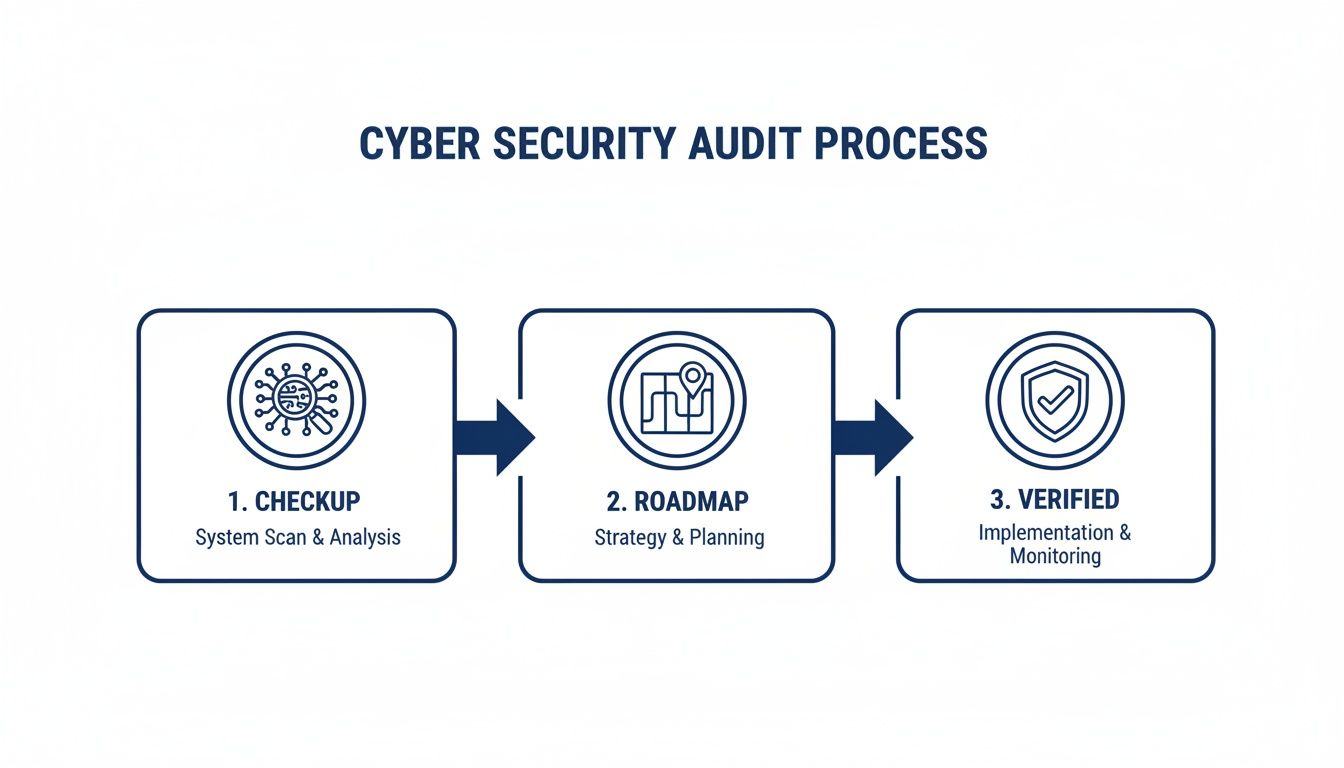
It clearly moves from discovery and planning to the final validation, making what can feel like a complex undertaking much more straightforward.
Phase 1: Scoping and Planning
Honestly, this first phase is the most important one for a successful audit. Think of it like drawing up the blueprint for a house; without a solid plan, the final structure is going to be shaky at best. This is where you and the auditor work together to define the audit’s boundaries and goals.
We need to answer some key questions right at the start:
- What systems are in scope? This could be anything from specific servers and cloud apps to the entire network.
- What’s the objective? Are we aiming for compliance with a specific standard like ISO 27001, or is this more of a general health check?
- Who are the key contacts? We need to identify the right people in your organisation who can answer questions and provide access. It makes everything run smoother.
Getting the scope right from the beginning prevents "scope creep"—where the audit unexpectedly expands, blowing out costs and timelines. A well-defined plan keeps the audit focused on the areas of highest risk and greatest importance to your business.
Phase 2: Fieldwork and Evidence Gathering
With the plan locked in, the auditors get to work. This is the "inspection" phase. They’ll actively test your security controls to see if they’re working as they should be. It’s not just about looking at documents; it involves hands-on verification.
During the fieldwork, auditors will:
- Interview key staff: They'll chat with your IT team, developers, and managers to really understand your processes.
- Review configurations: This means digging into firewall rules, server settings, and user access permissions to see how they're set up.
- Observe processes: They might watch how new employees are given system access or how your team handles a security incident.
Evidence is gathered meticulously to back up every single finding. This makes sure the final report is based on cold, hard facts—not opinions—giving us a credible foundation for what comes next.
Phase 3: Analysis and Reporting
Once the fieldwork is done, the auditors take all the evidence they’ve gathered and analyse it. They compare their findings against the criteria we established back in the planning phase, whether that’s a formal security framework or your own internal policies. The goal is to pinpoint the gaps between where your security is now and where it needs to be.
The main output here is the formal audit report.
This report is far more than just a list of problems. It’s a strategic document that prioritises risks based on their potential impact, giving you a clear roadmap for improvement.
Findings are usually categorised by severity—like Critical, High, Medium, or Low—so you know exactly where to focus your attention first.
Phase 4: Remediation and Follow-Up
The audit report isn’t the finish line; it’s the starting gun for making improvements. In this final phase, your team gets to work developing a plan to fix each vulnerability that was identified. This is where you turn the findings into concrete actions.
A good remediation plan needs to include:
- Specific actions to fix each finding.
- Assigned owners who are responsible for getting each task done.
- Realistic deadlines for completion.
After the fixes are in place, there’s often a follow-up verification. The auditor might come back to re-test the specific controls that failed, just to make sure the fix was effective and the vulnerability is well and truly closed. This final check confirms that your organisation’s security has genuinely improved as a direct result of the cyber security audit.
Understanding Key Audit Frameworks and Standards
A credible cyber security audit isn't built on guesswork or an auditor's personal preference. It follows a structured roadmap laid out by established frameworks and standards. Think of them as the official building codes for your digital security—they provide the blueprints for constructing a strong, compliant, and trustworthy defence.
For any New Zealand business, aligning with a recognised framework is a non-negotiable. It proves to customers, partners, and regulators that you're serious about security and are following globally accepted best practices. Picking the right one comes down to your industry, the kind of data you handle, and your specific business goals.
ISO 27001: The Global Gold Standard
The International Organization for Standardization (ISO) 27001 is one of the most well-known and respected security frameworks on the planet. Its core purpose is to provide a comprehensive model for establishing, implementing, maintaining, and continually improving an Information Security Management System (ISMS).
Getting an ISO 27001 certification isn't just a technical box-ticking exercise; it's a strategic business decision. It sends a clear signal to the market that your organisation manages information security with a structured, risk-based approach. It’s particularly valuable for businesses that handle sensitive data or want to operate in international markets where this certification is often a baseline expectation.
NIST: A Flexible Framework for Risk Management
Developed by the U.S. National Institute of Standards and Technology, the NIST Cybersecurity Framework (CSF) offers a more flexible and adaptable path. Instead of a rigid set of certifiable controls, it provides a voluntary framework that helps organisations of any size understand, manage, and reduce their cyber security risks.
The NIST CSF is structured around five core functions that are easy to understand:
- Identify: Know your assets, risks, and data flows.
- Protect: Implement the right safeguards to keep critical services running.
- Detect: Develop the activities needed to spot a cyber security event as it happens.
- Respond: Know exactly what actions to take once an incident is detected.
- Recover: Have a plan for resilience and restoring capabilities after an incident.
This practical structure makes it a fantastic tool for organisations to benchmark their capabilities and improve their security posture over time, without the formal overhead of certification. It's all about building genuine resilience, not just compliance.
The real value of a framework isn't just in passing an audit, but in its ability to foster a culture of proactive risk management. It forces organisations to not only implement controls but also to test and practice them, ensuring they actually work when a real incident occurs.
This is a critical point, especially as public sector organisations in New Zealand have been found to have significant gaps in this area. Many had underdeveloped incident response plans that were not sufficiently tested, leaving them unprepared for major attacks. You can discover more insights from the Office of the Auditor-General's report on cyber security.
Specialised Frameworks: SOC 2 and TPN
Beyond these broad frameworks, some standards are laser-focused on specific industries or business models.
SOC 2 (Service Organization Control 2) is absolutely essential for service providers that store or process client data in the cloud. Developed by the American Institute of Certified Public Accountants (AICPA), a SOC 2 audit report attests to the security, availability, processing integrity, confidentiality, and privacy of your customer data. It’s a must-have for SaaS companies and other cloud-based services.
For businesses in the media and entertainment supply chain, the Trusted Partner Network (TPN) provides specific security guidelines to protect valuable pre-release content from leaks and theft. If your work involves handling sensitive film or television assets, understanding the TPN assessment process is crucial for working with major studios. You can learn more about Wisely's TPN assessment services to see how these standards apply in a real-world production environment.
Preparing Your Business for a Successful Audit
The success of a cyber security audit is often decided long before the auditors even arrive. Getting organised beforehand transforms the audit from a stressful exam into a collaborative review, leading to a smoother process, lower costs, and far more valuable outcomes. When you get your house in order, security becomes a daily habit, not just an annual headache.
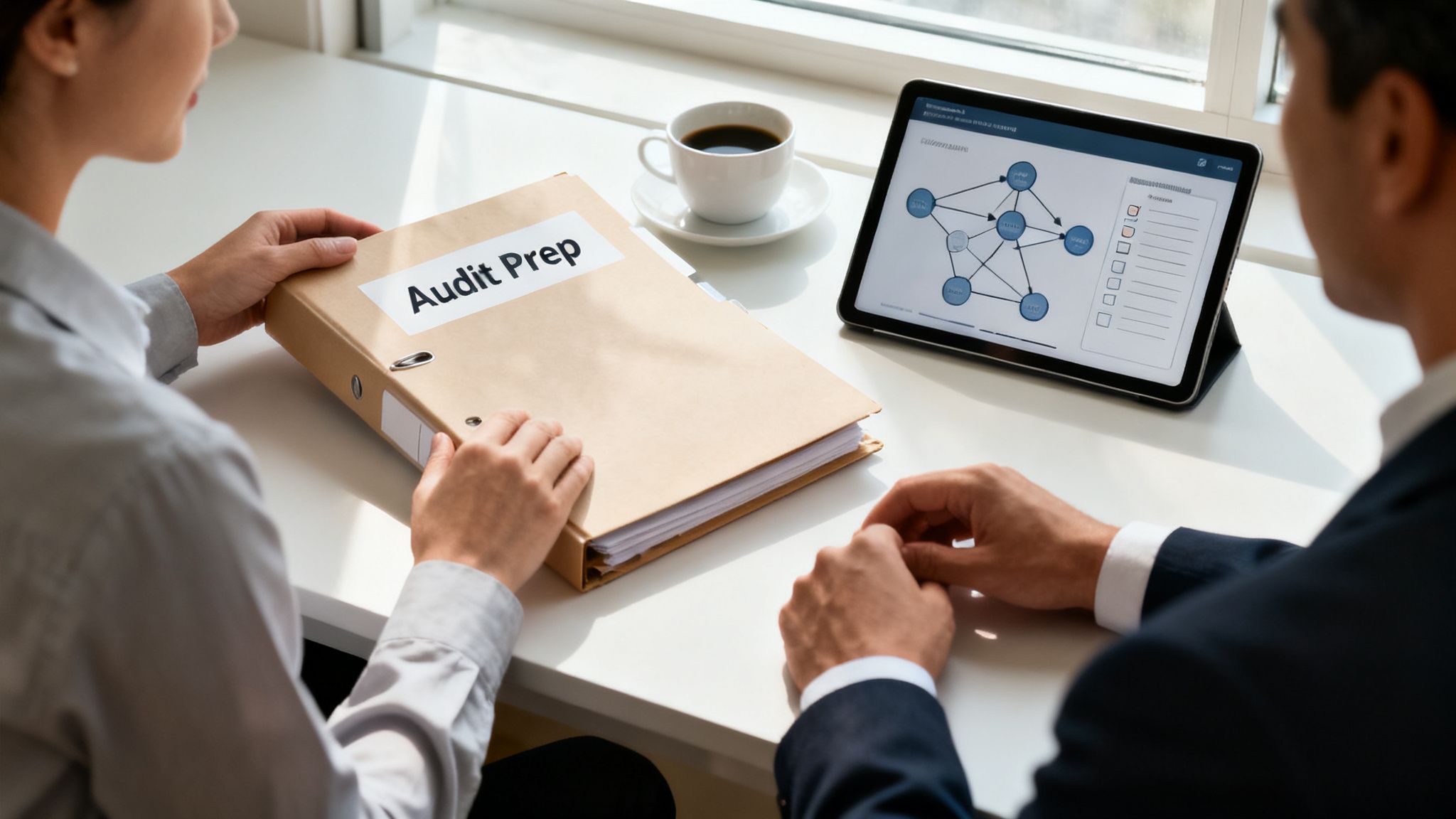
Think of it like getting your financial records together before meeting your accountant. The more organised you are, the more efficient the meeting. The same logic applies here; a business that's well-prepared gets a much better return on its audit investment.
Gather Your Key Documentation
Auditors run on evidence. One of the biggest time sinks in any audit is the frantic scramble to find requested documents. You can get way ahead of the game by creating a central repository of key information before the engagement kicks off.
Having this collection ready to go demonstrates maturity and streamlines the entire fieldwork phase, saving everyone time and frustration.
Your documentation checklist should include:
- Security Policies and Procedures: This includes your main information security policy, acceptable use policy, and your incident response plan.
- Network Diagrams: Up-to-date diagrams of your network architecture are essential, including any cloud environments.
- Asset Inventories: A complete list of all hardware, software, and data assets that fall within the audit's scope.
- Previous Audit Reports: Have any prior security audit or assessment reports handy, along with proof of how you fixed the findings.
- Compliance Records: Pull together any documents related to standards you adhere to, like the NZ Privacy Act or PCI DSS.
Identify Your Key People
An audit is a team sport. It’s vital to identify and brief the key people who will need to speak with the auditors. This avoids internal confusion and ensures auditors can get accurate information from the right person, fast.
Your team of "audit champions" will typically be drawn from different departments. Make sure to designate a single point of contact to coordinate all requests and schedule interviews. This creates one efficient channel for communication.
Key roles to assign include:
- IT and Security Staff: They'll handle the technical questions about network configuration, access controls, and system logs.
- Human Resources: HR can provide details on employee onboarding, offboarding processes, and security training records.
- Senior Management: They’ll need to discuss governance, your risk management strategy, and overall ownership of security. Using a cybersecurity risk assessment template can help formalise this, turning abstract concerns into a concrete plan.
Conduct a Self-Assessment
Before the external auditors walk through the door, do your own internal review. A self-assessment helps you find and fix the "low-hanging fruit"—obvious gaps you can close without waiting for an official finding. It’s a proactive step that can seriously reduce the number of issues in the final report.
Use the audit framework as your guide. If you're being audited against ISO 27001, for instance, walk through its controls and be honest about how well you're doing. This process doesn't just get you ready for the audit; it deepens your team’s understanding of your security controls.
A self-assessment turns your team from passive participants into active owners of the security process. It fosters a culture of continuous improvement and helps demystify the audit for everyone involved.
For example, you might find that your password policy isn’t being enforced consistently or that your employee offboarding checklist is being skipped. Fixing these issues beforehand shows a commitment to security and lets the formal audit focus on more complex, high-value areas. Foundational to all of this is effective staff cyber security training for NZ businesses, which ensures your people are your strongest defence.
Your Pre-Audit Readiness Checklist
To help you get organised, we've put together a simple checklist. Use this table to track your progress and ensure all your documentation, people, and systems are ready for inspection when the auditors arrive.
| Preparation Area | Key Actions | Status (To Do / In Progress / Complete) |
|---|---|---|
| Documentation | Gather all security policies, procedures, and incident response plans. | |
| Collect up-to-date network diagrams (including cloud). | ||
| Compile complete hardware, software, and data asset inventories. | ||
| Locate previous audit reports and remediation evidence. | ||
| Organise compliance-related records (e.g., Privacy Act, PCI DSS). | ||
| People | Identify the primary point of contact for the audit. | |
| Brief IT/Security, HR, and Management on their roles and responsibilities. | ||
| Schedule availability for key personnel for interviews. | ||
| Systems & Processes | Conduct an internal self-assessment against the audit framework. | |
| Identify and remediate any obvious gaps or "low-hanging fruit." | ||
| Review access controls to ensure they align with policies. | ||
| Confirm that logging and monitoring systems are active and collecting data. |
Ticking these boxes won't just make the audit smoother; it will strengthen your overall security posture and build confidence across the business.
Addressing Common Cyber Security Audit Findings
Instead of anxiously waiting for an auditor to point out your organisation's weaknesses, why not get on the front foot? You can anticipate and start fixing the most common issues long before the formal review kicks off.
This isn't about tackling obscure technical flaws. Many of the most frequent findings are actually foundational gaps in basic security hygiene. By focusing on these common pitfalls, you can make a real, tangible difference to your company's resilience and show auditors you take risk management seriously.
Weak Access Controls and Permissions
Time and time again, audit reports highlight a failure to enforce the principle of least privilege. This is what happens when employees gradually collect more access rights than they actually need to do their jobs, creating a security risk that’s just waiting to be exploited. Auditors consistently find user accounts with far too many permissions, generic shared admin accounts, and no process for regularly reviewing who has access to what.
The fix is to implement a strict role-based access control (RBAC) model.
- Assign permissions based on job function, not seniority. An employee’s access should be a direct match for their day-to-day responsibilities.
- Conduct quarterly access reviews. Make it a routine to verify that every user's permissions are still appropriate for their role.
- Enforce a strong password policy and multi-factor authentication (MFA). This is non-negotiable for adding a critical layer of defence against stolen credentials.
Proactive access management is a cornerstone of any mature security programme. It dramatically reduces your attack surface, ensuring that even if one account is compromised, the potential damage is contained.
Inconsistent Software Patching
Outdated software is basically an open invitation for attackers. It’s incredibly common for auditors to discover servers, workstations, and applications that are missing critical security patches—sometimes for months, or even years. This lag time leaves known vulnerabilities exposed and is one of the easiest ways for a breach to happen.
The solution is to establish a formal patch management process. This means regularly scanning your systems for missing updates, testing patches in a safe environment first, and then rolling them out according to a set schedule. Always prioritise the most critical vulnerabilities to close the most dangerous gaps first.
Underdeveloped Incident Response Plans
Many businesses have an incident response (IR) plan sitting in a folder somewhere, but auditors often find it’s untested, out of date, or completely unknown to key staff. A plan that has only ever existed on paper is unlikely to hold up during the chaos of a real crisis.
The fix here is simple: practice, practice, practice.
- Schedule regular IR drills. Run through different scenarios, like a ransomware attack or a major data breach, to see how your team responds.
- Update the plan after every exercise. Take what you’ve learned and use it to refine and improve your procedures.
- Ensure all stakeholders know their roles. Everyone from the IT team to the CEO needs to understand exactly what their responsibilities are when an incident occurs.
Lack of Employee Security Awareness
At the end of the day, your people are a critical line of defence. A very common audit finding is the complete absence of a consistent security awareness training programme. This leaves employees vulnerable to social engineering and phishing attacks. Data from New Zealand’s National Cyber Security Centre (NCSC) shows that phishing and credential harvesting incidents shot up by 15% in just one quarter, proving this human risk is as real as ever. You can explore the full quarter one cyber security insights for more detail on the current threat landscape.
Implement ongoing training that covers phishing detection, strong password habits, and the safe handling of sensitive data. The key is to make it engaging and directly relevant to your team's daily work. An informed team is a much stronger defence.
And if you have a nagging feeling that your defences have already been tested, it might be time to bring in the experts for penetration testing to uncover any hidden vulnerabilities before an attacker does.
How to Streamline Your Audit and Compliance Process
Trying to manage a cyber security audit with a tangled mess of spreadsheets, chaotic email threads, and documents scattered across different drives? It's a recipe for stress and a huge time sink. This old-school approach turns what should be a straightforward process into a frantic, reactive scramble.
Thankfully, there’s a much better way. Modern platforms can shift the audit from a dreaded annual fire drill into a smooth, continuous process that’s woven right into your team's daily work.
Imagine ditching all those disconnected files and instead running everything from a central hub like monday.com. This gives you a single source of truth for every single audit-related activity, from start to finish.
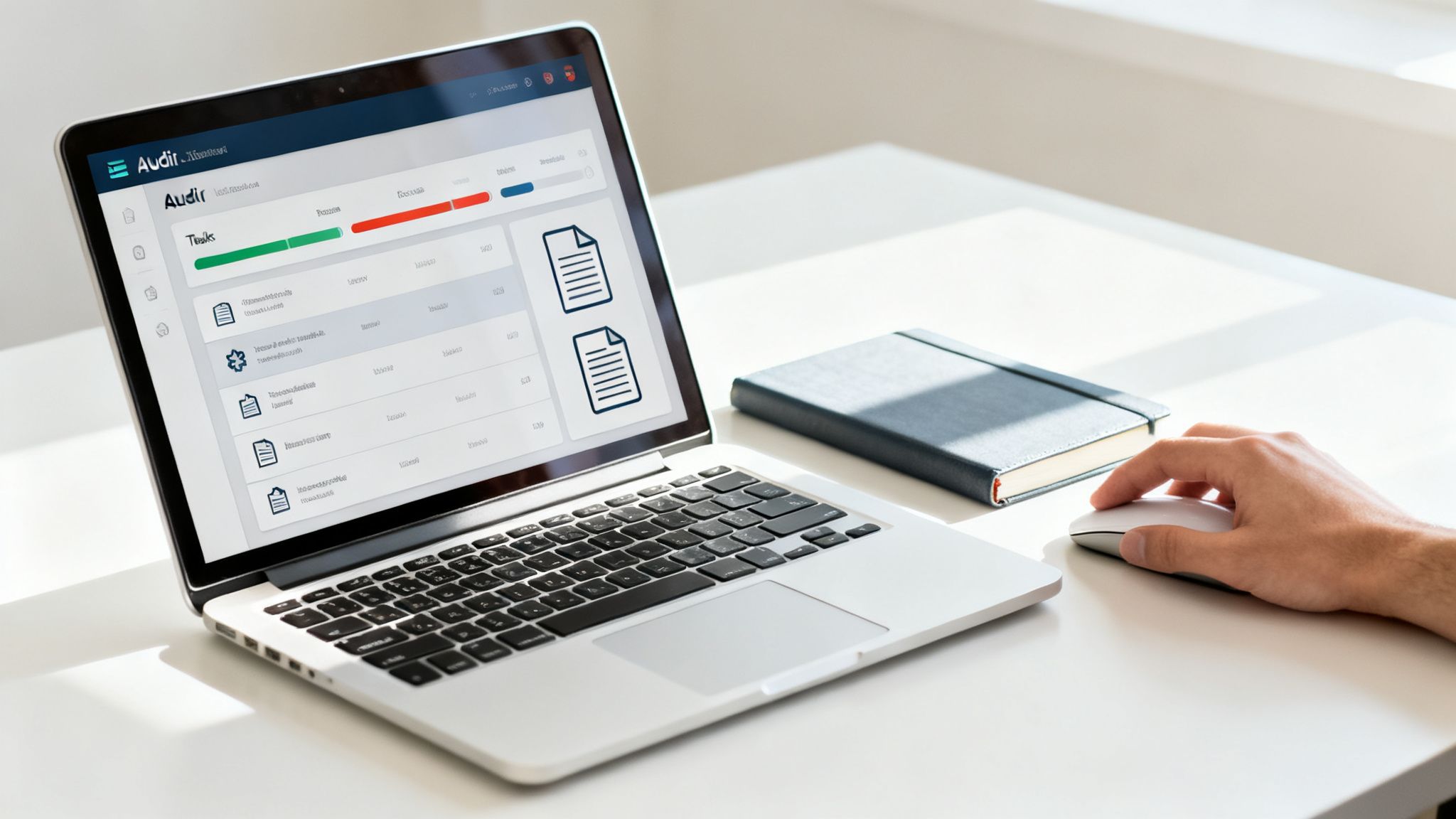
This approach immediately brings structure and clarity to every stage of the audit. Instead of spending hours chasing down information, everything you and your auditors need is organised and accessible in one place.
Creating an Audit Command Centre
A centralised system gives you complete visibility over the entire audit lifecycle. You can manage readiness tasks long before the auditors arrive, handle evidence requests in real-time, and assign remediation actions to specific people with clear deadlines. Live dashboards track progress, so there are no nasty surprises or last-minute panic.
The benefits are immediate and powerful:
- Clear Accountability: Every task, whether it's providing evidence or fixing a finding, is assigned to a specific person with a due date. Nothing falls through the cracks.
- Real-Time Visibility: Management gets an at-a-glance view of the audit’s progress, making it easy to spot bottlenecks before they become serious problems.
- Efficient Collaboration: You can give auditors guest access to request and review documents directly in the platform, killing off those endless back-and-forth email chains.
By digitising your audit workflow, you’re not just making the current audit easier. You’re also creating a permanent, auditable trail of all your security activities. This historical record is gold when it comes to demonstrating consistent compliance year after year.
Embedding Security into Daily Operations
The real game-changer is moving from periodic audits to a state of continuous compliance. Security stops being a separate, siloed function when your audit and security management processes are built into the same platform your teams use for their day-to-day work. It simply becomes part of the operational fabric of your business.
For example, when a new server is brought online, a task can be automatically created to ensure it’s configured to your security baseline. Or when an employee leaves the company, a workflow can instantly trigger a checklist to make sure all their access permissions are revoked.
This level of integration, powered by Wisely’s business process expertise, embeds security and compliance deep into your standard operating procedures. The result? You’re not just preparing for an audit once a year—you are audit-ready every single day.
Common Questions About Cyber Security Audits
Even after getting your head around the whole process, a few specific questions always pop up. Here are some straightforward answers to the queries we hear most often from New Zealand business owners.
How Often Should My Business Conduct an Audit?
For most businesses, an annual audit is a solid rule of thumb. It's the standard for a reason. But that’s not a hard and fast rule; certain situations will demand you get it done more often.
You’ll probably need to increase that frequency if:
- Your industry is heavily regulated, like finance or healthcare.
- You’ve recently dealt with a significant security incident.
- You've made major changes to your IT environment, like shifting everything to the cloud.
The best approach is to blend continuous internal checks with a formal, independent audit at least once a year. That’s how you maintain a genuinely strong security posture.
What Is the Typical Cost of an Audit?
The cost of a cyber security audit in New Zealand can vary wildly. It really depends on the scope, the complexity of your systems, and which specific compliance framework you're being assessed against.
A basic audit for a small business might start in the low thousands. A detailed assessment for a mid-sized company against a standard like SOC 2 will naturally be more. It’s critical to see this as an investment in managing risk. The potential cost of a data breach—in fines, reputational damage, and operational downtime—is almost always far higher than the proactive cost of an audit.
Can We Perform a Cyber Security Audit Ourselves?
While internal self-assessments are an excellent and highly recommended first step, a formal audit absolutely requires an independent, third-party expert.
An external auditor brings an objective, unbiased perspective that internal teams, by their very nature, can't. Their credibility, specialised knowledge, and impartial findings hold serious weight with customers, partners, and regulators, validating the true integrity of your security programme.
It’s this external validation that gives the final audit report its authority and trustworthiness.
Ready to move from guesswork to a verified security posture? Wisely provides managed cybersecurity and audit services that integrate seamlessly with your business operations, ensuring you're not just prepared for an audit, but protected year-round. Discover our approach at https://www.wiselyglobal.tech.