
How to Find the Right Monday Partner for Your Business
- 3 days ago
- 17 min read
A monday.com partner is a certified expert agency that helps businesses design, implement, and get the absolute most out of their monday.com workflows. They're far more than just tech support; they act as strategic consultants, helping you move beyond a simple DIY setup to build powerful, customised solutions that solve genuine business challenges and deliver a real return on your investment.
Why You Need a Monday Partner to Succeed
Getting started with monday.com is pretty easy. That's part of its appeal. But turning it into the central nervous system of your business—the single source of truth for all your operations—is a completely different ball game.
Far too many teams hit a ceiling with a do-it-yourself approach. Before they know it, they're drowning in cluttered boards, running inefficient automations, and fighting against low user adoption. This is exactly where a monday.com partner steps in. Think of them less as a technician and more as a strategic guide.
A partner's real job is to translate your unique business problems into efficient, scalable workflows inside the platform. They’ve seen what works (and what definitely doesn't) across hundreds of implementations. That hard-won experience helps you sidestep the common pitfalls that drain resources and kill project momentum before it even gets off the ground.
Moving From Generic Setups to Custom Solutions
Let's imagine a retail business struggling to manage its marketing campaigns. Without a partner, they might grab a generic project management template. This forces their creative, social media, and in-store teams into a rigid, one-size-fits-all process. The inevitable result? Confusion, missed deadlines, and inconsistent brand messaging across channels.
A seasoned monday.com partner would tackle this differently:
They'd analyse the entire campaign lifecycle, from the initial creative brief right through to the final signage being delivered to the stores.
They'd design interconnected boards, building one for creative development, another for the social media calendar, and a third for store-level execution—all seamlessly linked.
They'd build intelligent automations. For example, when a design is approved on the creative board, a new task is automatically created for the social media team and a notification is sent to the print supplier.
This creates a smooth, uninterrupted flow of information. Leadership gets crystal-clear visibility into campaign progress, and each team is empowered with a system that’s actually designed for how they work.
Or take a financial services firm needing to manage client onboarding. A generic setup is a huge risk, potentially leading to compliance breaches and a clunky, frustrating client experience. A partner can build secure, compliant processes with multi-step approvals, automated reminders for missing documentation, and dashboards that track every single stage of the client journey.
A certified monday.com partner doesn't just configure software. They re-engineer your processes for maximum efficiency, ensuring the platform adapts to your business, not the other way around.
Accelerating Your Return on Investment
The value of bringing in a monday.com partner goes way beyond the initial setup. They are genuinely invested in your long-term success, a partnership that's crucial in a rapidly growing market.
In New Zealand, for example, the demand for sophisticated CRM solutions is soaring. The market is projected to rocket from USD 698.5 million to an incredible USD 1,626.9 million by 2030. This growth is being driven by businesses in finance, retail, and healthcare who are all prioritising digital engagement. While large enterprises have historically led this charge, small and medium enterprises (SMEs) are now the fastest-growing segment, increasingly looking for partners who can deliver scalable, effective solutions.
By working with a partner, you tap into several key benefits:
Faster Implementation: They get it right the first time, dramatically shortening the time it takes to see tangible results from your investment.
Increased User Adoption: Partners are experts in change management. They provide targeted training that helps ensure your team actually uses—and loves—the new platform. You can find more tips on how to elevate team productivity with monday.com in our detailed guide.
Continuous Optimisation: A good partner provides ongoing support. They'll conduct regular health checks and help you introduce new features, evolving your setup as your business grows and your needs change.
Ultimately, a monday.com partner helps you unlock the platform's full potential, ensuring your investment delivers measurable improvements in productivity, visibility, and operational efficiency.
Your Vetting Checklist for Potential monday.com Partners
Choosing a monday.com partner is a big deal. The right one can genuinely act as a force multiplier for your business, while the wrong fit often leads to wasted time, blown budgets, and a system your team simply won’t use. Think of a systematic vetting process as your best defence against a charming sales pitch that lacks real substance.
This isn’t just about ticking boxes on a checklist. You're looking for a true strategic collaborator who understands your business challenges on a deep, practical level. It's vital to push past the surface-level promises and really dig into their track record, technical skills, and how they approach client relationships.
When you're building out your vetting process, it helps to apply the same principles you would for finding the right partner in any critical business area. A structured framework is what allows you to compare potential partners objectively and make a confident decision.
Assess Their Official Certification and Specialisations
First things first, check their official status in the monday.com ecosystem. The platform has a formal partner program with different tiers and specialisations that signal a partner's experience and expertise. An official certification isn't just nice to have; it's non-negotiable.
You should be looking for partners who hold an Advanced Delivery Partner status. This isn’t just a label; it signifies a high level of competency and a proven history of successful projects. What's more, monday.com now offers specialisations in key areas like CRM, AI, and Service. If you’re planning to roll out monday sales CRM, a partner with that specific specialisation has verified expertise and is far more likely to deliver a nuanced and effective solution.
A partner's official certification and specialisations are your first line of quality control. They demonstrate a real commitment to the platform and a validated level of skill, separating the serious experts from the casual consultants.
Scrutinise Industry and Process Experience
A partner might be a monday.com wizard, but if they don't get your industry's language, regulations, and operational headaches, their solution will almost certainly miss the mark. A one-size-fits-all approach is a massive red flag.
Ask them for specific, detailed examples of their work with businesses like yours. Don't just accept a logo on a presentation slide; ask them to walk you through a relevant case study, explaining the challenges and how they solved them.
For a marketing agency: How have you built systems for managing client retainers, creative approvals, and complex campaign reporting?
For a construction firm: Talk to us about your experience with project bidding, subcontractor management, and tracking on-site progress.
For a financial services company: What's your approach to building compliant client onboarding workflows and handling sensitive data securely?
Their ability to speak your language and reference familiar challenges is one of the strongest indicators of a good fit. This is the point where a partner’s expertise in building custom workflows really becomes invaluable.
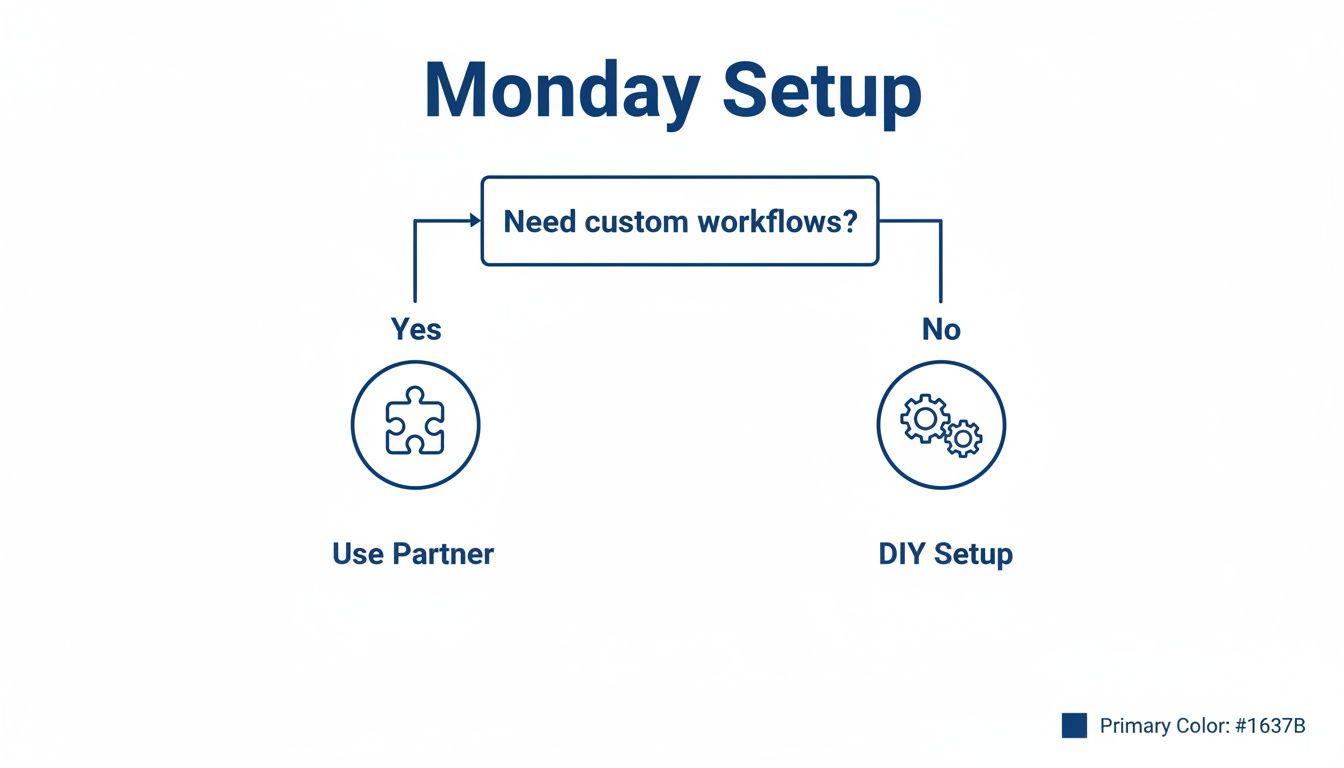
The flowchart makes it clear: if your needs go beyond basic task management and require truly tailored processes, bringing in a partner is the most effective way forward.
Evaluate Their Technical and Integration Skills
A great monday.com partner does far more than just set up boards. Their real value often comes from their technical depth, especially when it comes to connecting monday.com to the other critical tools in your tech stack.
You need to probe their technical capabilities:
Custom Integrations: Can they connect monday.com with your accounting software, ERP, or proprietary internal systems using APIs? Ask for specific examples of integrations they’ve built from scratch.
Data Migration: What is their process for moving data from your legacy systems into monday.com? A messy data migration can cripple a project right from the start.
Security Protocols: How do they approach data security and user permissions? This is particularly crucial if you operate in a regulated industry.
If a partner only talks about boards and automations but gets vague when you ask about integrations, they may not have the technical chops to build a truly unified system for your business.
Look for a Focus on Change Management
Finally, remember that the most perfectly designed platform in the world is useless if your team doesn't actually use it. A top-tier monday.com partner understands that technology is only half the battle. The other half is people.
During your conversations, pay close attention to how much they talk about user adoption and change management.
Do they have a structured plan for training your team?
How do they propose identifying and empowering internal "champions" to drive adoption?
What does their support look like after the project goes live?
A partner who is hyper-focused on the technical build but glosses over the human side of the implementation is a significant risk. You're not just buying a setup; you're investing in a business transformation, and that requires a partner who can guide your team through the entire journey.
To help you systematically evaluate your options, we've put together a simple checklist. Use this to score each potential partner against the same criteria, giving you a clear, objective way to compare them side-by-side.
Monday Partner Evaluation Checklist
Evaluation Criteria | What to Look For | Red Flags to Watch For |
|---|---|---|
Official Certification | Advanced Delivery Partner status. Relevant specialisations (CRM, AI, etc.). | No official certification listed. Vague about their partner level. |
Industry Experience | Specific case studies from your industry. They speak your business language. | Generic, one-size-fits-all examples. Can't reference similar challenges. |
Technical Skills | Proven experience with API integrations and data migration. Clear security protocols. | Avoids discussing integrations. Vague answers on data handling. |
Change Management | A structured plan for training and user adoption. A focus on post-launch support. | Focuses only on the technical setup. Glosses over the "people" aspect. |
Cultural Fit & Communication | Clear, direct communication. They listen more than they talk. | Overly salesy and pushy. Uses excessive jargon without explanation. |
Using a structured checklist like this ensures you move beyond gut feelings and make an informed decision based on the capabilities that will actually lead to a successful implementation and long-term value for your organisation.
Navigating the Engagement and Selection Process
You’ve done the research and now have a shortlist of potential partners. It's time to move from theory to reality. This stage is all about creating a structured, transparent process to see what working with each firm would actually feel like, letting you compare their proposals on a true apples-to-apples basis.
Think of it as a series of structured conversations. You're testing their expertise, their methodology, and their cultural fit. This is your chance to go deeper than the slick case studies on their website and understand exactly how they'd tackle your unique business challenges. A well-run selection process doesn't just find you the best monday.com partner; it sets the tone for a successful project from day one.
Kicking Off with a Discovery Call
That first discovery call is much more than a meet-and-greet. It’s a two-way interview, and you should be listening just as much as you're talking. A great partner will show up prepared, having already done their homework on your company. They'll ask sharp, insightful questions that cut to the heart of your operational pain points, not just tick off a list of requirements.
Pay close attention to how they steer the conversation. Are they trying to pigeonhole you into a pre-packaged solution, or are they genuinely curious about the nuances of your workflows? This first interaction is often the clearest signal of their collaborative style.
Key Questions to Ask Potential Partners
To cut through the sales pitch, you need to ask tough, specific questions. These are designed to reveal how a partner thinks, how they plan, and how they execute.
Have these questions ready:
Project Methodology: "Can you walk me through your typical project lifecycle, from initial discovery to post-launch support? What specific milestones and deliverables should we expect?"
Team Composition: "Who exactly will be on our project team? What are their specific roles, levels of monday.com certification, and direct experience in our industry?"
Change Management: "What’s your strategy for ensuring our team actually adopts and uses the new system? How do you handle training for different user groups?"
Post-Launch Support: "What does 'ongoing support' actually mean? Can you detail your service-level agreements (SLAs), support channels, and what’s included versus what costs extra?"
Their answers should be confident, detailed, and backed by real-world examples. If you get vague, hand-wavy responses, that’s a big red flag.
Understanding Different Pricing Models
One of the most confusing parts of this process can be deciphering the pricing. Proposals can look wildly different, so it's vital to understand the models they're built on to make a fair comparison.
Fixed-Scope Project: You get a set price for a clearly defined set of deliverables. This is ideal for projects with a very clear and stable scope, like setting up a specific CRM pipeline. The main benefit is budget predictability.
Time and Materials (Hourly): You pay an hourly or daily rate for the partner’s time. This model offers flexibility and is a great fit for complex projects where the scope might evolve. It just requires closer budget management to avoid surprises.
Ongoing Retainer: This is a recurring monthly fee for a set block of hours or ongoing support services. It’s perfect for businesses that need continuous optimisation, user support, and strategic guidance after the initial implementation.
There’s no single “best” model. The right choice depends entirely on your project's nature, your budget, and your long-term goals. A transparent partner will walk you through the pros and cons of each, recommending the structure that makes the most sense for you. To learn more about getting the most value from your partner, you can explore our insights on unlocking your team with a monday.com Platinum Partner.
A detailed, well-structured proposal should clearly outline the scope, deliverables, timeline, team, and costs. If a proposal feels vague or leaves too much room for interpretation, it’s a sign of potential problems down the road.
The Power of a Simplified RFP
For more complex projects, issuing a Request for Proposal (RFP) can formalise the whole process. An effective RFP doesn't need to be a hundred-page beast. Its real purpose is simple: give every potential partner the exact same information and questions so you get back proposals that are easy to compare side-by-side.
Your simplified RFP should include:
Company Overview: A brief intro to your business and what you do.
Project Goals: What are you trying to achieve? (e.g., "Improve project visibility," "Reduce manual data entry by 50%").
Current Challenges: What specific pain points are you trying to solve?
Scope of Work: The key processes or departments to be included.
Key Questions: Be sure to include the probing questions listed earlier.
Submission Deadline: A clear deadline for their response.
This structured approach forces you to be clear on your end and, in return, you'll get higher-quality, more comparable responses from potential partners. The impact of a well-chosen partner is obvious in success stories from across the ANZ region. Nutrition Warehouse, a leading sports nutrition retailer, used a partner to scale monday.com from one department to its entire support office and over 120 stores. This move unified complex campaigns that were previously stuck in email chains, allowing creative briefs to flow seamlessly into actionable tasks for every team. By running a diligent engagement process, you put your organisation in the best position to achieve similar results.
Driving a Successful Implementation and Adoption

Securing a great monday.com partner is a huge step, but it’s just the start. The real value is unlocked during implementation and adoption—this is where a technology project transforms into a genuine business improvement. A successful rollout hinges on meticulous planning and a deep focus on change management.
A tool is only as powerful as the team that uses it. Without a clear strategy to bring your people along for the ride, even the most perfectly designed system will struggle to gain traction. The goal is to move beyond a simple technical "go-live" and foster genuine enthusiasm and consistent use from day one.
The Go-Live Checklist Your Partner Should Manage
A top-tier partner will guide you through a structured go-live process. This isn’t about just flipping a switch; it’s a carefully orchestrated sequence of events designed to ensure a smooth transition and immediate value. Reviewing real-world examples, like this detailed partner launch case study, can provide practical lessons for a successful deployment.
Your partner’s checklist should cover several critical areas:
Clean Data Migration: Ensuring that data from legacy systems is accurately and cleanly imported into monday.com. This prevents the "garbage in, garbage out" problem that can kill user trust from the very beginning.
Role-Based User Training: Generic, one-size-fits-all training just doesn't cut it. The partner should deliver tailored sessions for different teams, focusing on the specific workflows and boards they will use daily.
Insightful Leadership Dashboards: Configuring high-level dashboards that give managers and executives the real-time visibility they need to make informed decisions.
Final User Acceptance Testing (UAT): A final run-through with a core group of users to catch any last-minute issues before the wider company rollout.
A great monday.com partner doesn't just build the system; they build the launchpad. Their expertise in managing the go-live process is critical for building momentum and ensuring the platform delivers on its promise from the moment it's introduced.
Driving User Adoption Is Everything
The single biggest factor determining the long-term success of your monday.com investment is user adoption. This is where your partner's change management skills become indispensable. They should work with you to create a proactive strategy that addresses the human side of the transition.
A strong adoption plan involves several key pillars, starting with clear communication. Your team needs to understand the "why" behind the change—how this new platform will make their specific jobs easier, reduce administrative headaches, and help achieve collective goals. This narrative is crucial for turning sceptics into supporters. You can learn more about what a comprehensive rollout entails by exploring our monday.com implementation services.
Empowering Champions and Building Support
Another core component is identifying and empowering internal champions. These are enthusiastic team members from various departments who can act as go-to resources for their colleagues. Your partner should help you spot these individuals and provide them with advanced training and support.
These champions become an essential, on-the-ground extension of the implementation team. They're invaluable for answering questions, sharing best practices, and maintaining positive momentum long after the initial launch.
Finally, establish clear and accessible ongoing support channels. Whether it’s a dedicated Slack channel, regular office hours with your partner, or a well-organised help centre within monday.com itself, your team needs to know exactly where to turn when they have questions.
Here’s what that support structure looks like in practice:
Identify Internal Champions: Select enthusiastic users from key departments to act as first-line support and advocates for the new system.
Communicate the 'Why': Clearly articulate the benefits for both the company and individual team members, connecting the platform to tangible improvements in their daily work.
Establish Support Channels: Create easy-to-access avenues for help, such as a dedicated help board in monday.com or scheduled drop-in sessions with your partner.
By focusing intently on the people and processes surrounding the technology, your monday.com partner helps ensure the platform becomes a deeply embedded and valued part of your organisation's culture.
Measuring ROI and Optimising for Long-Term Growth

Getting monday.com live in your business isn’t the finish line. Far from it. That’s actually where the real work—and the real value—begins. A solid implementation is the foundation, but the true test of success is how the platform evolves with your business, delivering compounding returns over time.
This is where the mindset has to shift from a one-off project to a cycle of continuous improvement. Your relationship with a monday.com partner should naturally transition from an implementation focus to a strategic collaboration. It becomes all about measuring what matters and proactively finding new ways to get more out of the platform.
Defining Your Key Performance Indicators
To properly measure success, you need to move beyond just gut feelings and anecdotal feedback. It’s absolutely essential to define a clear set of Key Performance Indicators (KPIs) that tie directly back to the business challenges you wanted to solve in the first place. A good partner will help you build dashboards to track these from day one.
These aren't just vanity metrics; they are the tangible proof of your return on investment.
Efficiency Gains: Track things like cycle time reduction for your core processes. For example, how long does it now take to move a new client from initial enquiry to fully onboarded compared to the old way of doing things?
Productivity Metrics: Keep an eye on task completion rates and on-time delivery percentages. A steady climb here is hard evidence that the platform is helping your team get more done, more effectively.
User Engagement: Watch user adoption trends closely. Are all your licensed users actually logging in and using the system? Are certain teams underutilising key features? Low engagement is an early warning sign that a workflow needs another look.
Data Accuracy: Measure the drop in manual data entry errors. You can quantify this by tracking the number of corrections or discrepancies flagged by your team each month.
These KPIs give you the hard data you need to show the platform’s value to leadership and justify any further investment in optimisation.
The goal is to create a data-driven feedback loop. By consistently tracking the right KPIs, you and your monday partner can move from guessing what’s working to knowing precisely where to focus your optimisation efforts.
The Power of Periodic Health Checks
Your business isn’t static, so why should your monday.com setup be? A critical part of any long-term partnership is conducting periodic health checks. Think of it like a regular service for your work OS, designed to keep everything running at peak performance.
During these sessions, your partner brings a fresh, expert set of eyes to your setup. They can often spot inefficiencies that you and your team have simply gotten used to over time.
A typical health check will uncover:
Workflow Bottlenecks: Identifying stages where tasks consistently get stuck, pointing to a process that needs to be re-engineered or could benefit from better automation.
Underused Features: Highlighting powerful features or recent platform updates that your team isn’t taking advantage of—a huge opportunity for quick wins.
New Optimisation Opportunities: As your business grows, your partner can suggest new workflows or integrations to support new service lines, products, or team structures.
For instance, a marketing agency might discover through a health check that their creative approval process is a major bottleneck. Their partner could then introduce a more sophisticated proofing and annotation app, instantly streamlining that workflow and cutting down revision cycles.
Building a Long-Term Optimisation Strategy
Ultimately, the goal is to foster a culture of continuous improvement, where your monday partner acts as a trusted strategic advisor. This ongoing relationship provides value that goes far beyond the initial build.
A long-term partnership ensures you're always getting the most out of the platform. This could mean advanced training for new team members, strategic advice on how to leverage new platform capabilities like AI, or evolving your workflows to match your company's big-picture goals. As monday.com introduces new partner specialisations in areas like AI and Service, having an established relationship with a certified expert gives you a direct line to cutting-edge solutions.
By collaborating with your partner for the long haul, you ensure your investment in monday.com is not a one-time expense, but a dynamic asset that grows and adapts with your business, delivering more and more value year after year.
Common Questions About Choosing a monday.com Partner
Even with the best plan in hand, some practical questions always come up when you’re on the verge of choosing a monday.com partner. Let's tackle some of the most common ones head-on to clear up any confusion and help you move forward with confidence.
How Much Does a monday.com Partner Cost?
There’s no simple answer here, because the cost is tied directly to what you need to achieve. The scope and complexity of your project are the biggest factors. A partner's engagement model also shapes the price, with options ranging from fixed-fee projects for clearly defined work to hourly rates or ongoing retainers for more dynamic, long-term support.
While it’s an upfront investment, the real metric to watch is the return. A great partner gets your implementation done right the first time, accelerates user adoption, and helps you sidestep the massive hidden costs of a poorly managed rollout—things like wasted time, tanking productivity, and having to pay someone else to fix it all later.
Can We Switch monday.com Partners If We’re Not Happy?
Yes, you absolutely can. If the relationship isn’t delivering the value you were promised, you have every right to make a change. A professional handover is key here. It should involve clear documentation of your current setup and a thorough knowledge transfer to the new partner to keep disruption to a minimum.
But honestly, prevention is the best strategy. If you put in the work upfront—using the vetting process and interview questions we’ve already covered—you dramatically reduce the odds of picking the wrong partner. It saves you the time, money, and operational headache of making a switch mid-project.
What’s the Difference Between a Partner and monday.com Support?
This is a critical distinction to make. Think of it like this: monday.com’s own support team is fantastic for technical, break-fix issues. If a feature isn’t working correctly or you’ve found a bug, they are your first port of call.
A monday.com partner, however, is a strategic business consultant. They aren’t just focused on the software; they’re focused on your business outcomes.
A partner’s role is to dig into your unique operational challenges and design customised solutions to solve them. They’re there to manage the entire change process, from workflow design and integrations to user training and long-term strategic improvements.
Do We Still Need a Partner If We Have an In-House IT Team?
Absolutely. In fact, some of the best results come from a collaboration between a company’s internal IT team and a specialised monday.com partner. Your in-house team holds priceless knowledge about your business systems, infrastructure, and internal politics. Nobody knows your setup better.
A certified partner brings a different kind of value: deep, specialised expertise on the monday.com platform. They’ve seen hundreds of implementations across dozens of industries and know what works—and what doesn’t. They can build more effective solutions, faster. This frees up your internal IT crew to focus on their core responsibilities, creating a powerful synergy that gets the best of both worlds.
At Wisely, we provide end-to-end services to ensure your monday.com platform drives real business growth, from initial implementation to long-term optimisation. Learn how our expert team can help you build a more efficient and connected organisation.
Comments