
IT Help for NZ Businesses A Guide to Proactive Tech Support
- Feb 11
- 14 min read
Updated: Feb 23
When you hear “IT help,” what’s the first thing that comes to mind? For most people, it’s the classic image of the ‘IT guy’ who only shows up when a laptop freezes or the printer throws a tantrum. This is the old way of thinking, seeing IT support as a purely reactive service—a friend with a wrench you call after the engine has already seized.
But for any growing business, that approach is a recipe for disaster. Relying on emergency fixes is like driving a race car without a pit crew. You might get by for a short while, but you’re not optimising performance, preventing wear and tear, or preparing for the hairpin turns ahead. It’s only a matter of time before a preventable issue takes you out of the race completely.
From Reactive Fixes to Proactive Strategy
Modern IT help isn't about waiting for things to break; it's about making sure they don't break in the first place. It functions like that professional pit crew, providing continuous monitoring, strategic adjustments, and fine-tuning every component to guarantee peak performance and reliability.
This proactive model brings together a few critical functions:
Preventative Maintenance: This means regularly updating systems, patching vulnerabilities, and keeping a watchful eye on network health to stop problems before they can disrupt your operations.
Robust Security: Instead of just cleaning up after a cyber-attack, it’s about building multi-layered defences to protect your valuable data from the constant threat of cyber criminals.
Strategic Planning: This is where technology decisions are aligned with your business goals, ensuring every new tool or system directly contributes to your efficiency, scalability, and bottom line.
This shift in mindset from reactive to proactive is crucial, but it’s a jump many businesses haven't made yet. A surprising 42% of New Zealand SMEs still turn to an informal ‘IT-savvy staff member’ as their first port of call for tech issues. This almost always leads to lost productivity and, even worse, accidental misconfigurations that create bigger problems down the line.
The table below breaks down the real difference between relying on your internal 'tech person' versus bringing in a professional partner.
Ad-Hoc Fixes vs Strategic IT Help
Aspect | Informal 'IT-Savvy' Employee | Professional IT Help Provider |
|---|---|---|
Focus | Reactive (fixes things when broken) | Proactive (prevents issues from happening) |
Cost | Hidden (lost productivity, opportunity cost) | Predictable (fixed monthly fee) |
Expertise | Limited to personal knowledge | Broad team with diverse specialisations |
Security | Basic, often an afterthought | Comprehensive, multi-layered, and strategic |
Availability | During work hours, if not busy | 24/7 monitoring and support |
Strategy | None; focused on immediate problems | Aligns technology with long-term business goals |
Relying on informal help might seem cheaper on the surface, but the hidden costs in downtime and security risks can be staggering. A professional provider offers the structure and strategy needed for sustainable growth.
An Integrated Approach to Business Growth
The most effective form of IT help today goes one step further, integrating technology management with business process automation. Imagine your IT partner not only keeping your systems running smoothly but also helping you connect your sales CRM to your financial software, creating seamless workflows that save countless hours and eliminate human error. To truly move beyond simple fixes, modern IT help must involve strategic planning and comprehensive solutions, a concept well-explored in resources like the Nonprofit IT Support Guide.
This integrated model transforms technology from a necessary expense into a strategic asset. It’s the foundation for scalable growth, providing the stability and efficiency needed to compete and thrive. By preventing problems before they start, you empower your team to focus on what they do best.
The Core Services Your Business Needs From IT Help
Good IT help isn't just one thing. It's a combination of specialised functions working together to protect your business and help it grow. Once you understand these core pillars, you can see where your current support might be falling short and what a truly strategic partnership can offer.
Think of these services as the foundation for both day-to-day stability and future growth.
This infographic nails the fundamental shift in IT support, moving away from simple fixes and towards proactive, long-term strategy.
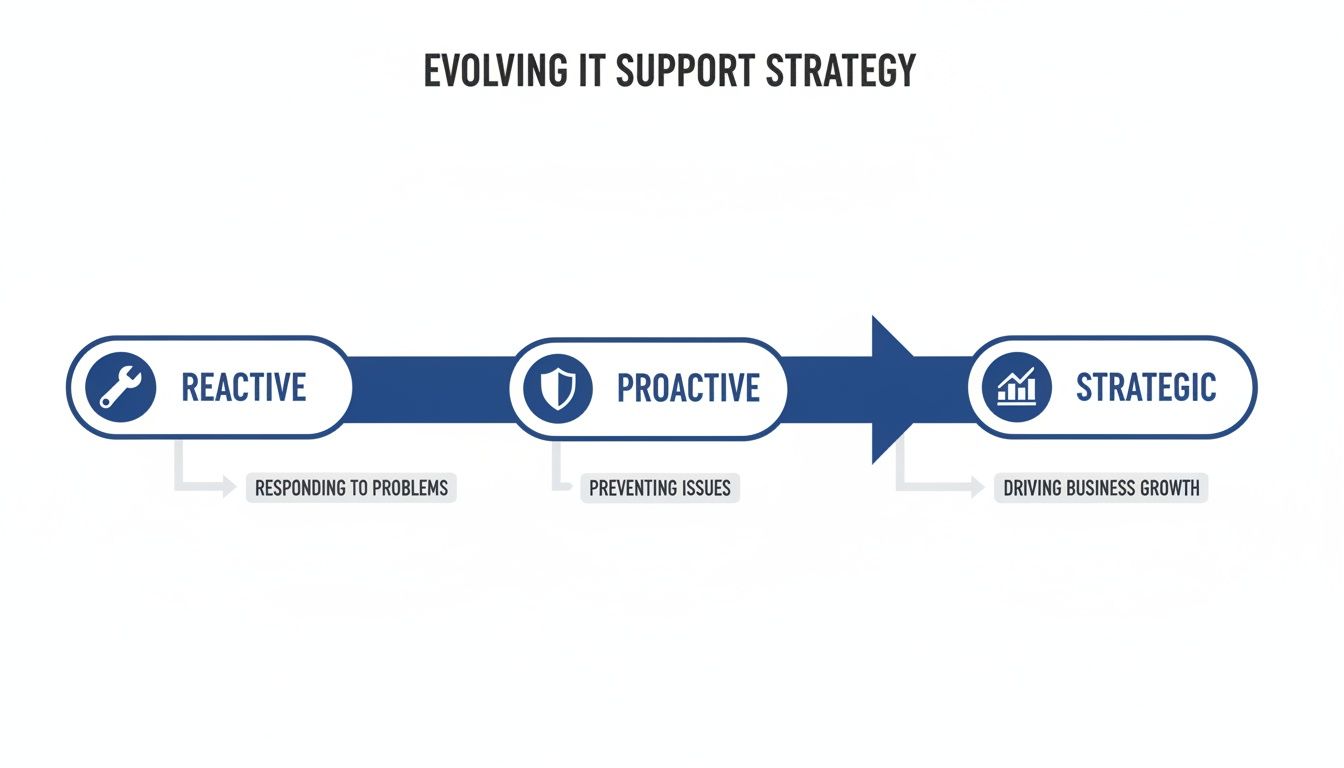
The key takeaway? Modern IT has evolved beyond just reacting to problems. The focus is now on preventing issues before they happen and aligning technology with your core business goals.
Managed IT Services
Imagine having a full-time property manager for your business's entire technology estate. That’s Managed IT Services. Instead of waiting for a pipe to burst (a server crash) or a window to break (a software glitch), this service provides constant oversight, maintenance, and fine-tuning. Its main goal is to keep your whole tech infrastructure running smoothly and reliably, day in and day out.
This proactive approach stops tiny issues from spiralling into major disruptions. A managed service provider will monitor your network for unusual traffic, apply security patches before vulnerabilities can be exploited, and manage your data backups to keep the business running no matter what. They handle the essential but time-consuming tasks that are the lifeblood of your operations.
To get a better handle on this, check out our guide to managed IT services for New Zealand businesses.
Cybersecurity Defence
In today's world, relying on basic antivirus software is like putting a simple padlock on a bank vault. Proper cybersecurity is a multi-layered defence system designed to protect your most valuable asset: your data. It’s a constant, active shield against an ever-growing list of threats, from convincing phishing scams to crippling ransomware attacks.
A strong cybersecurity posture isn't just one tool; it's several critical components working in concert:
Endpoint Protection: Securing every single device connected to your network—laptops, servers, and even mobile phones.
Network Security: Using advanced firewalls and monitoring tools to block unauthorised access to your internal systems.
Employee Training: Teaching your team to spot and avoid common threats like phishing emails, which are the entry point for over 90% of successful cyberattacks.
Incident Response Planning: Having a clear, actionable plan for what to do if a breach occurs, minimising damage and getting you back on your feet quickly.
Without this comprehensive protection, a single security incident can cause devastating financial loss, damage your reputation, and bring your operations to a standstill.
Cloud Solutions
Cloud solutions offer the flexibility and scalability that modern Kiwi businesses need to compete. Instead of buying and maintaining expensive physical servers on-site, you can use powerful, secure, and cost-effective infrastructure hosted by major providers. This is about more than just data storage; it’s about enabling a more agile and collaborative way of working.
For a growing business, the cloud means you can scale your resources up or down on demand, paying only for what you use. It empowers your team to access critical data and applications securely from anywhere, which is essential for supporting remote and hybrid work models.
This flexibility allows you to adapt quickly to market changes without being held back by rigid, outdated hardware. It’s the engine that powers a resilient, modern workforce.
Platform Integration
So many businesses are running on a collection of powerful but completely disconnected software tools. You’ve got a CRM for sales, an accounting platform for finance, and a project management tool for your operations team, none of which talk to each other. Platform Integration is the art of connecting these separate systems so they can share data automatically.
This service transforms isolated data silos into a single, intelligent workflow. When your CRM automatically syncs new sales data with your financial software, you eliminate hours of manual data entry, reduce human error, and give your leadership a real-time view of business performance.
This is where great IT help directly translates into better operational efficiency and smarter decision-making, turning your collection of software into a genuine strategic advantage.
Recognising the Signs You Need Professional IT Help
Waiting for a full-blown technology crisis before seeking professional IT help is a common but incredibly costly mistake. It’s like ignoring that persistent rattle in your car’s engine until it breaks down on the motorway during peak traffic. Proactive businesses, however, learn to spot the subtle warning signs that their current IT support—or lack thereof—is no longer cutting it.
These signals often start small but can quickly spiral into major operational headaches. Understanding them is the first step toward diagnosing your company’s IT health and sidestepping preventable disasters.

Frequent Downtime and Slow Performance
One of the most glaring red flags is recurring downtime. If your sales team constantly loses access to their CRM during crucial end-of-quarter reporting or your entire network slows to a crawl every afternoon, you have a productivity problem disguised as a tech issue. These aren't just minor annoyances; they are symptoms of an unstable or overloaded IT infrastructure.
These performance bottlenecks directly hit your bottom line. Every minute your team spends waiting for a slow system or rebooting a frozen computer is a minute they aren't serving clients or driving revenue. That lost time adds up far quicker than most business leaders realise.
In fact, the bigger picture of wasted time is staggering. New Zealanders collectively lost 24 million hours waiting to resolve service issues, highlighting a massive inefficiency that modern IT help can dramatically improve.
Rising Cybersecurity Concerns
Are you noticing more suspicious emails landing in your team's inboxes? Have employees mentioned unusual pop-ups or strange account activity? These are clear signs that your cybersecurity defences are being tested—and potentially failing. Relying on basic antivirus software is simply no longer enough to protect against sophisticated phishing attacks and ransomware threats.
A lack of professional oversight leaves your sensitive business and client data dangerously exposed. The fallout from a breach goes far beyond financial loss, often leading to severe reputational damage that can take years to repair.
If your team is spending more time questioning the legitimacy of emails than doing their actual jobs, it’s a strong signal that you need a more robust, proactive security strategy. Ignoring these early warnings is a gamble few businesses can afford to take.
Inefficient Support for a Growing Team
As your business expands, so do its technological complexities. What worked for a team of five in a single office quickly becomes unmanageable for a team of 20 spread across multiple locations or working remotely. If "Why Is My VPN Not Working?" becomes a frequent question, a guide for troubleshooting a VPN might offer a temporary fix, but it also points to a much larger, systemic problem.
Without a centralised and professional IT help system, you create inconsistency and risk. Common signs of this strain include:
Delayed Onboarding: New hires wait days for proper system access and equipment setup, slowing down their ability to become productive.
Inconsistent Fixes: Different employees get conflicting advice for the same problem, leading to confusion and recurring issues.
No Strategic Oversight: Technology decisions are made in silos without a clear plan, resulting in incompatible software and wasted investment.
Recognising these pain points early is crucial. The right support model ensures your technology can scale with your ambitions. To explore different approaches, check out our guide covering small business IT support options in NZ.
Choosing the Right IT Partner for Your Business
Picking the right provider for your IT help is one of the biggest decisions a growing business can make. This isn’t just about finding someone to fix laptops when they break; it's about bringing on a strategic partner who gets what you’re trying to build and knows how to use technology to get you there. It’s a choice that goes way beyond comparing monthly fees.
The best IT partners slot right into your team. They put in the effort to learn your industry, understand the specific roadblocks you face every day, and make sure their services are pushing your long-term goals forward. Get this wrong, and you’re looking at wasted money, constant friction, and tech that holds you back instead of giving you an edge.
Proactive Strategy Versus Reactive Fixes
One of the first things you need to figure out is the provider’s core philosophy. Are they a reactive, break-fix service that only answers the phone when a server is smoking? Or do they have a proactive model, focused on stopping problems before they ever have a chance to mess up your day?
A reactive team is a cost centre, plain and simple. A proactive one is an investment in stability and growth.
When you’re talking to potential partners, hit them with direct questions about how they operate:
How do you actually monitor our systems to prevent downtime?
What’s your process for keeping security patches and software up to date?
Can you give me a real-world example of how you helped a business like mine improve its efficiency?
Their answers will tell you everything you need to know. You’ll quickly see whether they’re just another helpdesk or a genuine strategic ally who will deliver far more value over time.
Evaluating Technical Expertise and Industry Experience
Let’s be clear: not all IT help is the same. A provider who’s brilliant at supporting retail stores might have no idea about the unique compliance and security headaches of a financial services firm. You need a partner with proven, hands-on experience in your specific industry.
That kind of specialised knowledge is gold. It means they’ll already be familiar with the core software you depend on, the regulations you have to follow, and the common challenges you’re up against. This translates to faster solutions, advice that actually makes sense for you, and tech that’s truly fit for purpose.
Don't be shy about asking for case studies or references from businesses in your field. Their experience with your essential tools, from your CRM to your accounting software, is non-negotiable. For a deeper look into this process, our ultimate guide to IT consulting services offers additional insights.
Finding the Right Fit for Your Business Model
The IT support world isn't one-size-fits-all. There are a few different models out there, and knowing the difference will help you find the right match for your company's size, budget, and ambitions.
To make sense of it all, here's a quick breakdown of the most common types of IT providers and who they're best for.
Types of IT Providers: A Quick Comparison
Provider Type | Best For | Typical Service Model | Strategic Value |
|---|---|---|---|
Break-Fix Shops | Micro-businesses with minimal IT needs and high risk tolerance. | Pay-per-incident; you call when something breaks. | Very low; focused only on immediate problem resolution. |
In-House IT | Larger companies that require constant, dedicated on-site support. | Full-time salaried employees. | High, but comes with significant overheads and skill gaps. |
Managed Services (MSP) | SMEs seeking proactive, predictable, and scalable support. | Fixed monthly fee for comprehensive monitoring and support. | High; aligns technology with business goals for a predictable cost. |
Specialist Consultants | Businesses needing expert advice for a specific project. | Project-based fees. | High for specific needs but not for ongoing operational support. |
For most small and mid-sized businesses here in New Zealand, a Managed Service Provider (MSP) hits the sweet spot, offering deep expertise, proactive management, and predictable costs without the massive overhead of an in-house team.
Choosing a partner is ultimately about trust and alignment. The right provider won't just solve your tech problems—they'll give you the confidence and stability to focus on what you do best: growing your business. They ensure your technology decisions directly support your primary objectives for efficiency and profitability.
The Tangible ROI of Strategic IT Help
It’s easy to look at professional IT help as just another line item on the expense sheet. But that’s a critical mistake. Good, strategic IT support isn't a cost centre—it's one of the most powerful drivers of profitability you can have. When you shift your thinking from just fixing what's broken to proactively managing your technology, the return on investment (ROI) becomes clear, measurable, and genuinely impactful.
The real value comes from connecting the dots between a stable, secure IT environment and a healthier bottom line. It’s about transforming technology from a background utility into a strategic asset that actively fuels your company's growth.

Boosting Productivity and Slashing Downtime
One of the first returns you’ll notice is a jump in employee productivity. When systems are fast, reliable, and secure, your team can get on with their actual jobs instead of being constantly derailed by tech glitches. Think about it: a sales team that never loses access to their CRM during peak hours, or a finance team that can pull real-time data without waiting on a sluggish server. That’s real time and money saved.
This efficiency gain is supercharged by the dramatic reduction in downtime. Unplanned outages don't just stop work; they kill deals, erode client trust, and put a direct dent in your revenue. Proactive IT management sidesteps these disruptions, keeping your operations continuous and your team productive. Every single hour of avoided downtime is money back in your pocket and an opportunity you didn't miss.
Strengthening Security and Enabling Growth
A less obvious, but equally critical, ROI comes from rock-solid data security. A single data breach can spiral into devastating financial penalties, lasting reputational damage, and a loss of customer confidence that is incredibly difficult to win back.
Strategic IT help builds a robust defensive posture that protects your most valuable assets. This isn't just about avoiding disaster; it's about building the secure foundation necessary for confident growth and scalability.
This forward-thinking approach is becoming non-negotiable, especially as New Zealand's IT services market is projected to expand from NZ$7.12 billion to NZ$8.52 billion by 2029. As more businesses go digital, the ones with secure and scalable systems will be perfectly positioned to ride that wave. You can get more details on these NZ IT market trends and what they mean for your business.
From Theory to Reality: Practical ROI Examples
The benefits of quality IT help aren't just theoretical. They show up in day-to-day business operations, driving real-world improvements you can see and measure.
Here’s what this looks like in action:
Sales Cycle Acceleration: By integrating a CRM with marketing automation tools, a sales team can shorten its sales cycle. This lets them close deals faster and boost quarterly revenue without having to hire more people.
Improved Financial Forecasting: A finance team gets real-time data visibility by connecting their accounting software with operational platforms. This leads to more accurate budgeting, better cash flow management, and smarter strategic planning.
Enhanced Client Service: A support team uses an integrated ticketing system to resolve client issues 30% faster. This directly lifts customer satisfaction and retention, contributing to long-term business stability.
Ultimately, strategic IT help pays for itself by making your entire organisation more efficient, secure, and resilient. It’s an investment that delivers compounding returns, setting your company up for a stronger, more profitable future.
We Get These Questions a Lot About IT Help
Stepping up to professional IT support is a big move, and it's natural to have questions. For business owners in New Zealand, getting straight answers is key to understanding the real value and what the process actually involves. We've put together the most common queries we hear to give you the clarity you need to make a confident decision.
Choosing the right partner starts with clearing up a few myths and getting a handle on how a strategic relationship should work. Let's tackle the concerns that business leaders bring up most often when they're thinking about upgrading their IT support.
Isn't Outsourced IT Help Too Expensive for a Small Business?
While it's definitely an investment, professional IT help is almost always more cost-effective than hiring an in-house team or, worse, absorbing the massive costs of downtime and security breaches. Managed services, for example, give you a predictable monthly fee. This makes budgeting a breeze and kills the risk of surprise bills when systems inevitably fail.
When you weigh that predictable expense against the lost revenue from even a single day of system failure—or the potentially crippling financial damage from a cyberattack—proactive IT support delivers a clear, long-term return. It’s about shifting your mindset from seeing IT as a cost centre to seeing it as an investment in your operational stability.
We’re Not a Tech Company, Do We Really Need Advanced IT Help?
Absolutely. These days, almost every company is a technology company at its core, no matter the industry. Whether you're in finance, media, or manufacturing, your entire business runs on technology for communication, managing data, and delivering services to your clients.
Professional IT help makes sure those essential tools are secure, reliable, and efficient. This lets you focus completely on your main business goals without being dragged down by technical dramas you shouldn't have to worry about. It’s about enabling your core business, not just babysitting computers.
The real goal is to make technology an invisible, seamless engine for your operations. When your IT just works, your team is empowered to perform at its best, focusing on innovation and client satisfaction instead of troubleshooting.
How Does Professional IT Help Work With Our Existing Tools?
A huge part of a modern IT partner’s job is to make your entire technology stack play nicely together. This isn't about ripping out everything you use and starting from scratch; it's about making your current tools more powerful by connecting them properly.
This involves expert implementation and custom integrations between your different software platforms, like hooking up your accounting system to your CRM. By building these bridges, you can automate workflows, slash manual data entry, and get rid of costly errors. This process turns your separate tools into a unified, efficient system that gives your leadership the real-time data needed for smarter decision-making.
What Does the Onboarding Process Look Like?
A well-structured onboarding process is designed to be a smooth and minimally disruptive transition to your new IT provider. Think of it as a carefully managed project with clear stages to get you up and running effectively.
The typical process breaks down like this:
Deep Discovery: First, we do a thorough assessment to get a complete picture of your current systems, workflows, and specific business needs.
Customised Planning: Based on what we find, we create a tailored service plan designed to tackle your unique challenges and help you hit your goals.
Managed Migration: We then execute a carefully planned migration of your data and systems, all managed to minimise any impact on your day-to-day operations.
Team Training and Support: The process wraps up with proper training for your employees and the launch of ongoing support, ensuring you get maximum value from day one.
At Wisely, we design and implement unified solutions that connect your people, processes, and technology. From managed IT and cybersecurity to business process automation powered by monday.com, we help you eliminate inefficiency and gain the visibility needed to grow. Discover how our strategic approach can strengthen your operations and drive measurable productivity gains. Learn more about our services.
Comments