Think of cloud IT services like your business's electricity supply. You don't build your own power plant to keep the lights on; you just plug into the grid and pay for what you use. That’s exactly how the cloud works for your technology.
What Are Cloud IT Services and Why Do They Matter?
Instead of buying and maintaining your own expensive servers, software, and databases on-site, you’re essentially renting them from a specialised provider over the internet. This completely changes the game for your IT budget, shifting it from huge, one-off capital expenses to predictable, scalable operational costs. You only pay for the resources you actually consume.
This isn't just a technical tweak; it's a fundamental change in how businesses operate. Forget the hassle of finding physical space, managing power and cooling, and dealing with constant hardware maintenance. With cloud IT services, you access enterprise-grade infrastructure hosted in highly secure, massive data centres. All your team needs is an internet connection, making it the perfect foundation for remote work, global collaboration, and rapid business growth.
A Strategic Move for NZ Businesses
For New Zealand businesses, embracing the cloud is a powerful strategic move. It levels the playing field, giving small and mid-sized companies access to the kind of powerful, resilient technology that was once only affordable for the big players.
It's about unlocking some serious operational advantages:
- Enhanced Agility: Need more computing power for a big product launch or a seasonal rush? You can scale up your resources in minutes, not weeks. Once the rush is over, you can scale back down just as easily.
- Improved Collaboration: When your data and applications live in one central, secure place, your team can work together seamlessly. It doesn't matter if they're in Auckland, Wellington, or working from a home office.
- Greater Resilience: Top-tier cloud providers have incredible backup and disaster recovery systems built-in. This means that even if something happens to your physical office, your business keeps running without a hitch.
By shifting your technology management to the experts, you free up your team to stop worrying about just "keeping the lights on." Instead, they can focus their energy on what they do best: driving innovation and growing your business.
Ultimately, getting on board with cloud IT services helps you build a more efficient, flexible, and future-proof operation. If you want to dig a bit deeper into the basics, this guide on cloud hosting explained is a great read. When done right, the cloud becomes the backbone of a business ready for whatever comes next.
You can learn more about the different facets of cloud computing and how they can be tailored to your specific needs.
Exploring the Main Types of Cloud Services
When you start digging into cloud IT services, you'll quickly find they aren't a one-size-fits-all solution. Think of it like getting power to your house; you can have a simple connection to the grid, or you could install solar panels and a battery system. Each option gives you a different level of control and responsibility.
The same goes for the cloud. The key is understanding the different models so you can pick the one that truly fits what your business needs. To make this a bit easier, let's use a simple analogy: ordering pizza for the team.
Infrastructure as a Service (IaaS): The DIY Pizza Night
Infrastructure as a Service (IaaS) is like renting a professional, fully-stocked kitchen. The cloud provider gives you the foundational stuff—the oven, the benchtops, the gas, the electricity. But it's on you to bring the ingredients, the recipe, and the chefs. You have total control over what you make and how you make it.
In the tech world, this translates to renting the raw computing building blocks. You get access to servers, networking, and data storage on demand. From there, your team has a blank canvas to build and run whatever they need, whether that’s a custom application or a heavy-duty data processing system.
IaaS is the go-to for businesses with very specific technical demands.
- A Wellington-based post-production studio could tap into IaaS to get immense processing power for rendering 4K video, scaling resources up for a big film project and then dropping them back down to keep costs low.
- A tech startup can use IaaS to build and test its new software without the eye-watering upfront expense of buying and housing their own physical servers.
This model offers the ultimate flexibility, but it also demands the most in-house technical expertise to manage everything properly.
Platform as a Service (PaaS): The Gourmet "Take and Bake" Kit
Platform as a Service (PaaS) is a bit like getting one of those gourmet "take and bake" pizza kits. The box comes with the pre-made dough, the sauce, the cheese, and all the toppings. You don't have to worry about the hassle of making dough from scratch or managing a kitchen, but you still get to assemble the pizza your way before you pop it in the oven.
With PaaS, the cloud provider handles all the underlying infrastructure—the servers, storage, and operating systems. On top of that, they provide a complete platform with tools for developing, testing, and deploying your own applications. This frees up your developers to focus purely on writing brilliant code and building software, rather than getting bogged down with server patching and maintenance.
PaaS is a fantastic choice for businesses wanting to create their own applications without the operational overhead. An Auckland logistics company, for example, could use a PaaS environment to rapidly build a custom app for tracking its delivery fleet in real-time.
Software as a Service (SaaS): The "Hot Pizza Delivered" Experience
Finally, we have Software as a Service (SaaS). This is the simplest option of all—it's like having a hot, delicious pizza delivered right to your office door. You don't have to cook, assemble, or clean up anything. You just open the box and enjoy.
This is by far the most common cloud service model you'll encounter. Anytime you use tools like Microsoft 365, Xero for your accounting, or a work management platform like monday.com, you're using SaaS. The software is completely ready to go, accessed over the internet, and managed entirely by the vendor. That includes all the updates, security patches, and maintenance. It's a straightforward subscription that gives you immediate access to powerful tools.
Cloud Service Models at a Glance
To bring it all together, here’s a simple breakdown of who manages what in each model.
| Service Model | What You Manage | What the Provider Manages | Common Use Case |
|---|---|---|---|
| IaaS (Infrastructure as a Service) | Applications, Data, Runtime, Middleware, OS | Virtualisation, Servers, Storage, Networking | Hosting custom apps, big data processing |
| PaaS (Platform as a Service) | Applications, Data | Runtime, Middleware, OS, Virtualisation, Servers, Storage, Networking | Software development and deployment |
| SaaS (Software as a Service) | Nothing—just use the software! | Applications, Data, Runtime, Middleware, OS, Virtualisation, Servers, etc. | Email, CRM, accounting, project management |
As you can see, the further down the list you go, the less you have to manage yourself, allowing you to focus more on running your business and less on running your IT.
Public, Private, or Hybrid? Choosing Your Environment
Beyond the type of service, you also have to decide where it will live. The diagram below shows how these cloud services move responsibility away from your team compared to a traditional, on-site IT setup.
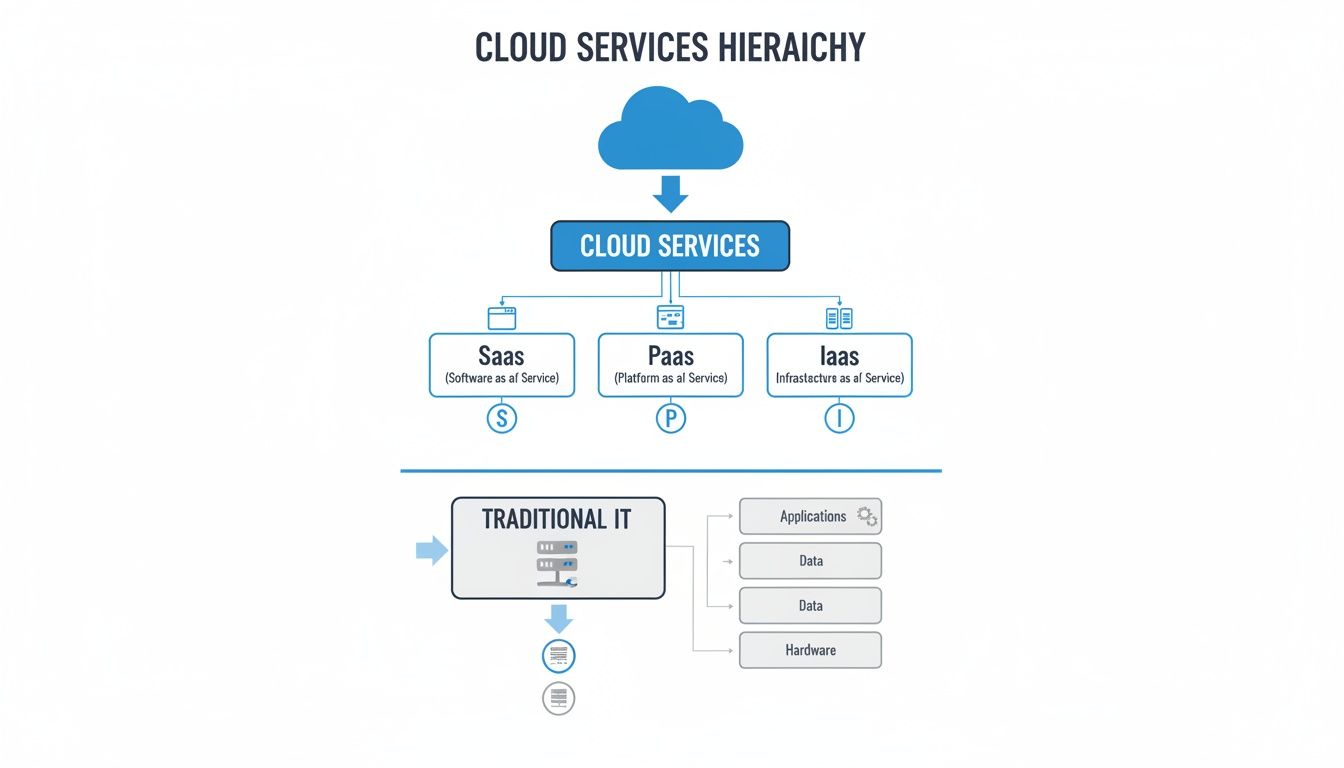
This shift is crucial. It’s about moving from owning and maintaining physical hardware to simply consuming services.
Public Cloud: This is the most common approach, where services are run on massive, shared infrastructure and delivered over the internet. It’s incredibly cost-effective and offers almost limitless scalability. With major providers expanding their footprint locally, it pays to understand the local landscape. For a deeper dive, check out our guide on the AWS cloud regions in New Zealand and Australia.
Private Cloud: In this model, the entire cloud infrastructure is dedicated exclusively to your business. This gives you unparalleled control and security, making it the preferred choice for organisations in highly regulated fields like finance or healthcare that handle sensitive data. In fact, driven by a strong focus on data privacy, New Zealand’s private cloud market is projected to grow at a CAGR of 11.9% from 2025 to 2035.
Hybrid Cloud: This is a "best-of-both-worlds" strategy that combines public and private clouds, letting you move data and applications between them as needed. A Kiwi business might keep its sensitive client records in a secure private cloud while using the public cloud to run its customer-facing website, striking the perfect balance between security and scalability.
The Key Business Benefits of Moving to the Cloud

Jumping into cloud IT services isn't just a technical upgrade; it's a fundamental shift in how you run your business. For Kiwi businesses especially, it unlocks real, tangible advantages that tackle the common hurdles of growth, efficiency, and staying power. These aren't just buzzwords—they translate into genuine improvements you can see and feel in your daily operations.
One of the first and most significant changes you’ll notice is in your finances. The old way of doing IT meant sinking a huge amount of cash upfront into physical hardware. This is known as Capital Expenditure (CapEx), and it means tying up money in servers and gear that start losing value the second you unbox them.
Cloud services completely flip that model. Instead, your IT spend becomes a predictable, monthly Operational Expenditure (OpEx). This move instantly frees up capital that can be poured back into what really matters—marketing, developing new products, or bringing on that next key team member.
From Fixed Costs to Flexible Spending
This switch to an OpEx model does more than just tidy up your accounting; it gives your business incredible financial agility. You can stop trying to predict your IT needs five years down the track and buying expensive hardware to match. With the cloud, you simply pay for what you use, when you use it.
This elasticity is a game-changer, particularly for businesses with seasonal peaks and troughs. Think about a local retailer gearing up for the Christmas rush. In the old world, they'd have to own enough server power to handle that peak traffic, which would then sit mostly idle—and still cost them money—for the other ten months of the year.
With the cloud, they can scale up their resources instantly to manage the flood of online orders, then scale right back down in January. This smart approach ensures they’re never paying for idle capacity. Getting the most out of this requires smart cloud cost optimization strategies to make sure every dollar is working for you.
Empowering Collaboration and Business Continuity
Beyond the bottom line, cloud services are the engine room for the modern, collaborative workplace. By centralising your data and apps in the cloud, your team can get secure access to everything they need from anywhere—whether they’re in the Auckland office, working from home in Christchurch, or on the road. This kind of seamless access is non-negotiable for keeping productivity high in today’s flexible work environment.
Even more critically, the cloud delivers a level of business continuity that’s incredibly difficult and costly for most small to medium businesses to build themselves.
- Robust Disaster Recovery: Top-tier cloud providers design their infrastructure with built-in redundancy and automatic backups. If something disastrous like a fire or flood hits your office, your data is safe and sound, allowing your business to keep running with minimal downtime.
- Enhanced Data Security: Cloud platforms invest billions in security measures that are simply out of reach for a typical SMB. We’re talking about advanced threat detection, powerful encryption, and entire teams of cybersecurity experts working 24/7 to keep your information protected.
For many growing businesses, adopting cloud services is like gaining an enterprise-grade technology department overnight. It levels the competitive playing field, giving you access to the same powerful, secure, and scalable tools used by global corporations.
This democratisation of technology means you can compete based on the strength of your ideas and the quality of your service, not the size of your IT budget. The end result is a more agile, resilient, and productive organisation, perfectly positioned to grab hold of new opportunities.
Navigating Cloud Security and Compliance in NZ

For many Kiwi business leaders, the idea of shifting sensitive data off-site brings up one big question: what about security? It’s a completely fair concern. But the reality is that a professionally managed cloud environment is almost always more secure than a typical in-house setup. The secret is understanding how security works in this new model.
This is where the shared responsibility model comes in. Think of it like renting a high-security storage unit. The facility owner takes care of the building’s physical security—the reinforced doors, the alarms, and the guards on patrol. But you’re still responsible for what you put inside your unit and who you give a key to.
In the cloud world, the provider (like Microsoft Azure or AWS) handles the security of the cloud. This covers the physical data centres and the core infrastructure they run on. Your responsibility is security in the cloud, which means managing user access, configuring your applications correctly, and protecting your data.
Your Role in the Security Partnership
It’s easy to think the provider handles everything, but you have to actively manage your side of the security partnership. A good partner doesn’t just hand over the keys and walk away; they help you build a solid defence to protect your most valuable asset—your data.
Here are the key security measures you need to own:
- Robust Access Controls: This is about putting strong identity and access management (IAM) in place to ensure only authorised people can get to specific data and applications. It's the digital equivalent of a "staff only" door.
- Data Encryption: All of your data needs to be encrypted, both when it’s sitting in storage (at rest) and when it’s moving across networks (in transit). This essentially scrambles the information, making it completely unreadable to anyone without the right decryption key.
- Advanced Threat Detection: Modern cloud platforms have powerful tools that constantly monitor for suspicious activity. This helps spot and shut down potential threats before they can do any real damage.
Getting these fundamentals right is non-negotiable. For a deeper dive into protecting your business, take a look at our ultimate guide to cybersecurity for companies in NZ.
The Importance of Data Sovereignty
For any NZ business, knowing exactly where your data lives isn't just a nice-to-have; it's a critical compliance requirement. Data sovereignty is the principle that your digital data is subject to the laws and regulations of the country where it is physically stored.
This is hugely important for complying with New Zealand's Privacy Act and building trust with your customers. Keeping data onshore here in NZ, or in a trusted jurisdiction like Australia, means it’s protected by legal frameworks we all understand.
Choosing a cloud partner that gets and respects data sovereignty is non-negotiable. It ensures your business stays compliant and your customers’ data is handled with the care it deserves, steering you clear of potential legal and reputational nightmares.
This intense focus on security and compliance is happening as the sector itself is growing rapidly. New Zealand's wider IT services sector, which includes in-demand cloud IT services, is seeing a major rebound. Revenue is projected to climb from NZ$7.12 billion in 2025 to NZ$8.52 billion by 2029, a steady growth rate of 4.57%. As these NZ IT market trends show, Kiwi businesses are increasingly relying on secure, well-managed cloud solutions. With the right strategy and partner, you can turn security from a source of anxiety into a genuine business advantage.
How to Choose the Right Cloud Services Partner
Picking a provider for your cloud IT services isn't just a technical purchase—it's a strategic business decision. You're choosing a partner who will be at the very centre of your company’s growth. The right one becomes a genuine extension of your team; the wrong one can be a source of constant headaches and missed opportunities.
Think of it as the difference between a simple vendor and a true partner. A vendor sells you a product, sets up your cloud infrastructure, and then largely disappears, leaving you to manage the day-to-day. A partner, on the other hand, rolls up their sleeves to understand your business goals, your unique challenges, and where you want to be in five years. They don’t just hand over technology; they align it with your people and processes to get real, tangible results.
The market for these services is booming. Here in New Zealand, the Data Processing and Web Hosting Services industry is on track to hit a revenue of $939.2 million in 2025. With 342 companies in this space, it’s clear that Kiwi businesses are leaning heavily on the efficiencies the cloud offers. You can dig into the growth of this local industry and see the impact for yourself. This explosion of choice is great, but it also means you need to be extra careful when evaluating potential partners.
Look for Proven Local Expertise
When you're sizing up providers, make sure local expertise is high on your checklist. A partner based right here in New Zealand gets the local market dynamics, understands compliance obligations like the Privacy Act, and knows why data sovereignty matters to Kiwi businesses.
Plus, they’re in your time zone. When something goes wrong and you need support, you aren’t left waiting for an office on the other side of the world to open. This local knowledge is about more than just tech support; it’s about strategic guidance that actually fits your business environment. They understand the reality of scaling a business in NZ and can recommend solutions that are a practical fit, not just a one-size-fits-all global trend.
Demand Clear and Transparent Agreements
Any partner worth their salt will be completely upfront about what they deliver. This is where the Service Level Agreement (SLA) comes in, and it’s non-negotiable. An SLA is your formal contract, and it should spell out the level of service you can expect in plain English, not confusing technical jargon.
A solid SLA should clearly define a few key things:
- Guaranteed Uptime: What percentage of the time will your services be online and available? You should be looking for a commitment of 99.9% or higher.
- Response Times: How quickly will they acknowledge your support requests? This should be broken down by the severity of the issue.
- Resolution Times: It’s one thing to respond, but how fast do they promise to actually fix the problem?
- Penalties for Non-Compliance: What happens if they don't meet their promises? This shows they have skin in the game and stand behind their service.
Don’t settle for vague promises of "great support." A detailed SLA is your assurance that the provider is accountable for the performance and reliability your business relies on. It protects you and sets crystal-clear expectations from day one.
Assess the Quality of Their Support
Finally, dig into what their support really looks like in practice. Technology will have hiccups—that’s a given. When it does, the quality of the support you get makes all the difference. The best partners offer far more than a faceless ticketing system; they provide accessible, responsive help from people who actually know your setup.
Before you sign anything, ask some direct questions. Do you get a dedicated account manager? Can you get an engineer on the phone when you have a tricky problem? A provider who offers a unified solution—one that integrates their tech with your team—is a partner who sees your success as their own. They're there to help you not just fix issues but also to proactively find new ways to improve your workflow and hit your long-term goals.
Your Guide to a Successful Cloud Migration
Moving your business to the cloud can feel like a massive, high-stakes project. But when you have a structured approach, it stops being a purely technical chore and becomes a powerful strategic move for your business.
A successful transition is about far more than just moving data from one place to another. It's really about setting your organisation up for future growth, smarter innovation, and a whole new level of efficiency.
Breaking the journey down into clear, manageable phases is the secret to a smooth transition that actually delivers on the promise of cloud IT services. This isn't just a "lift and shift" job; it's a carefully planned process that needs expert project management from day one. Get the planning right, and you'll minimise disruption and start seeing the benefits of the cloud much faster.
The Three Phases of Your Cloud Journey
Any good cloud migration follows a logical, three-part structure. Each phase builds on the one before it, making sure every single decision aligns with what your business is trying to achieve. Trying to rush through any of these steps is usually a recipe for budget blowouts and poor performance later on.
Here’s how the journey typically plays out:
- Assessment and Planning: Honestly, this is the most critical stage of all. It involves taking a deep dive into your current IT setup to figure out exactly what you're moving and, more importantly, why. You’ll need to identify the crucial links between your applications and decide which migration strategy makes sense for each part of your system.
- Migration Execution: With a rock-solid plan in hand, it’s time for the technical side of things. This is where your team or a partner like us actually moves your applications and data to the new cloud environment. It takes careful coordination to keep downtime to an absolute minimum and ensure everything works perfectly once the move is complete.
- Post-Migration Optimisation: Your journey doesn’t end the moment you're in the cloud. This final phase is all about fine-tuning your new setup. You’ll be analysing performance, keeping a close eye on costs, and tightening up security to make sure you’re getting the best possible return on your investment.
The Power of a Clear Strategy
Without a clear strategy, a cloud migration can go off the rails fast. Your plan needs to be more than just a technical to-do list; it has to be directly linked to real business outcomes. Are you moving to the cloud to cut costs, create a better disaster recovery plan, or make it easier for your team to collaborate from anywhere?
Having a clear "why" guides every decision, from choosing the right cloud provider to figuring out which applications to move first. It turns the project from an IT task into a business-wide mission, getting everyone on board and paving the way for a genuinely successful result.
The goal is a seamless transition that positions your business to take full advantage of the power and flexibility the cloud offers. By treating the migration as a strategic move, you build a strong foundation for future innovation, scalability, and long-term business resilience. It’s this thoughtful approach that ensures your investment delivers real value right from the start.
Frequently Asked Questions About Cloud IT Services
Making the move to the cloud is a big step, and it's completely normal to have questions. It’s a different way of thinking about your technology, but once you grasp the core ideas, the path forward becomes much clearer.
Here are a few of the most common queries we hear from NZ business leaders just like you.
How Secure Are Cloud IT Services?
This is usually the first question on everyone's mind, and for good reason. The truth is, major cloud platforms like AWS and Microsoft Azure offer a level of security that most small or medium-sized businesses could never realistically build themselves. They pour billions of dollars into physical and digital defences.
But security is a two-way street. Under what's known as the shared responsibility model, the provider is responsible for securing the cloud infrastructure itself. You, however, are responsible for securing whatever you decide to put in the cloud.
This is exactly where an expert partner makes all the difference. We add that critical layer of protection by implementing the right configurations, actively monitoring for threats, and making sure your data is locked down tight.
What Is the Difference Between Cloud and Managed IT Services?
It helps to think about this with an analogy.
Imagine cloud services are like the raw power, water, and gas lines supplied to a new building. They’re the essential utilities—powerful servers, unlimited storage, and sophisticated software platforms—provided by global giants and available whenever you need them.
Managed IT services, then, are the expert architects, builders, and engineers. They're the team that designs the building, connects the utilities, and maintains the entire structure so it perfectly serves your needs. They take the raw potential of the cloud and shape it to fit your specific business goals, ensuring everything is secure, cost-effective, and running smoothly.
Cloud services provide the potential. Managed IT services unlock that potential, turning powerful technology into a real-world business advantage that drives efficiency and growth.
How Much Do Cloud IT Services Cost?
This is where the cloud really changes the game. Traditional IT demands massive, upfront capital investment in servers and hardware that start ageing the moment you buy them. Cloud IT services flip that model on its head.
Most services run on a pay-as-you-go basis, where you only pay for the exact resources you use. Others, like software, often have predictable, fixed subscription fees. This immediately shifts your technology spend from a huge, unpredictable capital expense (CapEx) to a manageable, predictable operating expense (OpEx).
But the real financial win isn't just about what you see on the monthly invoice. It's about the total cost of ownership (TCO).
When you start adding up the money saved on hardware maintenance, lower power bills, and the huge productivity gains from better uptime and easier team collaboration, the true value becomes crystal clear. The real savings come from building a more agile, resilient, and efficient business from the ground up.
Ready to harness the power of the cloud with a partner who understands your business? Wisely provides expert cloud IT services designed to enhance security, boost productivity, and drive growth for NZ businesses. Learn how we can create a unified solution for you at https://www.wiselyglobal.tech.