Data centres are the unsung heroes of New Zealand's digital economy, providing the secure and resilient backbone that keeps our businesses running. The local market is in the middle of a massive growth spurt, fuelled by the widespread move to the cloud, tightening data sovereignty requirements, and the need for high-speed performance for modern applications. For any Kiwi business, figuring out where to house your digital assets is a huge strategic call.
Your Guide to the New Zealand Data Centre Market
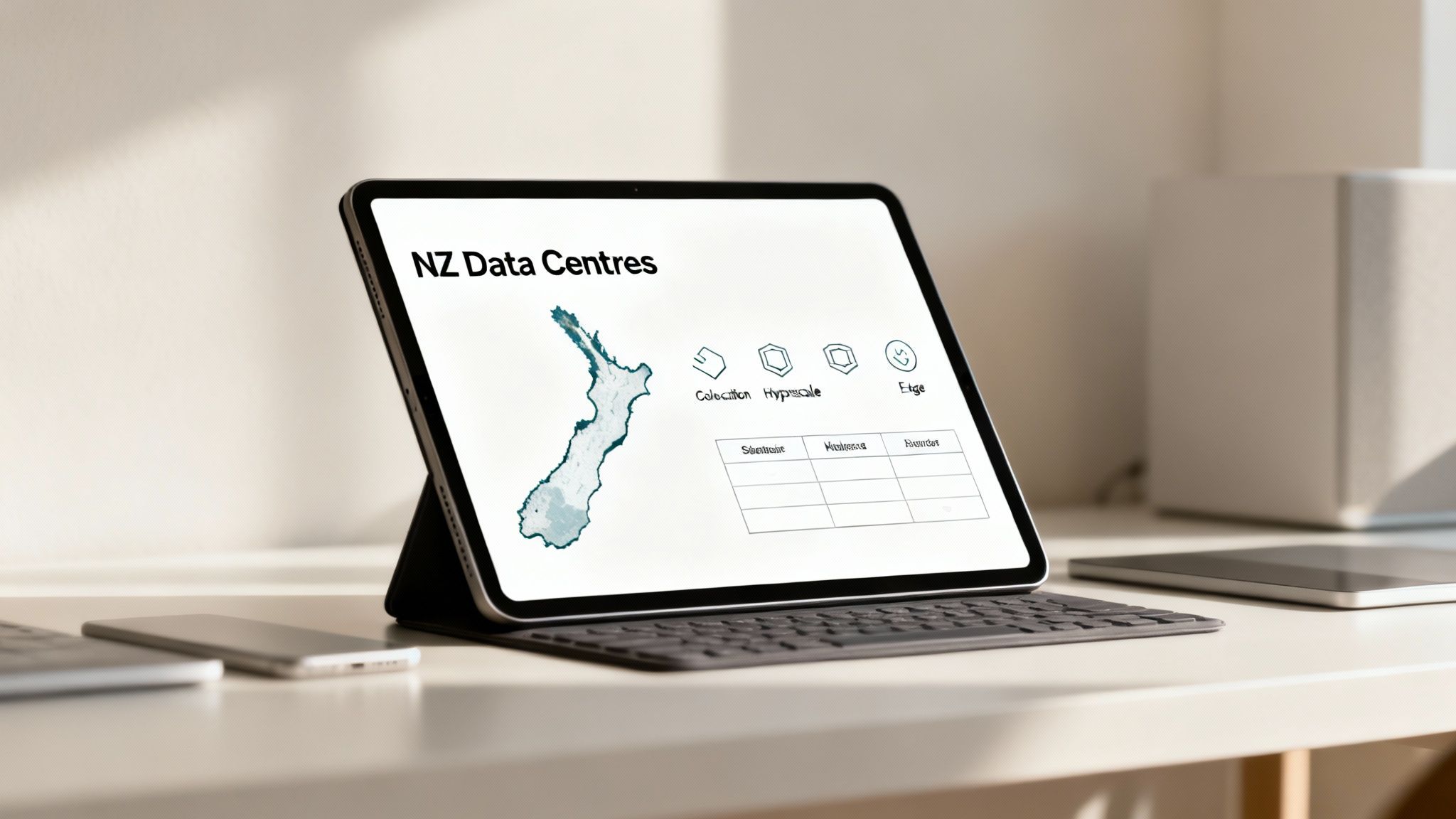
The data centre scene in New Zealand is growing faster than ever before. This isn't just a small uptick; it's a boom driven by a colossal surge in our digital lives. The market, currently valued at $1.2 billion in 2024, is on track to hit a staggering $3.5 billion by 2032.
This explosive growth makes perfect sense when you see that our national internet data usage jumped by 42% in 2023 alone. We’re all using more digital services, and that data has to live somewhere. You can dive deeper into the numbers by reading the full research on the New Zealand data centre market.
Think of this guide as your go-to reference for getting your head around the NZ data centre ecosystem. We’ll break down the different types of facilities, where they are, and what really matters when you're making a decision.
Why Local Data Centres Matter
Choosing a provider right here in New Zealand isn't just about patriotism; it brings some serious, tangible benefits that go way beyond simple server hosting. It’s about performance, compliance, and ultimately, a smarter way of operating.
- Lower Latency: In the digital world, distance equals delay. Hosting your data close to your Kiwi customers means less lag and a much snappier experience for your website or app. It’s that simple.
- Data Sovereignty: Keeping sensitive data on New Zealand soil is non-negotiable for many industries. It ensures you’re compliant with our Privacy Act and other local regulations, which is a massive tick in the box for trust and security.
- Enhanced Security: Local providers live and breathe the New Zealand security landscape. They understand the specific regional threats and compliance standards, offering physical and digital security that's built for our environment.
Understanding Your NZ Data Centre Options
Getting your head around the right data centre model is a make-or-break decision for your business. It's about making sure your tech stack actually supports your strategy. Here in New Zealand, the main choices—colocation, hyperscale, and edge—all cater to different needs, from getting hands-on with your own gear to tapping into massive, globally-scaled cloud infrastructure.Figuring out the difference is the first real step to building a digital foundation that’s both tough and efficient. This decision ripples through everything, affecting your IT budget, how quickly your team can move, and even your ability to stay on the right side of local laws. Each option offers a different trade-off between cost, control, and outright performance.
Colocation Facilities
Think of colocation as a secure, purpose-built home for your own servers and network hardware. You bring the gear, and the data centre provider takes care of the tricky bits: the physical security, power, cooling, and network connections. It’s the perfect middle ground if you're not ready to go all-in on the cloud but have outgrown the old server room.
A great real-world example is a Kiwi media production house needing to meet strict Trusted Partner Network (TPN) security standards. By using a colocation data centre in NZ, they can install their own specialised hardware in a highly secure, audited facility. They keep total control over their servers while getting the resilience of an enterprise-grade building.
Hyperscale Cloud Regions
Hyperscale is the term for the enormous data centres run by the global public cloud giants like Amazon Web Services (AWS), Microsoft Azure, and Google Cloud. These places are built for incredible scale, offering a huge menu of on-demand services, from simple virtual machines to sophisticated AI and machine learning tools.
Imagine a fast-growing New Zealand SaaS company. With a hyperscale provider, they can instantly scale their app to serve thousands of users around the world without ever having to buy a physical server. The arrival of local AWS cloud regions here has been a game-changer, giving Kiwi businesses access to these powerful services with much lower latency and clear data residency. We've actually put together a detailed guide to the local AWS cloud regions that digs into what this means for local businesses.
The AWS investment of NZD $7.5 billion into its New Zealand region is forecast to add NZD $10.8 billion to our GDP. That really drives home the sheer scale of this infrastructure and its economic impact right here on our shores.
Edge Computing Sites
Edge computing flips the traditional model on its head. It uses smaller, decentralised data centres placed much closer to where data is actually being created and used. Instead of shipping data all the way to a central cloud in Auckland, an edge site could process it right there in a regional town. This setup is all about speed and is built for applications that need ultra-low latency.
Take a smart agriculture business in rural Canterbury using IoT sensors for real-time crop monitoring. An edge data centre can process that sensor data on-site, instantly, allowing for automated irrigation changes without the lag of a round trip to a distant cloud. It’s all about getting maximum efficiency and immediate response.
Exploring Major Data Centre Hubs in New Zealand
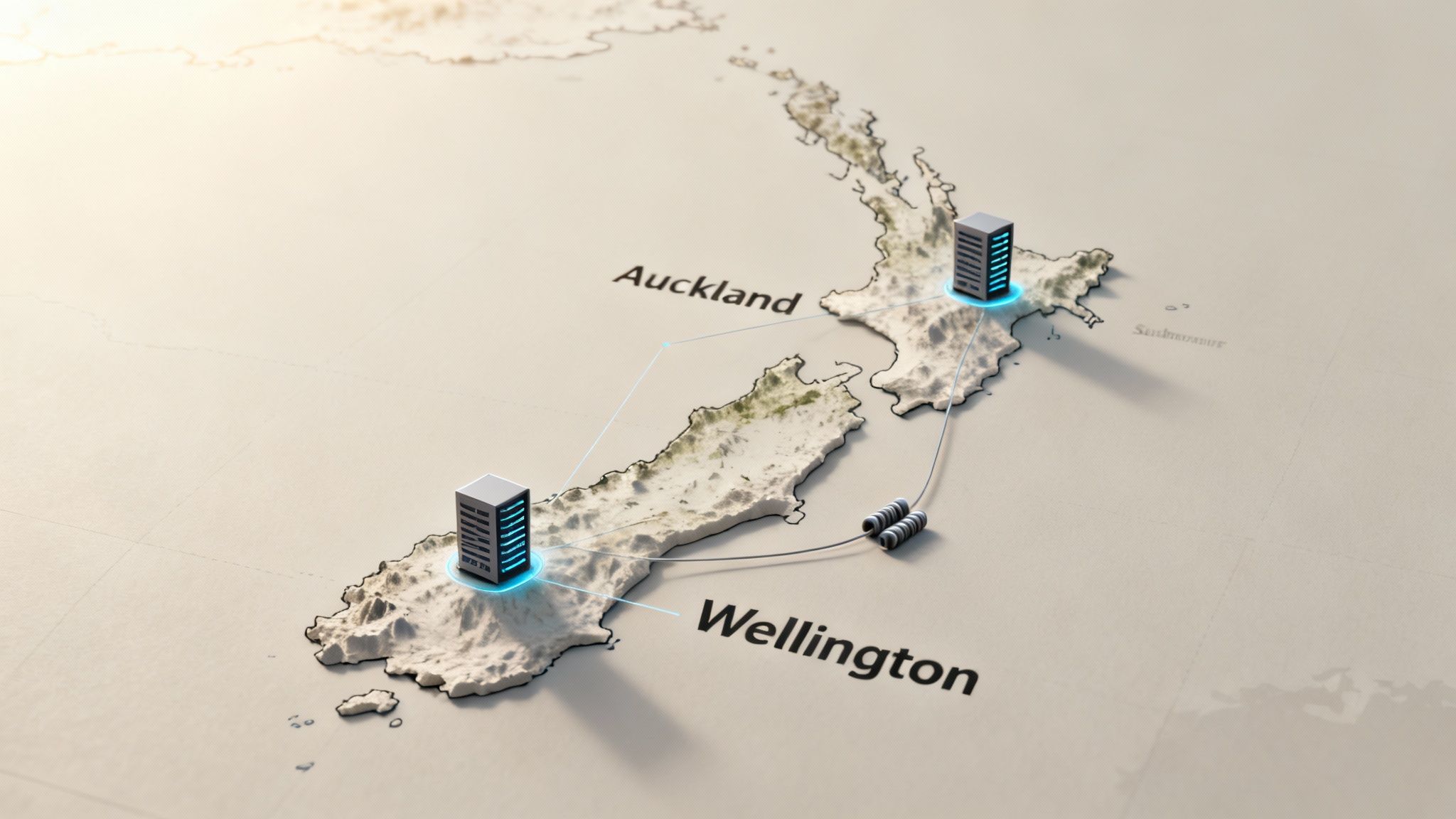
When you're picking a data centre, geography is every bit as critical as the technology inside. Here in New Zealand, our digital infrastructure is largely clustered around two main hubs. Each one offers its own set of strategic perks, driven by connectivity, population, and the local business scene.
Getting your head around these locations is fundamental to building a solid national infrastructure plan. The right spot has a direct impact on latency for your customers, your access to different network carriers, and your options for disaster recovery.
Auckland: The Primary Hub
Auckland is, without a doubt, the heart of New Zealand's data centre market. It serves as the main gateway for pretty much all international data traffic coming in and out of the country. Its importance really boils down to its direct access to the major submarine cable landing stations that connect Aotearoa with Australia, the US, and Asia.
This incredible connectivity has created a vibrant ecosystem of providers. All the major cloud players and colocation facilities have set up shop here, which has fostered a really competitive environment—great news for businesses looking for choice and top-notch performance.
This concentration is fuelling some serious growth, with investments expected to hit USD 1.44 billion by 2030. The city is already home to 33 facilities, and with occupancy rates topping 89% in 2024, the demand for a world-class data centre in NZ is only getting stronger. If you want to dig deeper into the numbers, you can check out the latest industry forecasts from Arizton.
Wellington: The Government and Connectivity Hub
Wellington stands as New Zealand’s secondary data centre hub, but it has its own distinct flavour. Its role as the seat of government and a crucial connectivity point makes it unique. Many government agencies and businesses with strict data sovereignty needs deliberately choose Wellington facilities for their proximity and security.
The capital also boasts excellent network diversity, with solid connections to fibre backbones running across both the North and South Islands.
A smart strategy many businesses use is to host their primary infrastructure in Auckland and keep secondary or backup systems in Wellington. This creates a geographically redundant setup that protects against regional outages or disasters, making sure critical services stay online.
Emerging Secondary Regions
Beyond the big two, other regions are starting to pop up on the radar. Cities like Invercargill and Hamilton are becoming attractive spots, particularly for disaster recovery and more specialised workloads. They offer valuable geographic separation from the main seismic and volcanic risks you find in the North Island.
Navigating Data Sovereignty and NZ Compliance

For a lot of Kiwi businesses, deciding where your data lives isn't just a tech question—it's a massive legal and ethical one. This is where the concept of data sovereignty becomes absolutely critical. At its core, it’s the idea that your digital information is subject to the laws and rules of the country where it’s physically stored.
Choosing a local data centre in NZ is the most straightforward way to keep your sensitive information on home soil. Doing so simplifies your compliance headaches and shields your data from the reach of foreign laws. The moment your data crosses borders, it can suddenly fall under another country's jurisdiction, opening up a can of worms with legal risks and potential clashes with our own regulations.
Key Compliance Frameworks in New Zealand
Sticking to local laws isn't optional, and the main piece of legislation you need to know is the Privacy Act 2020. This act lays down the ground rules for how personal information is collected, used, and shared, including specific conditions for sending data offshore.
On top of that, many industries have their own stringent standards for data management:
- Healthcare: Patient records are incredibly sensitive. Hosting this information onshore is non-negotiable for protecting patient confidentiality and meeting the specific codes for health information privacy.
- Legal and Financial Services: Law firms and financial institutions have a duty of care to their clients. Regulations and professional obligations often demand that all client data is kept securely within New Zealand to prevent any unauthorised access.
- Media and Entertainment: Film studios working with valuable, unreleased content often need to meet Trusted Partner Network (TPN) standards. Achieving and auditing this level of security is far easier inside a local, physically secure data centre.
Think about a law firm that must, by its own professional conduct rules, keep all client files hosted in New Zealand. If that data ended up on an overseas server, it could constitute a breach of client confidentiality, leading to serious legal fallout and reputational ruin. Using a local data centre isn't just a "nice-to-have"; it's fundamental to their entire operation.
At the end of the day, building your digital infrastructure here in New Zealand gives you a clear and direct path to meeting your obligations. It cuts through the ambiguity, dials down the risk, and sends a clear signal that you’re serious about protecting your customers' data according to our laws.
Engineering Resilience Against Downtime and Disasters
When you're running a business in New Zealand that relies on a data centre, resilience isn't just a nice-to-have feature; it's the bedrock of your ability to keep operating. Our unique geography—from shakes to storms—means that top-tier providers make engineering for disaster their absolute mission. This isn't a single fix but a layered approach designed to keep your digital assets safe and online, no matter what.
It all starts with the physical building. A modern data centre's first line of defence is its construction. We're talking serious seismic bracing and structural reinforcements designed to handle major earthquakes—a non-negotiable for our part of the world. This ensures the building, and the server racks inside it, stay put during a seismic event, protecting the hardware that runs your business.
Redundancy for Uninterrupted Operations
Beyond a solid foundation, true resilience is engineered into every system through redundancy. You'll often hear the term "N+1", which simply means there's at least one independent backup for every critical component.
- Power Systems: An N+1 power design includes multiple grid connections, banks of uninterruptible power supplies (UPS), and massive on-site diesel generators. If one power source goes down, another kicks in instantly. You won't even notice the switch.
- Cooling Infrastructure: The same principle applies to cooling. Backup chillers and air conditioning units are on standby, ready to prevent overheating—one of the biggest culprits of hardware failure and downtime.
This built-in redundancy isn't just a technical detail; it translates directly into high uptime guarantees and protects your revenue. A solid plan for keeping the lights on is essential, and you can dive deeper into these strategies in our guide to business continuity planning for resilient Kiwi SMEs.
A common and very smart strategy we see is pairing a primary data centre in Auckland with a secondary site in a completely different seismic zone, like the South Island. This geographic separation means a regional disaster hitting one location won't touch your backup, keeping your critical applications running.
To add another layer of protection, it's wise to implement robust virtual machine backup solutions within your data centre setup. These tools are crucial for creating copies of your servers, allowing you to recover quickly and minimise data loss if something does go wrong. It’s all about being proactive so your business can bounce back fast from any disruption.
How to Choose the Right NZ Data Centre Provider
Picking the right data centre partner is one of those crucial business decisions that goes far beyond just ticking off technical specs. It's about finding a provider that truly lines up with your day-to-day operational needs, your compliance obligations, and where you see your business heading in the future.
To make this complex process a bit more manageable, a structured checklist is your best friend. It helps you compare apples with apples when you're talking to potential partners.
Security and Connectivity
Your first port of call should always be physical and digital security. You need to ask the hard questions. Do they hold recognised certifications like ISO 27001? Dig into the details of their multi-layered security protocols – everything from on-site security guards and biometric access controls to their network firewalls and intrusion detection systems. This is the bedrock for protecting your most valuable asset: your data.
Next up, get a clear picture of their connectivity and network performance. A top-tier data centre in New Zealand will be carrier-neutral, which is a huge plus. It means you have the freedom to choose from multiple network providers, fostering competitive pricing and building in connection resilience. Also, make sure to confirm they have diverse fibre entry points into the building. You don't want a single point of failure—like a digger accidentally cutting a cable—to take your entire operation offline.
Evaluating Scalability and Support
Think about your growth trajectory. How easily can you scale up your power, space, and cooling as your business expands? A provider's flexibility here is absolutely key if you want to avoid a painful and costly migration down the line. Their ability to grow with you should be a core part of your initial conversation.
Finally, take a close look at the support on offer. What are their Service Level Agreements (SLAs) for uptime and response times? Having access to skilled 24/7 remote hands support can be a lifesaver when you need to troubleshoot an issue out of hours.
For businesses that would rather hand off the day-to-day IT grind, it’s worth asking if the provider or their partners can offer extra help. You can get a better sense of this approach in our guide to managed IT services for New Zealand businesses.
The flowchart below gives a simple but effective decision path for checking a provider’s disaster resilience.
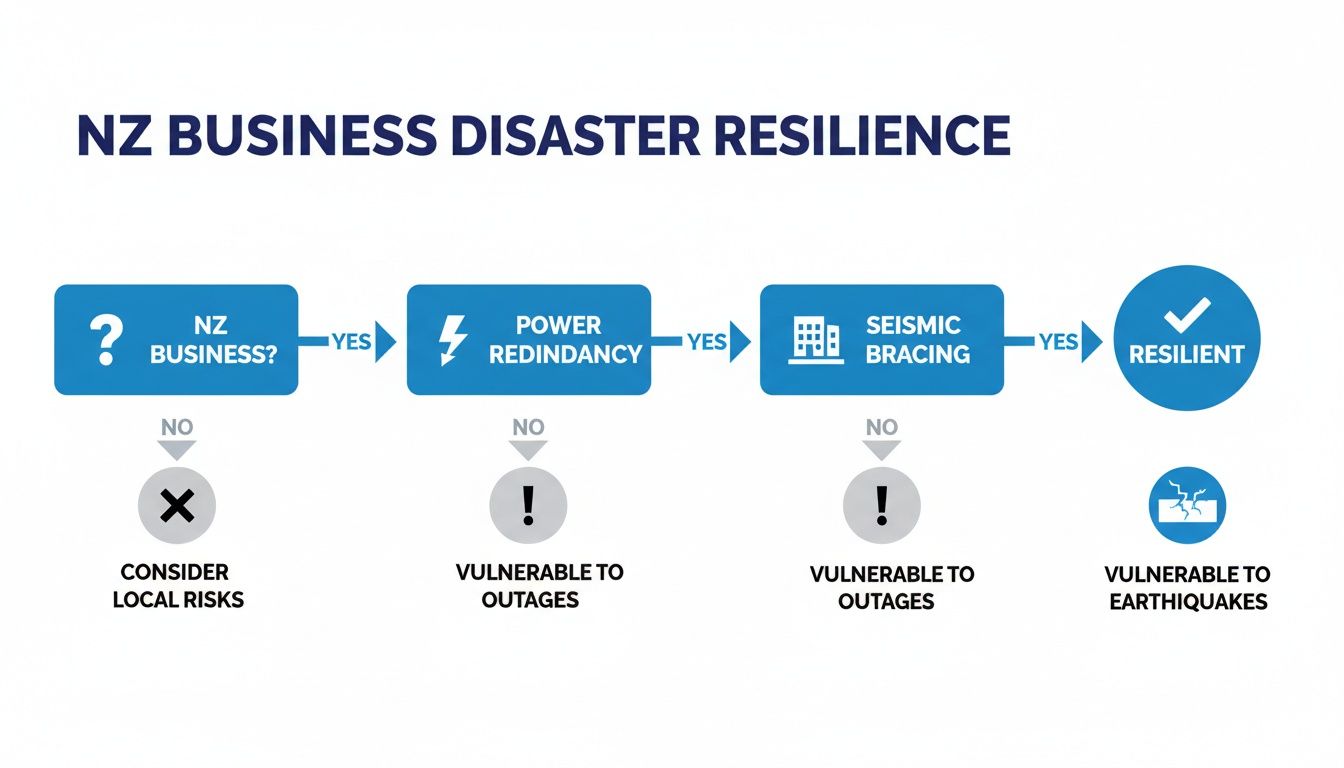
As the visual shows, fundamental features like solid power redundancy and seismic engineering aren't just nice-to-haves; they are non-negotiable for any serious business operating in New Zealand.
Provider Evaluation Checklist
To help you with your due diligence, we've put together a checklist of key questions. Use this table to structure your conversations and compare potential data centre partners effectively.
| Category | Key Question to Ask | Why It Matters |
|---|---|---|
| Security & Compliance | What security certifications do you hold (e.g., ISO 27001)? Can you detail your physical and digital security layers? | Certifications provide third-party validation of security practices, while layered security protects against diverse threats. |
| Connectivity | Are you a carrier-neutral facility? How many network providers are on-net, and do you have diverse fibre entry points? | Carrier neutrality gives you choice and competitive pricing. Diverse entry points prevent a single physical incident from causing an outage. |
| Resilience & Uptime | What is your power and cooling redundancy (e.g., N+1, 2N)? What are your uptime SLAs, and what are the remedies for a breach? | High redundancy minimises the risk of downtime. A strong SLA provides financial and operational assurance. |
| Scalability & Flexibility | How easily can we scale our space, power, and connectivity? What are the contractual terms for expansion? | Your data centre needs to support your business growth without requiring a costly and disruptive migration. |
| Support & Services | Do you offer 24/7 remote hands support? What is the average response time? Do you provide managed services? | On-site expertise is crucial for immediate issue resolution, especially when your team can't be there. |
| Location & Risk | Is the facility located outside of known hazard zones (flood, seismic fault lines)? What seismic rating does the building have? | In New Zealand, a facility's ability to withstand natural disasters is paramount for business continuity. |
| Cost & Commercials | What is included in the base price? What are the costs for extra services like power, cross-connects, and remote hands? | Transparent pricing helps you avoid unexpected costs and accurately budget for your IT infrastructure. |
This checklist isn't exhaustive, but it covers the critical areas you need to investigate. Getting clear, satisfactory answers to these questions will put you in a strong position to select a partner who can genuinely support your business for the long haul.
Answering Your Key Data Centre Questions
Getting your infrastructure strategy right often boils down to asking the right questions. We get a lot of common queries from New Zealand businesses, so this section tackles them head-on to help you find clarity and build a solid plan.
When To Move From Cloud To Colocation
Many businesses start in the cloud, but there comes a point when colocation just makes more sense. The tipping point is usually when cloud costs start spiralling out of control and become unpredictable.
If your monthly cloud bill is giving you a fright, or if you have specific hardware needs that the public cloud just can't handle efficiently (like running legacy apps on dedicated servers), it’s definitely time to look at colocation options within a data centre in NZ.
Tier III vs Tier IV Data Centres
You'll hear these terms thrown around a lot. A Tier III data centre is built to guarantee 99.982% uptime, meaning it allows for maintenance without taking services offline. It's incredibly reliable.
A Tier IV facility, on the other hand, steps it up to 99.995% uptime and is designed to be fully fault-tolerant. For the vast majority of NZ businesses, Tier III offers more than enough resilience. Tier IV is typically reserved for large enterprises where even a moment of downtime could be catastrophic.
Moving between cloud, on-premise, and colocation environments can get complicated. Proper planning is non-negotiable. To help you navigate the process, we highly recommend consulting a technical guide to Data Center Migration Best Practices to ensure everything goes smoothly.
Hosting your applications and data locally makes a huge difference in reducing latency—that’s the tiny delay it takes for data to travel. For Kiwi businesses, this means much faster load times and a snappier user experience, which is a win for both your team's productivity and your customers' happiness.